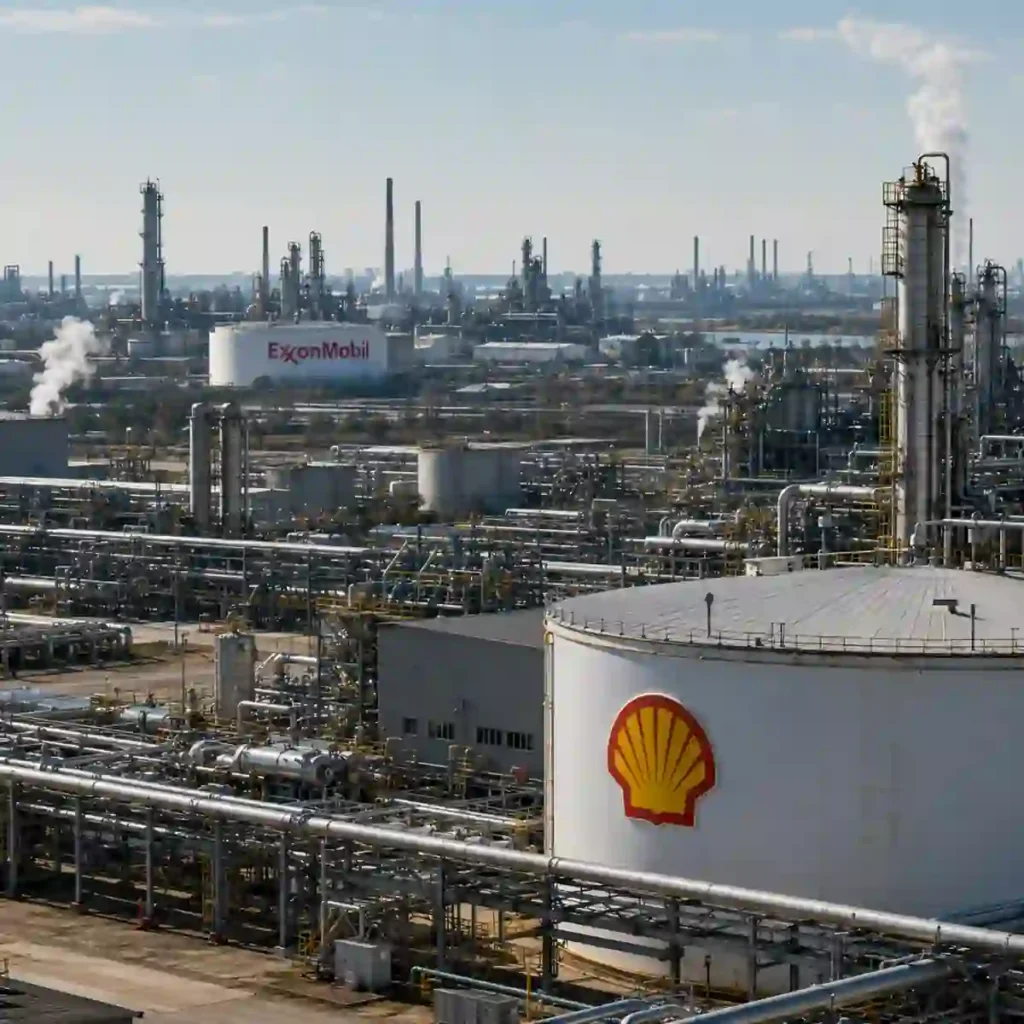

Shell shares edged lower in London on Monday, August 24, as investors assessed reports that ExxonMobil is competing to buy a US chemicals portfolio that could fetch as much as $8 billion.
Shell stock was trading at 3,397.50p shortly after 9:40am BST, down 0.35%. The shares opened at 3,401.50p after closing the previous session at 3,409.50p. The timing is notable, but the modest decline cannot be directly attributed to the reported sale process.
Exxon is reportedly competing with LyondellBasell, Apollo Global Management and the chemicals arm of state-owned Kuwait Petroleum Corporation. Potential buyers submitted non-binding indicative offers in July, according to the Financial Times.
Has Exxon agreed to buy Shell’s chemicals business?
No agreement has been announced. Exxon is one of several reported bidders, and Shell has not confirmed a preferred buyer or final valuation.
The preliminary proposals reportedly include offers for the entire US operation and bids for individual parts. Non-binding offers can be changed, withdrawn or rejected. Any transaction would still require due diligence, final negotiations and regulatory approval.
Which Shell chemical facilities could be sold?
The portfolio covers operations at four sites in Louisiana, Texas and Pennsylvania. They manufacture chemicals used in plastics, detergents, pharmaceuticals and other industrial and consumer products.
The most closely watched asset is Shell’s petrochemical complex in Monaca, Pennsylvania. It started operating in 2022, can produce approximately 1.6 million tonnes of polyethylene annually and reportedly required about $14 billion in capital investment.
Polyethylene is used in packaging, containers and numerous household products. Investors will therefore compare any final proceeds with the amount Shell invested in the complex.
The reported valuation of up to $8 billion applies to the wider US portfolio, not solely to the Pennsylvania facility. It remains an indicative figure rather than a confirmed sale price.
Why Shell is considering a sale
Shell has been simplifying its portfolio and directing capital toward businesses expected to deliver stronger long-term returns. Chemicals are cyclical, with earnings affected by energy costs, plant utilisation, economic demand and the amount of global production capacity.
A sale could reduce Shell’s exposure to lower-return assets and release capital for debt reduction, LNG projects, oil and gas production, acquisitions or shareholder distributions.
Shell’s recent transactions demonstrate the wider portfolio shift. It has agreed to sell its European onshore wind and solar business to TotalEnergies. That portfolio includes around 500 megawatts of operating and developing capacity, plus future projects in Italy, the Netherlands, Spain and the UK. Completion is expected by the end of 2026, subject to approvals.
Shell also agreed to sell its 35% interest in Cyprus Offshore Block 12 to Hungary’s MOL for $720 million as it concentrates more capital on LNG operations.
What the potential deal means for Shell investors
Selling the assets at an acceptable price could simplify Shell and improve future returns on capital. However, an $8 billion headline does not mean shareholders would automatically receive $8 billion.
The final bid could be lower, only selected facilities may be sold, and taxes or transaction costs could reduce net proceeds. Shell may also record an impairment if an agreed price falls below the assets’ accounting value.
There is no guarantee that a transaction would produce a special dividend or larger repurchase programme. Investors assessing the company’s payout capacity can review the existing context around the Shell dividend and multibillion-dollar share buybacks.
For Exxon, a purchase could expand its US petrochemical position while it continues investing in large energy projects. Its recent Gulf Coast expansion includes the start of production at the Golden Pass LNG facility in Texas.
Walmart Stock Falls After Q2 Earnings: What Investors Need to Know
Nebius Stock Surges as AI Cloud Revenue Jumps in Q2 Earnings
Chemicals delivered a stronger second quarter
The possible sale follows an improved quarter for Shell’s chemical operations. Its global indicative chemical margin increased from $139 per tonne in the first quarter to $270 in the second quarter.
Chemicals generated approximately $400 million in adjusted earnings, their strongest performance since the third quarter of 2021. The broader Chemicals and Products division reported $2.88 billion, although that figure includes refining and products operations not necessarily involved in the reported sale.
Across the group, Shell recorded second-quarter adjusted earnings of $9.84 billion, cash flow from operations of $21.43 billion and free cash flow of $17.5 billion. Net debt stood at $41.8 billion, while gearing was 19%.
Shell announced another $3 billion share-buyback programme. Its official quarterly results show that this was the 19th consecutive quarter in which the company announced buybacks of at least $3 billion.
What shareholders and workers should watch
The next important developments would be binding offers, the selection of a preferred buyer and confirmation of which facilities are included. Investors will also watch the final valuation, use of proceeds and any accounting charge.
Employees will want clarity about job protections, pensions, operating plans and whether workers would transfer to a buyer. For now, Shell continues to own and operate the facilities, and expressions of interest do not change employment conditions by themselves.
Shell’s third-quarter results are scheduled for October 29, 2026. A material agreement could be announced before then, but Shell could retain all or part of the business if the offers do not meet its expectations.

Make Swikblog your go-to source on Google for reliable updates, smart insights, and daily trends.