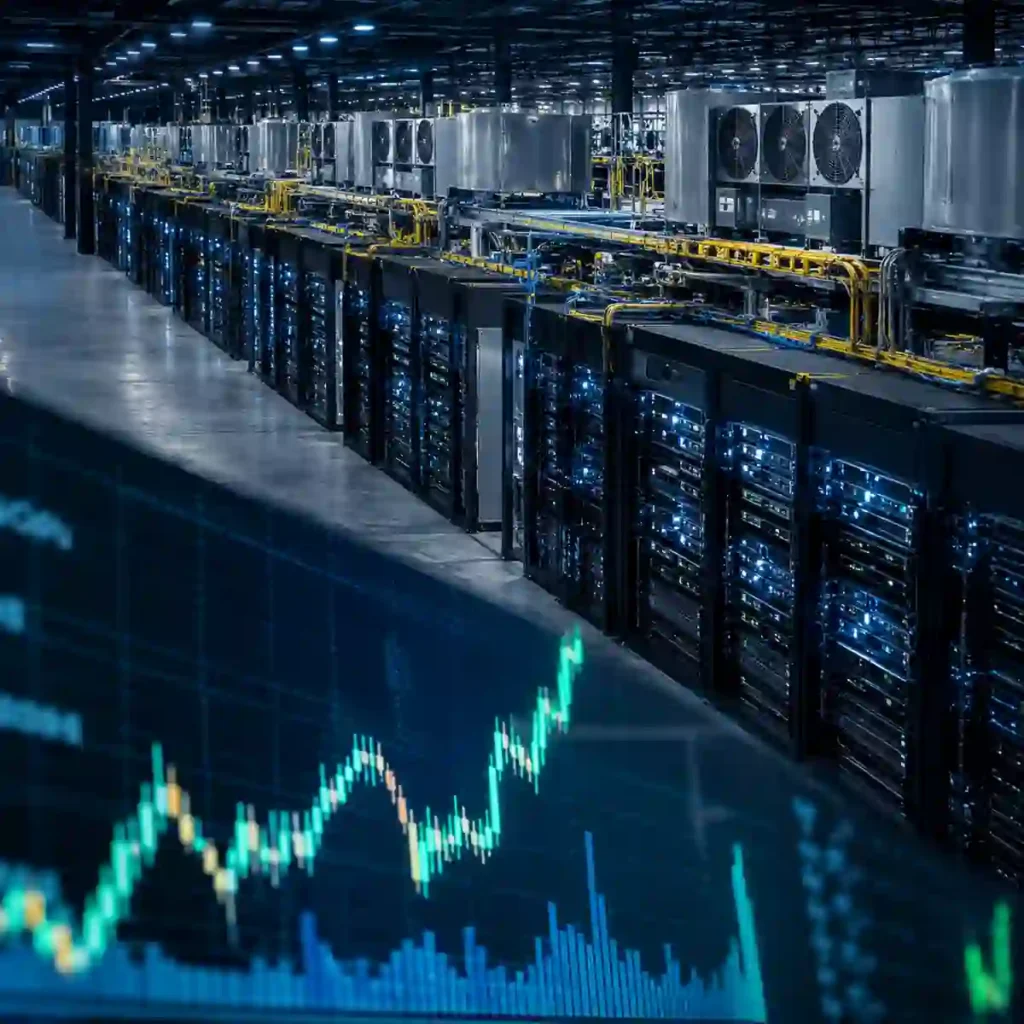

Nebius Group (NASDAQ: NBIS) gave Wall Street two very different numbers to think about on Wednesday: AI cloud revenue jumped 514%, while quarterly capital expenditure climbed to roughly $5.7 billion. Investors focused on the growth side of that equation, sending Nebius shares about 18% higher following its second-quarter results.
The rally was backed by more than an earnings beat. Nebius is signing billion-dollar AI contracts, raising its power-capacity target and collecting billions in customer prepayments as companies compete to secure scarce computing resources.
The quarter in numbers
Nebius generated $582.3 million in Q2 revenue, up 454% from $105.1 million a year earlier and 46% from the first quarter. That topped the roughly $572.75 million consensus estimate cited by LSEG.
Nearly the entire business is now being driven by AI infrastructure. Nebius AI Cloud produced $574.9 million of revenue, up 514% year over year and accounting for approximately 98% of group revenue. Annualized run-rate revenue reached $3 billion at the end of June, compared with $1.9 billion at the end of March.
Adjusted EBITDA improved dramatically, swinging from a $21 million loss a year earlier to a $236.2 million profit. Nebius’ official investor information provides its latest financial results and shareholder materials.
The bigger surprise sits beyond quarterly revenue
Four large AI cloud agreements signed during Q2 had an average total contract value above $1 billion. Total contract value for deals closed during the quarter increased roughly fourfold sequentially, while the value of new-customer contracts rose more than ninefold.
Nebius now has more than $40 billion in customer commitments and expects more than $9 billion of customer prepayments in 2026. For the four landmark Q2 agreements, those prepayments are expected to finance roughly 50% to 60% of associated capital expenditure.
That financing structure matters because Nebius must buy GPUs and build infrastructure before much of the contracted revenue can be recognized.
The company has also strengthened its relationship with its key technology supplier. Earlier this year, Nvidia invested $2 billion in Nebius as the companies expanded their AI infrastructure partnership.
Why megawatts matter almost as much as dollars
Nebius raised its end-2026 contracted-power target again, this time to 5 GW, from more than 4 GW previously. It expects to deploy more than 1 GW annually from 2027.
The company said large Q2 AI cloud deals were signed at annual contract values above $20 million per megawatt, with capacity related to those agreements expected to start coming online late in the fourth quarter.
Management also signaled confidence about future demand, saying the company could sell its planned 2027 capacity at current terms despite additional competitors entering the market.
This is why power has become central to the AI cloud story. GPUs cannot generate revenue without suitable data centers, electricity, cooling and networking. Securing those resources early can determine how quickly providers can turn customer demand into usable computing capacity.
The catch: growth is extraordinarily expensive
Nebius spent approximately $5.7 billion on capital expenditure during Q2, above the roughly $4.7 billion expected by analysts according to Visible Alpha data cited in reports.
The company also recorded a GAAP net loss from continuing operations of around $190 million, despite its positive adjusted EBITDA.
That creates a more complicated picture than the 18% stock rally alone suggests. Nebius has customers willing to make huge commitments, but delivering those contracts requires equally aggressive infrastructure spending.
Nebius and CoreWeave are sending the same demand signal
The timing of Nebius’ report made the results particularly important. Larger rival CoreWeave had just raised its annual forecasts as AI computing demand remained strong, sending CRWV shares sharply higher as well.
The trend has been developing for months. CoreWeave previously reported a $66.8 billion AI infrastructure backlog, illustrating how customers have been reserving future computing capacity long before every data center is operational.
Together, the two companies suggest that the AI infrastructure boom is increasingly about more than Nvidia GPU sales. Investors are now tracking contracted megawatts, power availability, customer prepayments, backlog and the speed at which new capacity becomes operational.
Read More
Michael Burry’s short adds pressure to the trade
Another factor surrounding NBIS is Michael Burry’s recently disclosed short position in the company. A sharp earnings-driven rally can put pressure on short sellers because they may need to repurchase shares to limit losses, potentially adding further buying pressure.
Short covering may have contributed to the move, but Nebius also gave investors fundamental reasons to reassess the company: a 514% jump in AI cloud revenue, four billion-dollar-plus contracts, $40 billion-plus in commitments and another increase in its capacity target.
What investors need to understand from here
The next phase will be less about announcing demand and more about delivering it. Nebius needs to bring contracted capacity online on schedule, convert customer commitments into revenue and demonstrate that its enormous infrastructure investments can generate durable returns.
Its $9 billion-plus expected customer prepayments provide useful financing support, while positive adjusted EBITDA shows improving operating leverage. But $5.7 billion of quarterly capital expenditure makes execution and capital efficiency impossible to ignore.
For NBIS investors, that is the real tension behind Wednesday’s rally. Nebius is demonstrating that customers are willing to pay heavily for AI computing capacity today. The longer-term question is whether it can build that capacity quickly and profitably enough to keep pace with the expectations now being placed on the business.
Disclosure: This article is for informational purposes only and does not constitute investment advice.

Make Swikblog your go-to source on Google for reliable updates, smart insights, and daily trends.