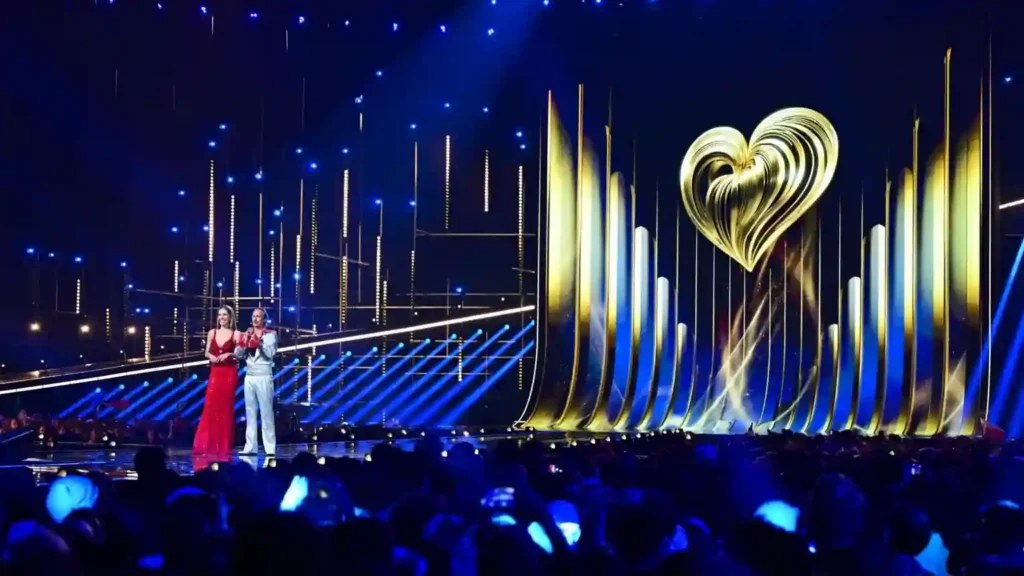

Dutch public broadcaster AVROTROS will not participate in the Eurovision Song Contest 2027, extending its boycott for a second year as disagreement over Israel’s participation and the war in Gaza continues to divide broadcasters.
AVROTROS announced the decision on August 24, saying Eurovision could no longer be considered sufficiently neutral while a participating country remains involved in a large-scale military conflict. It cited humanitarian suffering in Gaza, restrictions on press freedom and wider geopolitical tensions.
However, the Netherlands is not necessarily out of Eurovision 2027. AVROTROS has returned responsibility for Dutch participation to NPO, the umbrella organisation for Dutch public broadcasting, leaving open the possibility that another broadcaster could participate.
Why AVROTROS is boycotting Eurovision 2027
AVROTROS has asked the European Broadcasting Union (EBU), which organises Eurovision, for clearer criteria explaining when broadcasters representing countries involved in military conflicts should be allowed to compete.
In its official Eurovision 2027 statement, AVROTROS said the latest changes did not provide sufficient confidence that the contest’s independent and neutral character had been restored.
Director-General Taco Zimmerman said Eurovision was created to bring people and countries together but argued that international conflicts were increasingly affecting the competition and turning it into a “platform for division.”
Why Israel is central to the dispute
AVROTROS specifically referred to Gaza, press freedom and geopolitical tensions in the Middle East. Its decision follows the long-running controversy over Israel’s continued Eurovision participation through public broadcaster KAN.
Our earlier explanation of why Israel was allowed to compete in Eurovision 2026 examines the dispute and comparisons with Russia’s exclusion following its invasion of Ukraine.
Israel has participated since 1973 and finished second in both 2025 and 2026. Those results intensified questions about what would happen if Israel won while conflict continued in the region.
Five broadcasters stayed away in 2026
The Netherlands was among five countries whose broadcasters stayed away from Eurovision 2026 in Vienna, alongside Spain, Ireland, Slovenia and Iceland, after Israel was allowed to participate.
The controversy also reached the streets around the Eurovision 2026 final and protests over Israel’s participation. AVROTROS says opposition extended into the cultural community, pointing to former winners returning trophies and more than 1,000 musicians and cultural professionals supporting an open letter calling for EBU action.
What changed in Eurovision’s 2027 rules?
The EBU revised its rules after Eurovision 2026. A significant change concerns hosting rights when a winning country is affected by armed conflict or a sensitive geopolitical situation.
If security, safety or stability concerns make hosting unsuitable, the following contest can be staged elsewhere. However, the rule does not automatically prevent that broadcaster from competing or winning.
That distinction is central to AVROTROS’s objection. The new provision addresses where Eurovision can be hosted, while AVROTROS wants clearer criteria governing whether broadcasters representing countries involved in military conflicts should participate in the first place.
Olivia Dean Auckland Tickets Sell Out: Latest 2026 Concert Update
Russia and Ukraine provide a precedent
Russia was excluded from Eurovision following its full-scale invasion of Ukraine in 2022 and has not returned.
Ukraine’s Kalush Orchestra won Eurovision that year, but security conditions prevented Ukraine from hosting in 2023. Liverpool instead staged the competition in the United Kingdom on Ukraine’s behalf.
The precedent illustrates why eligibility to compete and the ability to safely host are separate Eurovision decisions.
Is the Netherlands officially out of Eurovision 2027?
Not yet. AVROTROS is definitely withdrawing, but NPO has not ruled out another Dutch broadcaster taking responsibility for an entry.
NPO said it regretted AVROTROS’s decision, recognised the divisive impact of geopolitical tensions and was still considering the next steps.
Eurovision director Martin Green said the EBU respected the decision and would continue discussions with NPO about opportunities for another broadcaster to participate.
The Netherlands therefore should not yet be described as definitively withdrawn from Eurovision 2027.
Why the decision matters
The Netherlands competed in the inaugural Eurovision in 1956 and has won five times. If no alternative Dutch broadcaster participates, 2027 would be the country’s second consecutive absence.
Attention will now turn to Spain, Ireland, Slovenia and Iceland. Their decisions will provide an important indication of whether the EBU’s changes are enough to bring 2026 boycotting broadcasters back.
When and where is Eurovision 2027?
The 71st Eurovision Song Contest is scheduled for Burgas, Bulgaria, after DARA won Eurovision 2026 in Vienna with “Bangaranga.” It will be Bulgaria’s first time hosting the competition.
The semi-finals are scheduled for May 11 and May 13, with the Grand Final on May 15, 2027. For Dutch fans, the key development to watch is now NPO’s decision on whether another broadcaster will replace AVROTROS.

Make Swikblog your go-to source on Google for reliable updates, smart insights, and daily trends.