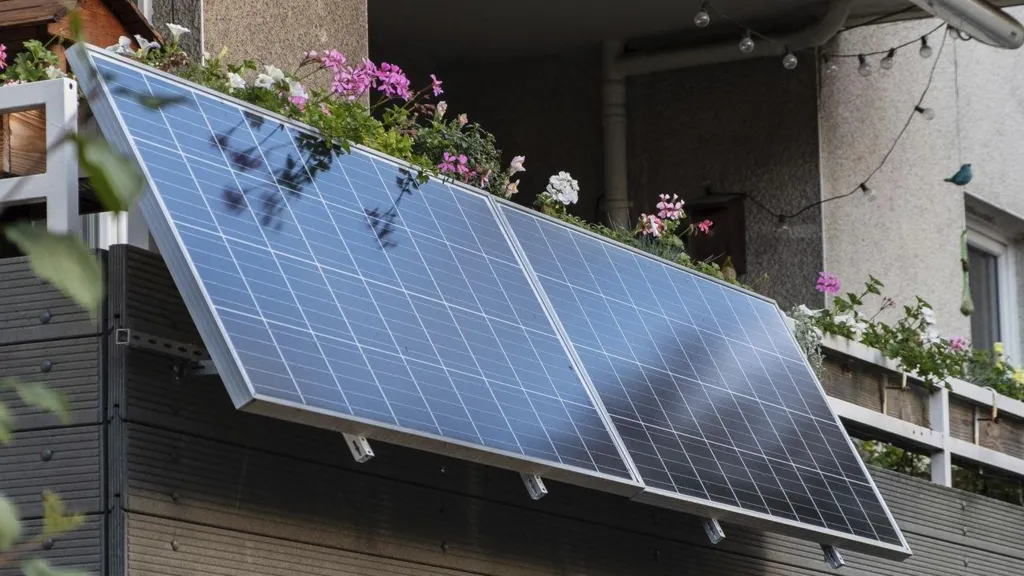

Plug-in solar panels are going on sale in Great Britain under new rules that give households a cheaper, simpler way to generate some of their own electricity without a conventional rooftop installation.
The systems connect to a suitable household mains socket through a microinverter and are limited to 800 watts of output. They could particularly appeal to renters, flat residents and households with balconies, terraces or gardens, although not every property will be suitable.
How much do UK plug-in solar panels cost?
UKSOL, which is producing plug-in solar equipment in Sheffield, has priced a one-panel kit at £699 and a two-panel kit at £1,089. The government expects prices to eventually settle around £400 to £600 as competition increases.
Government research estimates households could save around £70 to £110 a year. Actual savings will depend on sunlight, shading, panel orientation, electricity prices and how much power is used while the panels are generating.
Where can you buy plug-in solar panels?
Argos is among the retailers stocking the new products, with other retailers expected to follow as the market develops.
Consumers should avoid choosing an unverified product simply because it is cheaper online. Electrical Safety First recommends buying from established retailers or their own websites.
Households can check the UK government’s official plug-in solar guidance before purchasing.
How does plug-in solar work?
The panel converts sunlight into direct-current electricity. A microinverter converts it to alternating current that household appliances can use, with an AC cable connecting the system to an appropriate mains socket.
The microinverter restricts output to 800W, even if the panels can produce more. The government says that could provide around one-fifth of an average household’s electricity consumption while sufficient solar power is being generated.
It will not independently run high-powered appliances. If a kettle needs around 3kW while solar is supplying 800W, the grid supplies the remaining electricity.
What happens during a power cut?
The microinverter monitors the grid connection. If there is a power cut or the system is unplugged, it is designed to shut down rapidly so electricity is not fed into wiring that should be de-energised.
How can households save the most?
An unshaded, south-facing location generally offers the best generation potential. Households using electricity during daylight hours should also benefit more because the electricity is most valuable when consumed as it is generated.
Consumers comparing potential savings can also check the October 2026 Ofgem energy price cap and expected bill changes.
Do you get paid for unused electricity?
Excess electricity can flow back to the grid, but households should not assume they will be paid for it.
Unlike many rooftop installations, plug-in systems do not need Microgeneration Certification Scheme (MCS) certification and therefore will not normally qualify for the Smart Export Guarantee. Using as much generated electricity as possible within the home is therefore important.
Are plug-in solar panels safe?
Government tests found sample systems could operate without unacceptable heating or unsafe energy flows under the tested conditions. Products legally sold for use in Great Britain must meet relevant requirements, including the industry’s G98 standard and the government’s product specification.
Buyers should check that a product is listed as compliant on the Energy Networks Association’s public register.
Electrical Safety First recommends having household electrics checked by a registered electrician, particularly in older properties or when the condition of wiring and RCD protection is unknown.
Never connect plug-in solar through an extension lead, cable reel, multiway adaptor or plug-in adaptor. Current safety advice also recommends using only one plug-in solar device per household.
Can renters and flat owners use them?
Potentially. Panels can be mounted on suitable balconies and other outdoor spaces and, because they are not necessarily permanently attached, may be moved to another property.
Renters and leaseholders may still need permission from a landlord, freeholder or building owner. Planning or listed-building restrictions may also apply. Panels must be securely mounted and should never obstruct windows, communal walkways or fire escape routes.
Friday Afternoon Fraud: UK Homebuyers Warned About Costly Scam
Do you need to notify anyone?
Households must notify their local Distribution Network Operator (DNO) within 28 days of connecting the system. The DNO operates the local electricity network and is different from the household’s energy supplier.
Do plug-in solar panels have batteries?
The launch systems should not be confused with complete solar-and-battery installations. Without battery storage, electricity generated during the day cannot simply be stored by the system for use after sunset, making daytime consumption particularly important.
Are plug-in solar panels worth buying?
Plug-in solar is not a replacement for a multi-kilowatt rooftop array. Instead, it provides a smaller and potentially more accessible way to reduce daytime grid electricity consumption.
Using estimated savings of £70 to £110 annually, recovering a £699 purchase price could take several years before considering any electrical work. A sunny, unshaded property with substantial daytime electricity use will have a stronger financial case than a shaded home where most power is consumed at night.
Wider energy-market movements, including recent changes in Brent oil prices amid Strait of Hormuz developments, also help explain why reducing exposure to imported energy remains part of the government’s case for expanding household renewable generation.

Make Swikblog your go-to source on Google for reliable updates, smart insights, and daily trends.