
NEW SOUTH WALES, Australia, October 22, 2026 — Alinta Energy has cancelled its proposed $1.8 billion Oven Mountain pumped hydro project in northern New South Wales, ending years of development work on a major electricity storage facility expected to support regional jobs and Australia’s energy transition.
The 900-megawatt development was designed to provide eight hours of electricity storage, potentially supplying more than 600,000 homes. Alinta cited economic and timing challenges, particularly involving a critical transmission line, as reasons the project could no longer proceed.
The cancellation follows Origin Energy’s decision earlier this month to abandon its proposed 870MW Skye Ridge Wind Farm near Walcha, marking another setback for a major renewable energy proposal in northern NSW.
Alinta Energy Confirms Oven Mountain Project Cancellation
Alinta said it had made the difficult decision after assessing available options and the project’s commercial viability.
The company had spent years conducting technical studies, environmental assessments, planning work and consultations with landholders, Traditional Custodians and government agencies.
Despite that progress, transmission infrastructure difficulties and financial pressures made further development unviable.
Inside the $1.8 Billion Oven Mountain Hydro Project
The proposed facility was located near Georges Junction at Carrai, approximately 60 kilometres south-east of Armidale and 75 kilometres north-west of Kempsey.
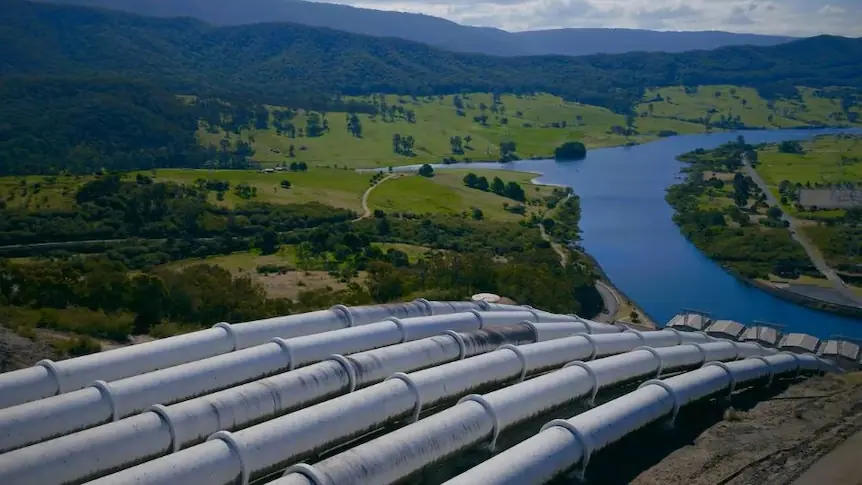
Its off-river design involved two reservoirs separated by approximately 600 metres in elevation. Water would be pumped uphill when electricity was plentiful and released through turbines during periods of higher demand.
The project offered 900MW of generating capacity and 7,200 megawatt-hours of storage, making it one of Australia’s largest proposed pumped hydro developments.
In 2020, the NSW government granted the project critical state significant infrastructure status. In 2024, Alinta signed an early contractor agreement involving Malaysia’s Gamuda and Spain’s Ferrovial Construction.
Transmission Challenges and Construction Costs
Oven Mountain’s remote mountainous location offered suitable conditions for pumped hydro generation but created expensive engineering and logistical challenges.
The development required reservoirs, underground tunnels, electricity connections and extensive access roads. Engineering investigations examined more than 40 kilometres of roads and associated infrastructure.
Alinta identified a critical transmission line as a major obstacle but has not disclosed a complete breakdown of the project’s final financial assessment.
The NSW government said the facility was not intended to connect to new transmission infrastructure being developed for the New England Renewable Energy Zone.
Regional Jobs and Road Infrastructure Plans Affected
Armidale Regional Council Mayor Sam Coupland expressed shock at the cancellation, saying the council had worked with Alinta for years on road improvements associated with the development.
He questioned whether extensive planning and environmental requirements were increasing costs for major infrastructure projects.
NSW Member for Oxley Michael Kemp described the decision as a disappointing economic outcome for the Mid North Coast, particularly because of the potential construction and ongoing employment opportunities.
Kempsey deputy mayor Arthur Bain, chief executive of the Thunggutti Local Aboriginal Land Council, said the project’s steep terrain was suitable for hydro generation but difficult and costly to develop.
Bain also noted that an earlier hydro proposal at the site had failed during the 1980s.
Cheaper Battery Storage Challenges Pumped Hydro
Falling battery prices are making large pumped hydro developments increasingly difficult to justify financially.
Energy analyst Tristan Edis, director at Green Energy Markets, estimated pumped hydro construction costs at approximately $5,000–$6,000 per kilowatt, compared with around $1,400 per kilowatt for four-hour battery storage.
However, the technologies serve different purposes. Pumped hydro can provide electricity for eight to 24 hours, while batteries generally offer faster construction and greater flexibility in choosing locations.
Australia’s growing battery investment includes community battery projects in Western Australia, although these operate at a smaller scale than pumped hydro facilities.
Government Grants and Public Funding Questions
The Oven Mountain proposal previously received government development support, including assistance through NSW programs and the Australian Renewable Energy Agency.
Reports have raised questions about approximately $10 million in state grant support and $951,000 in federal funding. However, the amounts actually paid or potentially recoverable remain unclear.
A NSW government spokesperson said the previous administration’s funding program recognised that not every supported project would reach completion.
The official NSW planning portal provides the project’s assessment history and infrastructure details.
Impact on NSW Electricity Supply and Energy Prices
Oven Mountain was intended to provide long-duration electricity storage as NSW gradually replaces ageing coal-fired generation with renewable energy.
Its cancellation does not immediately reduce electricity supply because the facility was never built or operational. There is also no confirmed evidence that the decision alone will increase household electricity bills.
The NSW government said operating renewable energy capacity had increased by more than 88% since 2023, while large-scale battery storage had expanded more than twentyfold.
Australia’s changing electricity network also includes the redevelopment of the former Liddell Power Station site as coal generation is retired.
Future of the Oven Mountain Site Remains Uncertain
Alinta Energy, acquired by Singapore’s Sembcorp Industries in a transaction completed in June 2026, has not announced an alternative development for the site.
Questions remain about government funding, planned road improvements, outstanding planning applications and whether other energy storage projects can replace the proposed 7.2GWh capacity.
For communities around Armidale, Kempsey and the Macleay Valley, the cancellation means losing anticipated investment and employment opportunities. For NSW energy planners, it highlights the difficulty of delivering large storage projects when construction costs, transmission requirements and market conditions no longer align.

Make Swikblog your go-to source on Google for reliable updates, smart insights, and daily trends.