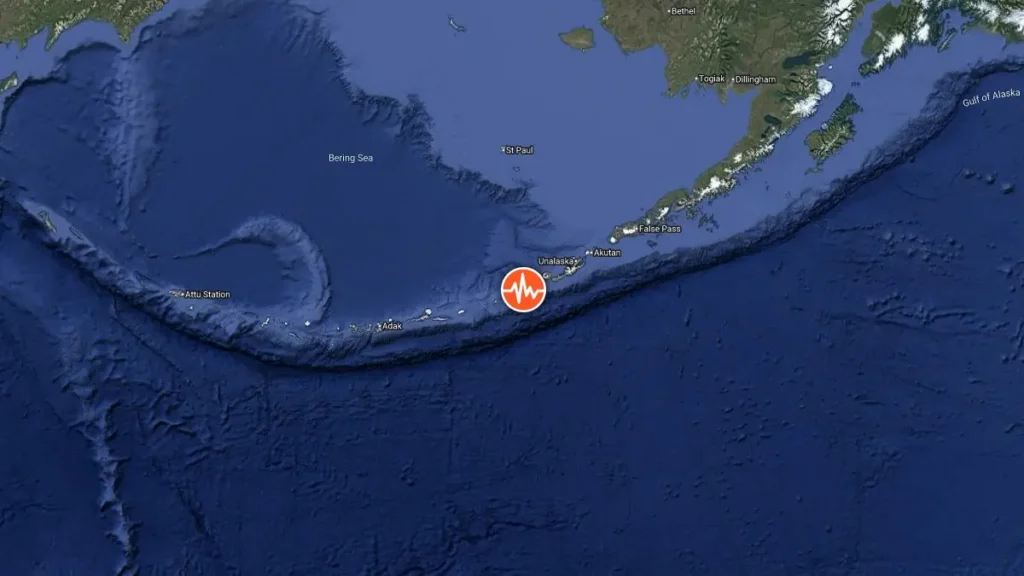

NIKOLSKI, Alaska — A magnitude 6.2 earthquake struck southwest of Nikolski in Alaska’s remote Aleutian Islands on Thursday, September 3, 2026, triggering an immediate tsunami assessment as the region experiences continued seismic activity. U.S. officials confirmed there is no tsunami warning, advisory, watch or threat from the earthquake.
Right on schedule, Alaskas central Aleutian Island chain has been struck by a M6.2 earthquake.
— Dutchsinse (@RealDutchsinse) September 3, 2026
They were warned for up to M6.5.https://t.co/iHkvFwJGI0 pic.twitter.com/Df5TpujJgF
The quake occurred at 11:17:23 UTC and was centered about 65 miles (105 km) southwest of Nikolski, according to the National Tsunami Warning Center. Its depth was estimated at 78 km, or 48 miles.
There were no immediate authoritative reports of deaths, injuries or major structural damage. Because the epicenter was in a remote section of the Aleutian chain, however, detailed assessments of local effects may take time.
Alaska earthquake today: What happened?
The National Tsunami Warning Center placed the earthquake at approximately 52.015°N, 169.221°W. Officials issued their first information statement at 11:22:58 UTC, roughly six minutes after the earthquake.
- Magnitude: 6.2
- Location: 65 miles southwest of Nikolski, Alaska
- Depth: 78 km (48 miles)
- Time: 11:17:23 UTC on September 3
- Tsunami status: No warning, advisory, watch or threat
The quake matters because the Aleutian Islands sit along one of North America’s most active earthquake zones, where strong offshore earthquakes can quickly raise concerns about coastal impacts.
Is there a tsunami warning after the 6.2 quake?
No. The U.S. National Tsunami Warning Center said there was no tsunami warning, advisory, watch or threat in effect for Alaska, British Columbia or the U.S. West Coast following the earthquake.
A magnitude alone does not determine whether an earthquake will generate a tsunami. The location of the rupture, its mechanism, depth and whether the seafloor is displaced are among the factors specialists assess.
Similar questions about seismic and coastal hazards followed the recent magnitude 5.6 earthquake near Milford Sound, highlighting why official tsunami guidance is important after significant earthquakes near coastal regions.
More earthquakes have occurred near Nikolski
The magnitude 6.2 event follows several other earthquakes around the Nikolski area.
On September 1, the National Tsunami Warning Center recorded a magnitude 5.1 earthquake about 45 miles southwest of Nikolski. That earthquake was extremely shallow at an estimated depth of about 1 km, and officials also reported no tsunami threat.
USGS data show a magnitude 3.4 earthquake about 86 km south of Nikolski on September 2 at a depth of 4 km. The Alaska Earthquake Center has also recorded other smaller events south of the community in recent days.
Those earthquakes demonstrate elevated seismic activity in the broader area, but scientists do not automatically classify every nearby event as a foreshock or aftershock. Establishing a relationship between earthquakes requires analysis of their timing, location and faulting.
Why the Aleutian Islands have so many earthquakes
The Aleutian Arc marks the boundary where the Pacific Plate moves beneath the North American Plate. The Alaska Earthquake Center says thousands of earthquakes occur along the arc each year.
The region has produced some of the largest earthquakes recorded in Alaska, including the magnitude 8.6 Andreanof Islands earthquake in 1957 and the magnitude 8.7 Rat Islands earthquake in 1965.
Earthquakes in the Aleutians can originate from the main plate boundary, within the descending Pacific Plate or from shallower crustal and volcanic processes.
Alaska earthquakes closer to population centers can have a very different impact. A magnitude 6.0 earthquake that shook Southcentral Alaska near Anchorage provides a useful comparison of how location, depth and proximity to communities influence earthquake risk.
What does the 78-km depth mean?
Thursday’s magnitude 6.2 earthquake was considerably deeper than many of the smaller recent earthquakes near Nikolski.
Depth can influence the way shaking reaches the surface, but it should not be treated as the sole reason major damage or a tsunami was not reported. Magnitude, distance, rupture characteristics and local geology all affect an earthquake’s impact.
Could more earthquakes follow?
Additional seismic activity is possible after an earthquake of this size. Aftershocks commonly occur as stresses in the surrounding crust adjust, although scientists cannot reliably predict their exact timing or magnitude.
Anyone who experiences strong shaking should drop, cover and hold on. Coastal residents should follow official emergency alerts and tsunami instructions rather than relying on earthquake predictions circulating on social media.
For now, the key safety update remains unchanged: a magnitude 6.2 earthquake struck southwest of Nikolski on September 3, but authorities have identified no tsunami threat.

Make Swikblog your go-to source on Google for reliable updates, smart insights, and daily trends.