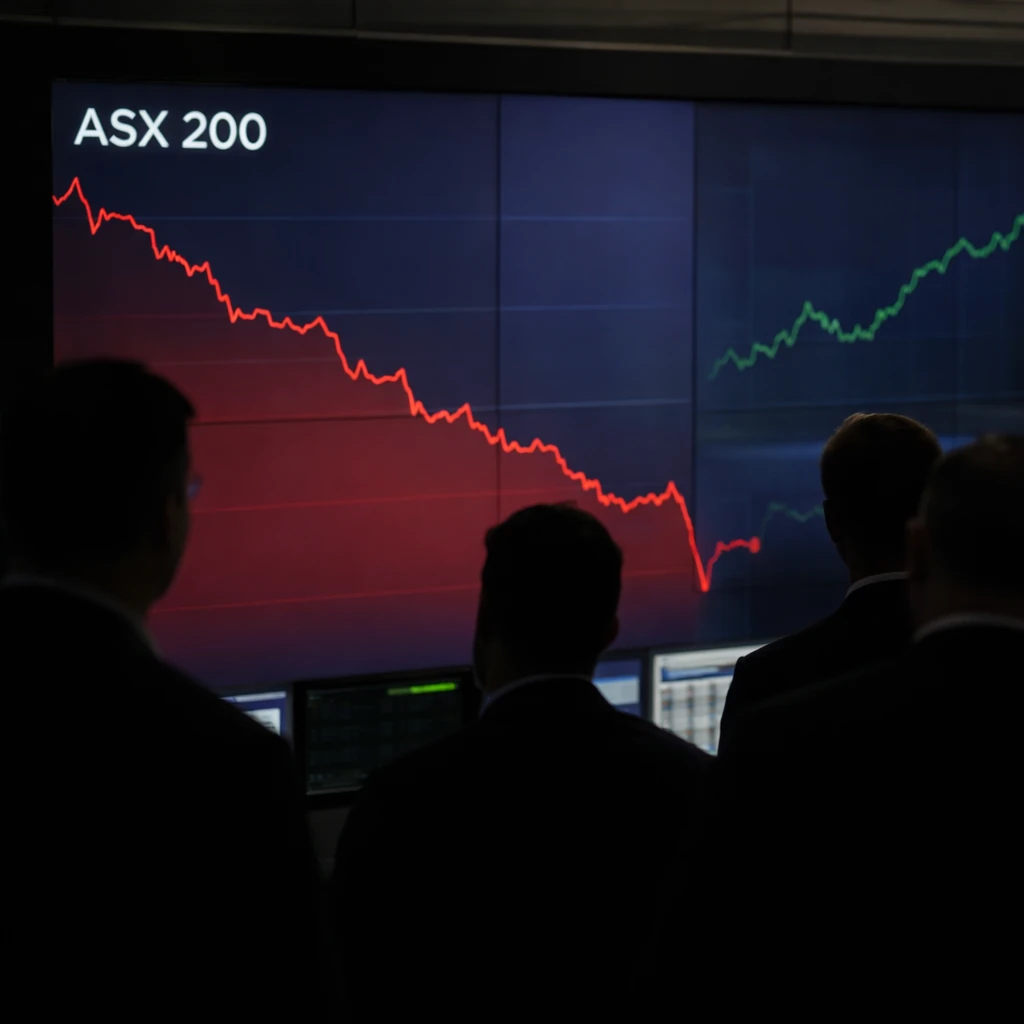

Australian shares traded lower on Monday, with the benchmark S&P/ASX 200 falling to 8,572.50, down 44.60 points or 0.52%, as rising oil prices, global geopolitical tensions and expectations of a potential Reserve Bank of Australia rate hike weighed on investor sentiment.
The index slipped steadily through the trading session after opening near the previous close of 8,617.10. The ASX 200 traded within a day range of 8,563.30 to 8,617.50, reflecting cautious market activity as traders digested global developments and prepared for the RBA’s policy meeting.
The pullback came as global equity markets weakened after investors reacted to renewed fears that the escalating conflict in the Middle East could disrupt energy supplies and push inflation higher worldwide.
Oil surge adds pressure to global markets
Energy markets have become the biggest driver of investor anxiety. Brent crude climbed to about $104.03 per barrel, while West Texas Intermediate traded near $98.59 per barrel. The sharp rise in oil prices has raised concerns that inflation may remain stubbornly high globally, forcing central banks to maintain tighter monetary policies.
The spike in crude prices follows escalating tensions involving the United States, Israel and Iran. According to energy analysts, the conflict has triggered one of the largest supply disruptions the global oil market has experienced in decades.
In response to the growing energy crisis, the International Energy Agency announced that its 32 member countries agreed to release 400 million barrels of oil from emergency reserves in an attempt to stabilize global prices and maintain supply.
Despite this measure, economists warn that if the conflict drags on, energy shortages could intensify and continue to influence global financial markets.
RBA interest rate decision looms over the market
Investors are also closely watching the Reserve Bank of Australia, which is meeting as markets brace for a possible interest rate increase.
Higher interest rates tend to weigh on equity markets because they raise borrowing costs for companies and reduce consumer spending power. With oil prices surging and inflation risks rising again, traders are increasingly concerned that policymakers may have to keep monetary policy restrictive for longer.
Currency markets reflected this shift in expectations, with the Australian dollar strengthening 0.4% to around 70.09 US cents. A stronger currency can help offset imported inflation but may also create headwinds for export-heavy companies.
Consumer staples outperform as investors turn defensive
Sector performance on the ASX highlighted a clear defensive rotation among investors.
The consumer staples sector rose nearly 1%, making it one of the few areas of the market trading in positive territory. Defensive grocery retailers led the gains as investors shifted toward companies with stable earnings.
Woolworths (ASX: WOW) shares climbed more than 1% in recent trade, while Coles (ASX: COL) also gained over 1%. These companies tend to perform well during uncertain economic conditions because demand for essential goods such as groceries remains steady even when households reduce discretionary spending.
The move into defensive stocks signals that investors are becoming more cautious about the global economic outlook.
Mining and materials stocks struggle
While defensive sectors gained ground, the materials sector declined nearly 2%, making it the weakest-performing part of the Australian market.
Mining giant BHP (ASX: BHP) slipped in recent trading as investors reassessed commodity demand expectations. Rising energy prices can increase operational costs for mining companies and raise concerns about slowing industrial activity globally.
Resource companies make up a significant portion of the Australian share market, meaning weakness in the materials sector often has an outsized impact on the overall index.
Global markets turn cautious
The softer tone in Australian shares followed a negative lead from global markets.
On Wall Street last Friday, the S&P 500 fell 0.6%, the Dow Jones Industrial Average declined 0.3%, and the Nasdaq dropped 0.9%. European markets also ended the session lower, with Germany’s DAX down 0.6%, the FTSE 100 losing 0.4%, and the Euro Stoxx index falling 0.5%.
Across Asia, markets showed mixed performance. Japan’s Nikkei fell 0.5%, China’s Shanghai Composite dropped 0.7%, while Hong Kong’s Hang Seng index remained mostly flat.
The global sell-off highlights the growing concern among investors that geopolitical tensions and energy market volatility could weigh on economic growth.
Fuel rationing fears emerge in Australia
Energy experts have also warned that the ongoing Middle East conflict could eventually force countries, including Australia, to consider fuel rationing if supply disruptions intensify.
According to energy policy specialists, panic buying among motorists has already increased demand for fuel by 35% to 40% in some regions. Experts say this surge in demand is placing additional strain on supply systems that are not designed to handle sudden spikes in consumption.
Analysts warn that if the geopolitical crisis continues without resolution, global oil supply buffers could disappear quickly, leaving governments with limited options to maintain stable fuel availability.
Some energy experts believe that rationing may become necessary if supply disruptions persist and emergency reserves begin to run low.
Market outlook
For investors, the next few days could prove crucial. Markets will be closely watching the outcome of the RBA’s policy meeting and monitoring developments in global energy markets.
If oil prices continue climbing above $100 per barrel, inflation concerns could intensify and put additional pressure on global equities. On the other hand, any signs of easing geopolitical tensions or stabilizing energy supply could help restore confidence across financial markets.
For now, the drop in the ASX 200 to 8,572.50, down 44.60 points or 0.52%, reflects a market that is increasingly sensitive to geopolitical risk, energy shocks and central bank policy decisions.
Investors can track broader commodity movements through global commodities coverage and monitor Australian market developments via ABC business updates.

Make Swikblog your go-to source on Google for reliable updates, smart insights, and daily trends.