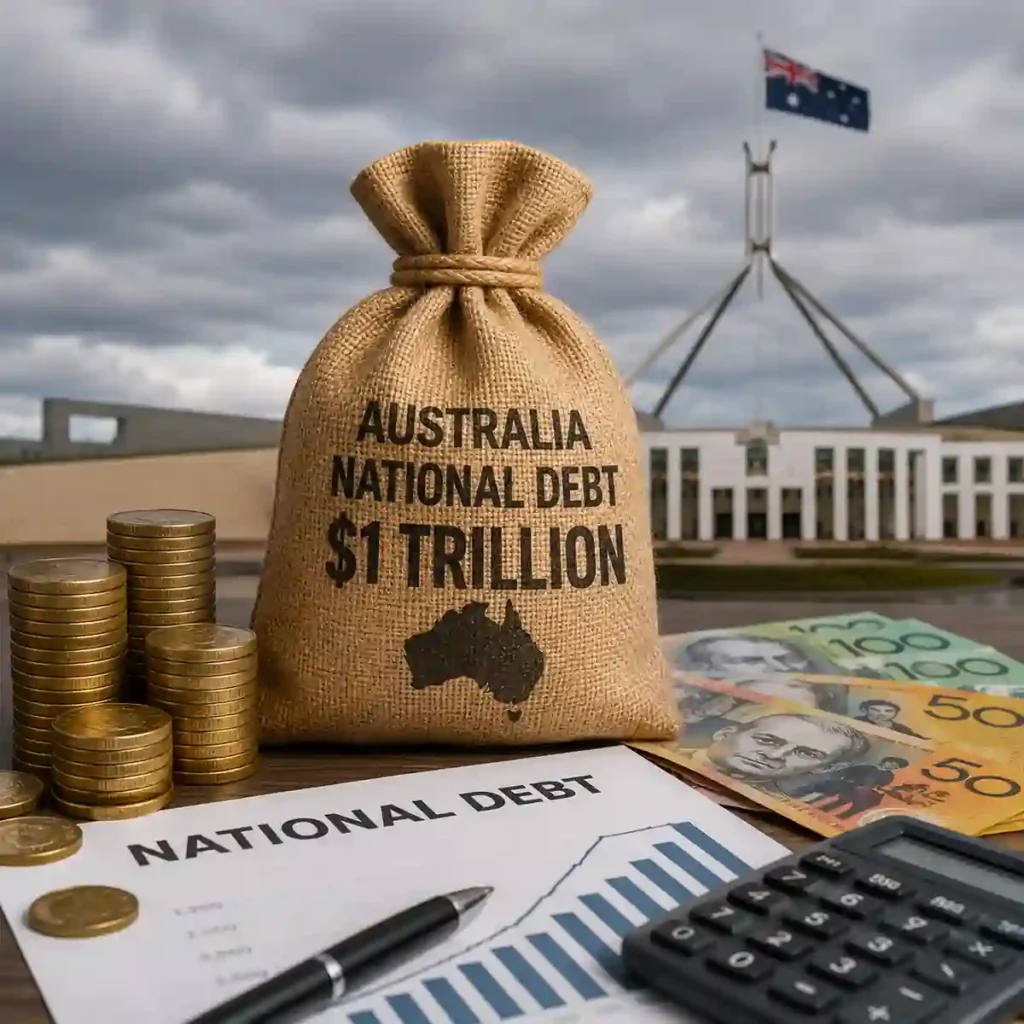

Australia’s Commonwealth gross debt crossed $1 trillion for the first time on August 20, 2026, a symbolic milestone that has renewed debate over federal deficits, borrowing and rising interest costs. However, the latest Australian Office of Financial Management (AOFM) data shows the total moved back below the threshold after securities matured.
As of August 21, Australian Government Securities on issue totalled about $994.8 billion. The movement shows why the trillion-dollar figure is best understood as a milestone in Australia’s longer-term debt trend rather than a sudden $1 trillion borrowing event.
How Australia crossed the $1 trillion mark
The AOFM reported $983.7 billion of Australian Government Securities outstanding on August 14. New issuance during the following week, including borrowing on August 20, briefly pushed the total beyond $1 trillion.
About $6 billion of Treasury Notes then matured on August 21, helping bring securities outstanding back below the threshold. Australia still has substantial financing requirements as the government funds deficits and refinances debt reaching maturity.
Gross debt and net debt are different
The headline figure refers to gross Commonwealth debt, measured by the face value of Australian Government Securities on issue. Net debt is lower because it accounts for selected government financial assets.
According to Australian Office of Financial Management budget data, net debt was estimated at $556 billion, or 18.8% of GDP, at June 30, 2026. The 2026–27 Budget forecasts net debt at $616.6 billion, or 19.9% of GDP, by June 2027.
Gross debt is forecast to reach $1.051 trillion, or 34% of GDP, by June 2027 and $1.249 trillion by June 2030. Comparing debt with the size of the economy gives more useful context than the trillion-dollar number alone.
Why Australia is still borrowing
Australia recorded two consecutive federal budget surpluses before returning to deficit. The underlying cash deficit is forecast at $28.3 billion for 2025–26 and $31.5 billion for 2026–27.
The Commonwealth borrows to finance deficits, refinance securities as they mature and manage funding needs. Debt also increased significantly during the COVID-19 pandemic as governments funded emergency health and economic support.
Current spending pressures include health, defence, housing and cost-of-living measures. The 2026 federal budget measures affecting households and businesses show how those commitments sit alongside efforts to limit deficits and future borrowing.
What the debt means for taxpayers
The main long-term concern is the cost of servicing government debt. Budget estimates put total Commonwealth interest payments at $29.6 billion in 2026–27, rising to $42.3 billion by 2029–30.
Higher interest expenses can reduce the flexibility governments have to fund services, infrastructure or tax relief. Crossing $1 trillion does not automatically cause taxes to rise, but continued deficits and growing interest bills can make future budget decisions more difficult.
The pressure comes as households are already adjusting to the July 1 tax, Centrelink, superannuation and minimum wage changes affecting workers, families and retirees during the 2026–27 financial year.
Who holds Australian government debt?
The Commonwealth does not owe the entire amount to one country, bank or organisation. It raises money by issuing government securities bought by Australian and overseas investors.
Those investors include banks, superannuation funds, insurers, investment managers and international institutions. They receive interest and are repaid according to the terms of the securities they hold.
Labor and Coalition disagree over the milestone
Shadow Treasurer Tim Wilson criticised the trillion-dollar crossing, arguing that continued borrowing and interest costs would increase the burden carried by future taxpayers.
The Albanese government argues that debt would have reached the threshold earlier under projections inherited from the previous Coalition government. Treasurer Jim Chalmers has pointed to lower projected debt compared with the 2022 outlook and says improved budget outcomes have avoided more than $70 billion in projected interest costs over the longer term.
Polymarket and Kalshi Face Australia ASIC Warning: What Users Need to Know
Medicare $272 Million Unclaimed Money: Australians Could Be Owed a $280 Rebate
Is Australia facing a debt crisis?
The $1 trillion crossing alone does not indicate an immediate sovereign debt crisis. What matters more is whether debt remains manageable relative to the economy and how much revenue is required to service it.
Australia’s debt outlook therefore depends on future budget deficits, economic growth, borrowing costs and interest payments. Although securities outstanding fell back to about $994.8 billion on August 21, official projections show gross debt is expected to move above $1 trillion again as borrowing requirements continue.

Make Swikblog your go-to source on Google for reliable updates, smart insights, and daily trends.