
Skilled migrants already living in Australia have gained a potentially important advantage under a new visa processing strategy designed to limit fresh arrivals while retaining workers the country needs.
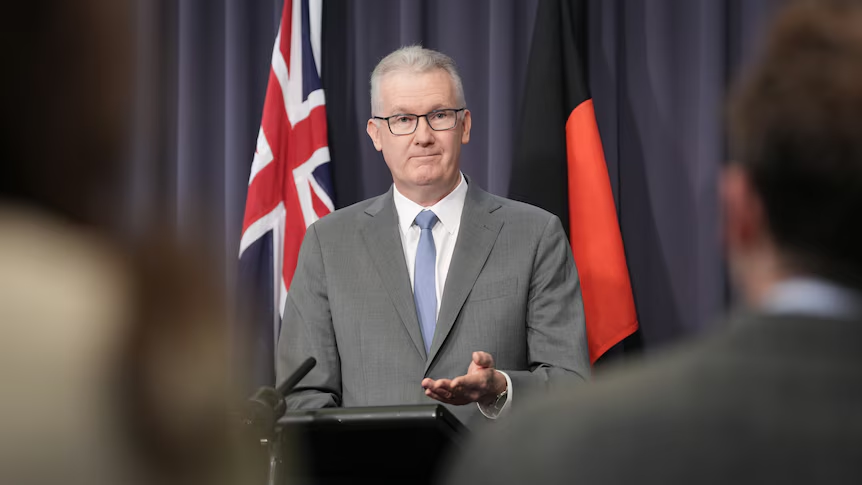
Home Affairs Minister Tony Burke’s Ministerial Direction 119, effective from July 25, 2026, changes how immigration officers order thousands of skilled visa applications. Instead of placing broad regional sponsorship at the top, the system now gives greater weight to an applicant’s location and occupation.
The decision matters most to temporary migrants planning a permanent future in Australia. It could bring some applications forward while pushing many offshore cases further back. However, it does not create extra permanent places, change eligibility rules or guarantee a faster decision.
A queue redesigned around location and occupation
At the front of the queue are applicants who were in Australia when they applied and whose work supports national defence or law enforcement. Equivalent offshore applicants receive the second-highest priority.
The defence category includes specified roles connected to AUKUS and applicants sponsored by the Australian Defence Force or Department of Defence. Police priority is limited to defined occupations sponsored by the Australian Federal Police or an eligible state or territory police force. Employment in private security does not automatically qualify.
Next are onshore candidates in construction, healthcare and teaching. Other skilled applicants already in Australia follow, while offshore candidates outside the defence and police groups sit in the final priority category.
The location test generally applies at the time of lodgement. Someone who submitted an application overseas should not assume that entering Australia later will move the case into an onshore group. Family members included in the same application receive the primary applicant’s priority.
The new order applies to eligible cases already lodged but not finally decided, along with new applications. Current details are available through the Department of Home Affairs skilled visa guidance.
Covered pathways include subclasses 186, 187, 189, 190, 191, 482, 489, 491, 494, 887 and 888. The Skills in Demand subclass 482 program is included after not being covered by the previous Direction 105 priorities.
The occupations likely to feel the change first
Priority construction roles include managers, architects, civil engineers, building technicians, electricians, welders, crane operators and earthmoving plant operators.
Healthcare coverage reaches beyond doctors and nurses. Medical scientists, psychologists, counsellors, social workers, medical technicians, aged or disabled carers, nursing support workers and personal care assistants are among the designated occupations.
The teaching group includes schoolteachers, principals, childcare centre managers, childcare workers, vocational education teachers and university lecturers.
Being employed in one of these sectors is not enough on its own. Priority depends on the nominated occupation matching the definitions in the direction, and the applicant must still qualify for the relevant visa.
The construction preference also exposes a central tension in Australia’s migration debate. Reducing population growth may relieve some demand for homes, but limiting skilled arrivals could leave fewer workers available to build them. The competing pressures are examined in this report on how migration reductions could affect Australia’s housing shortage.
Applicants also face a more expensive process after visa charges increased from July 1. Costs differ between subclasses, so prospective applicants should check the latest Australian visa fee increases before preparing a budget.
$20,000 U.S. Visa Bond Explained: Eligible Countries, Refund Rules and Who May Be Affected
Australia Student Visa Processing Times 2026: Current Wait Times and What Applicants Should Expect
Visit the homepage for the latest immigration news, visa updates and global travel guides
Why changing visa status can lower migration numbers
Australia’s permanent migration program provides 185,000 places, with about 70% expected to be directed towards people already in the country. The strategy can reduce the permanent program’s immediate contribution to net overseas migration without cutting the same number of visas.
A temporary migrant already living in Australia has generally been counted in the population. Giving that person permanent residency changes their legal status but does not create a fresh arrival. An offshore visa grant is more likely to bring an additional resident into the country.
Net overseas migration stood at approximately 301,000 in the year to December 2025. That was well below the post-pandemic peak but remained above the government’s target of 225,000.
The policy also addresses a large temporary population. Australia had a record 432,300 people on bridging visas, while former senior immigration official Abul Rizvi estimated that around three million people were living in the country on temporary visas.
Australian National University Migration Hub director Alan Gamlen said transitioning eligible temporary residents to permanent status could reduce this backlog while recognising people already working and contributing to Australia.
The effect on total migration may nevertheless be modest. Rizvi noted that the number of defence and AUKUS visas is likely to be small, despite those applications receiving the highest priority.
Offshore applicants face greater uncertainty
Applicants outside Australia remain eligible, but many may wait longer because most onshore applications are now ranked ahead of them. Regional sponsorship also no longer carries the broad top priority it received under the previous direction.
Processing order should not be confused with automatic approval. Applicants must still meet requirements involving sponsorship or nomination, occupation, skills, points, English ability, age, health and character. Incomplete evidence, verification checks, program limits and case complexity can all affect timing.
Shadow Home Affairs and Immigration Minister Jonno Duniam accused the government of managing “migration by stealth,” arguing that rearranging the queue would not resolve visa hopping, backlogs or poor administration.
Burke also postponed a planned National Press Club address on migration settings, with no reason provided at the time. Until further policy details emerge, applicants should focus on four factors: their location when they applied, nominated occupation, visa subclass and whether the case is complete and eligible for assessment.

Make Swikblog your go-to source on Google for reliable updates, smart insights, and daily trends.