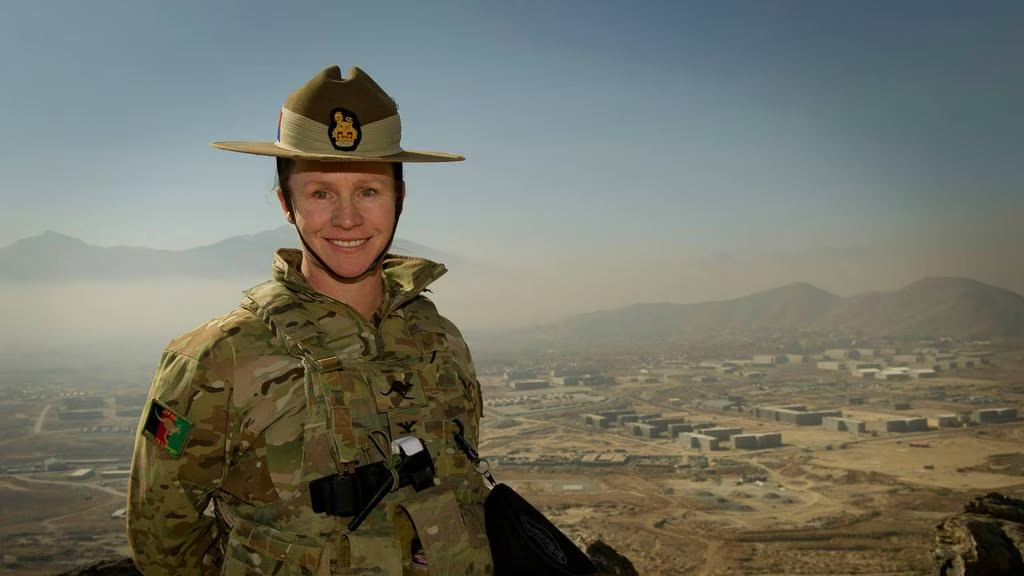

Australia has appointed Lieutenant General Susan Coyle as its first female Chief of Army, marking a historic leadership shift at a time of heightened global tensions and internal restructuring within the Australian Defence Force. The announcement, made on April 13, comes just months before a scheduled transition in senior military leadership and amid increased scrutiny of defence operations.
Coyle will officially assume the role in July, replacing Lieutenant General Simon Stuart, who has served as Army Chief since 2022 and is set to retire. Her appointment forms part of a wider shake-up, with Vice-Admiral Mark Hammond promoted to Chief of the Defence Force, succeeding Admiral David Johnston, whose tenure concludes after more than 48 years of service.
Rear-Admiral Matthew Buckley, currently Deputy Chief of Navy, will step into Hammond’s previous role as Chief of Navy. The coordinated changes signal a generational shift across the top ranks of Australia’s military leadership at a time when defence priorities are rapidly evolving.
Coyle’s elevation is being described as a “deeply historic moment” for the Australian military. She becomes the first woman to lead the Army in its history, reflecting broader changes within the force. When she first joined in 1987 as a member of the Army Reserve, women made up only around 10% of personnel and were largely absent from senior command roles. Today, multiple women hold three-star general positions, underscoring a transformation in representation and leadership pathways.
Over a career spanning more than three decades, Coyle has built extensive operational and strategic experience. She graduated from the Australian Defence Force Academy in 1992 and has since commanded troops on deployments to Timor-Leste, the Solomon Islands and Afghanistan. Her leadership roles have included Commander of Joint Task Force 633 in the Middle East and Commander of Task Group Afghanistan.
She has also served as Head of Information Warfare and, more recently, as Chief of Joint Capabilities, where she oversaw critical areas such as cyber operations, space command and advanced defence systems. Her academic credentials include postgraduate master’s degrees and recognition as a distinguished graduate of the US Army War College.
The timing of the reshuffle adds further weight to the announcement. Defence leadership changes come amid rising geopolitical uncertainty, including tensions in the Middle East and increased focus on maritime security in strategic waterways like the Strait of Hormuz. Hammond, upon his promotion, acknowledged the challenges ahead, describing the role as “the most humbling moment” of his career and emphasising the responsibility of leading Australia’s sailors, soldiers and aviators through a complex security landscape.
Leadership shift reflects changing military priorities
The appointment of Coyle highlights how the nature of military leadership is evolving. Modern defence strategy increasingly requires expertise beyond traditional combat roles, with cyber warfare, information operations and space capabilities becoming central to national security. Coyle’s background in these areas positions her at the forefront of that transition.
Her rise also carries symbolic importance. Defence officials have pointed to her appointment as an inspiration for women currently serving or considering military careers, reinforcing the message that leadership roles are becoming more accessible across the force.
At the same time, the broader reshuffle ensures continuity in leadership as experienced figures transition out. Admiral Johnston and Lieutenant General Stuart’s retirements mark the end of long-serving careers, while their successors are expected to guide the military through an increasingly uncertain global environment.
As Australia recalibrates its defence posture and strategic priorities, the appointments signal both renewal and readiness. Coyle’s leadership will be closely watched not only for its historic significance, but for how effectively it navigates the operational and technological challenges shaping modern warfare. More details on Australia’s defence leadership and structure can be accessed via the Australian Department of Defence.
You may also like: New video games this week (April 13–19, 2026)
Make Swikblog your go-to source on Google for reliable updates, smart insights, and daily trends.