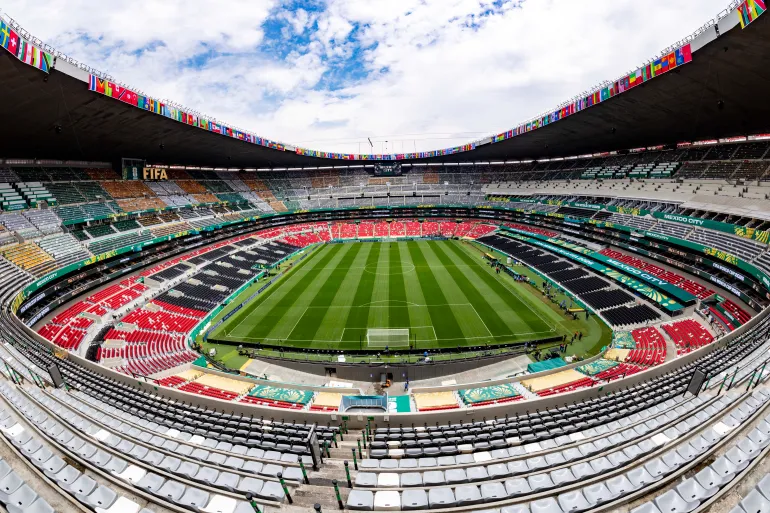

Mexico City’s iconic Azteca Stadium is set to make football history once again. When the 2026 FIFA World Cup begins, the legendary venue will become the first stadium ever to host matches at three separate World Cups, adding a new chapter to a legacy that already includes some of the sport’s most unforgettable moments.
The stadium will host the opening match of the tournament as Mexico take on South Africa, placing one of football’s most celebrated venues back at the centre of the global spotlight. While World Cup 2026 will introduce a new 48-team format across three host nations, Azteca remains a powerful link between football’s past and future.
Azteca Stadium’s Historic FIFA Milestone
Few sporting venues can match the significance of Azteca Stadium. Opened in 1966, the stadium quickly became a landmark of international football and hosted the final of the men’s football tournament at the 1968 Olympic Games.
Its global reputation grew dramatically during the 1970 FIFA World Cup, when Mexico became the first nation outside Europe and South America to host football’s biggest tournament. Azteca staged ten matches during that competition and became the backdrop for several historic moments.
More than five decades later, the venue is preparing to achieve a FIFA first by hosting World Cup matches in 1970, 1986 and 2026. No other stadium has reached that milestone.
The Stadium Where Pele Lifted His Third World Cup
Azteca played a major role in one of football’s greatest tournaments. The venue hosted the memorable semifinal between Italy and West Germany, a dramatic 4-3 encounter that many historians still rank among the greatest World Cup matches ever played.
It also staged the 1970 final, where Brazil defeated Italy 4-1. That victory secured Pele’s third World Cup title and cemented Brazil’s status as one of football’s greatest teams.
The image of Pele celebrating inside a packed Azteca remains one of the defining photographs in World Cup history and helped establish the stadium as a global football landmark.
How Maradona Created Football Folklore At Azteca
When Mexico hosted the World Cup again in 1986, Azteca once more became the tournament’s most important venue.
The stadium hosted nine matches, including the final, but it was Argentina’s quarterfinal against England that secured Azteca’s place in football folklore.
Diego Maradona scored two goals that continue to be discussed decades later. His controversial “Hand of God” goal remains one of the most debated moments in sports history, while his second strike, a dazzling run through England’s defence, is widely regarded as one of the greatest goals ever scored.
Argentina later defeated West Germany 3-2 in the final at Azteca, giving the venue another iconic World Cup celebration.
Why World Cup 2026 Could Feel Different For Players
World Cup 2026 will be the largest edition of the tournament in FIFA history, featuring 48 teams and matches spread across Canada, Mexico and the United States. According to the official FIFA World Cup 2026 tournament information, the expanded format will significantly increase the number of matches and host cities involved.
Despite the tournament’s scale, Azteca remains one of its headline venues. The stadium is scheduled to host five World Cup matches, including the opening ceremony and opening fixture.
Another factor that makes the venue unique is its location. Sitting approximately 2,200 metres above sea level, Azteca presents a physical challenge for visiting teams. Reduced oxygen levels can affect endurance, recovery and high-intensity performance, making preparation especially important for players unfamiliar with Mexico City’s altitude.
Mexico will play two of its group-stage matches at the stadium, potentially benefiting from familiar conditions and passionate home support.
A Major Renovation Ahead Of The World Cup
To prepare for the tournament, Azteca underwent nearly two years of renovation work. The project included upgraded seating, modernised dressing rooms, improved lighting systems and infrastructure improvements around the stadium.
Although the redevelopment faced delays, the venue reopened in March 2026 with a friendly match between Mexico and Portugal. The reopening served as a key test event before the arrival of World Cup fans from around the globe.
The upgrades were designed to modernise the stadium while preserving the atmosphere and identity that have made it one of football’s most respected venues.
Why Azteca’s Legacy Continues To Grow
Many stadiums are remembered for architecture, capacity or technology. Azteca is remembered for moments.
It has hosted Pele’s greatest triumph, Maradona’s most famous performance, Olympic competition, World Cup finals and now the opening match of the biggest World Cup ever staged.
Read More
As football enters a new era in 2026, Azteca Stadium offers something increasingly rare in modern sport: a direct connection between generations. Its third World Cup appearance is more than a record. It is proof that some venues become part of football history itself.
Readers interested in major tournament developments can also explore our latest sports news coverage and follow ongoing updates from international football throughout World Cup 2026.

Make Swikblog your go-to source on Google for reliable updates, smart insights, and daily trends.