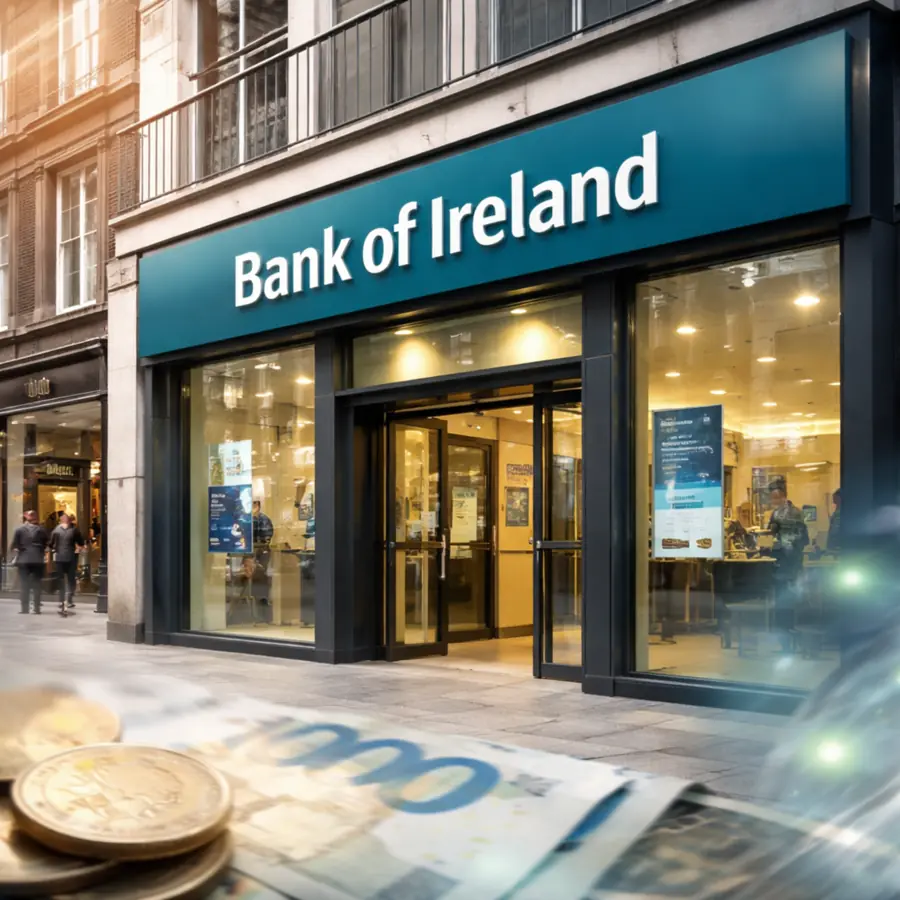

Bank of Ireland has raised the rate on its 12-month fixed-term deposit account to 2.14%, a move that signals the pressure now building across Ireland’s savings market as digital-first rivals push harder for customer money. The increase, which takes effect from today, lifts the annual equivalent rate from 1.75% and marks a 0.40 percentage point jump at a time when traditional lenders are being forced to respond to a more crowded field.
The change may look modest at first glance, but it lands in a market where households are estimated to hold around €170bn in savings and current accounts. That huge pool of cash has become increasingly attractive to both established banks and newer challengers, especially as savers become more aware of the gap between older low-yield products and the better rates now appearing across Europe’s retail banking sector.
For customers considering the updated Bank of Ireland offer, the main change is straightforward. The bank’s 12-month Advantage Fixed Term Deposit now pays 2.14% AER, up from 1.75%. Existing customers who already hold a fixed-term deposit account will continue on their original rate until their current term ends, meaning the uplift is aimed at new deposits rather than repricing accounts already in place.
Competition in the savings market is becoming harder for legacy banks to ignore
The timing of the rate increase has drawn attention because it comes as neobanks and newer online banking brands step up their push into Ireland. Price comparison analysts have pointed to a sharper competitive backdrop, with names such as Monzo, MoCo and Bankinter all becoming more active in the savings space. The pressure is not only about pricing, but also about visibility, app-based banking convenience and the growing willingness of consumers to move their money when better returns are available.
That shift is especially relevant now because many households still keep large balances in low-interest current accounts, where returns are minimal or close to zero. Against that backdrop, even a move to 2.14% can stand out. It does not suddenly make Bank of Ireland the most aggressive name in the market, but it does show that Ireland’s mainstream lenders are no longer operating in a market where they can ignore challenger brands.
The pressure intensified further after Monzo said this week that it had 100,000 customers in Ireland on a waiting list ready to sign up for its current account and savings products. That kind of early demand matters because it shows there is a sizable audience prepared to look beyond the long-established domestic banks for better digital tools and more attractive returns.
The wider competitive backdrop is also evolving quickly. MoCo is part of Bawag, the group due to buy PTSB, while Bankinter has already established Avant Money locally as a fully fledged bank. Those developments are reshaping the retail savings conversation and making deposit pricing more important than it had been during the long stretch of ultra-low rates.
A better headline rate, but limits remain for savers looking for real growth
Bank of Ireland’s increase will still be judged against one unavoidable fact: 2.14% does not match inflation. That means cash held in a product like this may still lose value in real terms, even if the nominal return is higher than before. For savers focused mainly on preserving purchasing power, that remains a significant drawback.
The tax treatment makes the equation even tougher. In Ireland, Deposit Interest Retention Tax is charged at 33% on interest gains, cutting the effective return further. A saver may therefore see the new headline rate as welcome, but not transformative. It is a step up from a low base rather than a dramatic reset of the market.
Even so, the product does have one feature that gives it practical appeal for cautious households. All Advantage Fixed Term Deposit accounts, whether they run for 6, 12 or 18 months, allow customers to access up to 25% of their deposited funds during the term. That flexibility could matter for savers who want some structure around their cash without fully losing access in an emergency. In effect, it makes the account feel slightly less rigid than many fixed-term products.
For regular savers, Bank of Ireland has also kept its SuperSaver account at 3.00% AER fixed for the first 12 months. After that introductory period, the prevailing regular saver interest rate applies on balances under €30,000, which is currently 2.00%. That means customers looking to drip-feed money into savings rather than lock away a lump sum still have a separate option, although the higher opening rate there is time-limited.
The latest increase therefore sits in an important middle ground. It is stronger than the near-zero return many customers receive by leaving money parked in a current account, and it may suit households building a rainy-day fund while keeping some access to their money. At the same time, it is not likely to satisfy savers with longer-term targets such as building education funds or growing family wealth over many years. For those people, the debate usually moves beyond cash and toward broader investment options, though with a different risk profile.
What Bank of Ireland’s move really underlines is that the Irish savings market has entered a more competitive phase. Legacy banks are still benefiting from trust, scale and branch networks, but they are now facing a generation of rivals built around speed, mobile access and more visible pricing. Anyone comparing rates can also review the bank’s latest savings products through Bank of Ireland’s savings and investment pages. For savers, that should be a positive development. For banks, it is a reminder that the fight for deposits is becoming much harder to win with old rates and old assumptions.

Make Swikblog your go-to source on Google for reliable updates, smart insights, and daily trends.