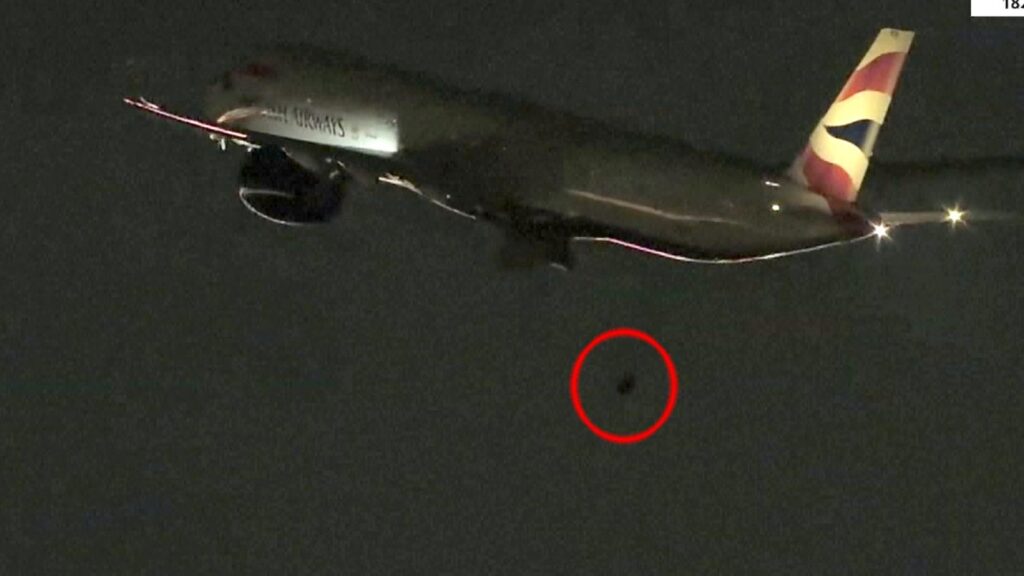

British Airways is working with aviation authorities after one of its Airbus A350 aircraft lost a wheel shortly after taking off from Las Vegas on a scheduled flight to London. Although dramatic video of the incident spread rapidly online, the aircraft returned safely to the airport, and everyone on board landed without injury.
The unusual mechanical failure has renewed attention on aircraft maintenance and inspection procedures. While footage of a wheel separating from an airliner can appear alarming, aviation experts say modern commercial aircraft are designed with multiple backup systems that allow crews to handle unexpected technical problems safely.
Wheel detached moments after take-off
The Airbus A350 had departed Harry Reid International Airport and was climbing toward cruising altitude when one of its wheels separated from the landing gear assembly. Videos shared on social media appear to show the wheel falling away beneath the aircraft shortly after take-off.
British Airways confirmed the flight crew followed standard operating procedures before returning safely to Las Vegas. The airline said there were no injuries among passengers or crew, and the aircraft landed without further incident.
The jet has since been removed from service while engineers complete detailed inspections and investigators examine the cause of the wheel separation.
Why the aircraft remained safe
Although the incident attracted widespread attention, aviation specialists note that losing a single wheel does not automatically place a commercial aircraft in immediate danger. Large passenger jets are built with multiple wheels on their landing gear, allowing pilots to perform a controlled landing even if one wheel is unavailable.
Flight crews also receive extensive simulator training for landing gear malfunctions, hydraulic failures and other technical emergencies. Airports serving long-haul international flights maintain emergency response teams that are prepared whenever an aircraft reports a mechanical issue.
The latest incident follows other aviation events that have drawn regulatory attention, including a Southwest Airlines emergency landing after a cockpit windshield cracked, highlighting how investigators carefully examine every significant safety event.
Investigation now underway
Investigators will inspect the detached wheel, landing gear components and the aircraft’s maintenance history to determine exactly what caused the failure. They will also examine whether the issue resulted from mechanical wear, maintenance procedures, manufacturing defects or another technical problem.
Even when passengers are not injured, aviation authorities routinely investigate unusual mechanical events to identify lessons that could improve safety across the industry. Findings sometimes lead to revised inspection schedules, updated maintenance procedures or manufacturer service bulletins.
About the Airbus A350
The Airbus A350 is one of the world’s newest long-haul passenger aircraft and is operated by airlines across Europe, Asia, North America and the Middle East. Built with lightweight composite materials and advanced flight systems, the aircraft is designed with multiple layers of redundancy that help crews manage unexpected equipment failures safely.
British Airways uses the A350 on several international routes, including transatlantic services between the United Kingdom and North America.
What passengers should know
Mechanical incidents involving commercial aircraft remain uncommon, and aviation experts continue to describe flying as one of the safest forms of transportation. Events that receive significant public attention often demonstrate how aircraft systems, maintenance standards and pilot training work together when an unexpected problem occurs.
Authorities are expected to provide additional information after completing the technical investigation. Until then, the aircraft will remain out of service while inspections continue and investigators establish the precise cause of the wheel separation.
British Airways said it is cooperating fully with regulators and manufacturers throughout the investigation. More information about aviation safety investigations is available from the U.S. Federal Aviation Administration.