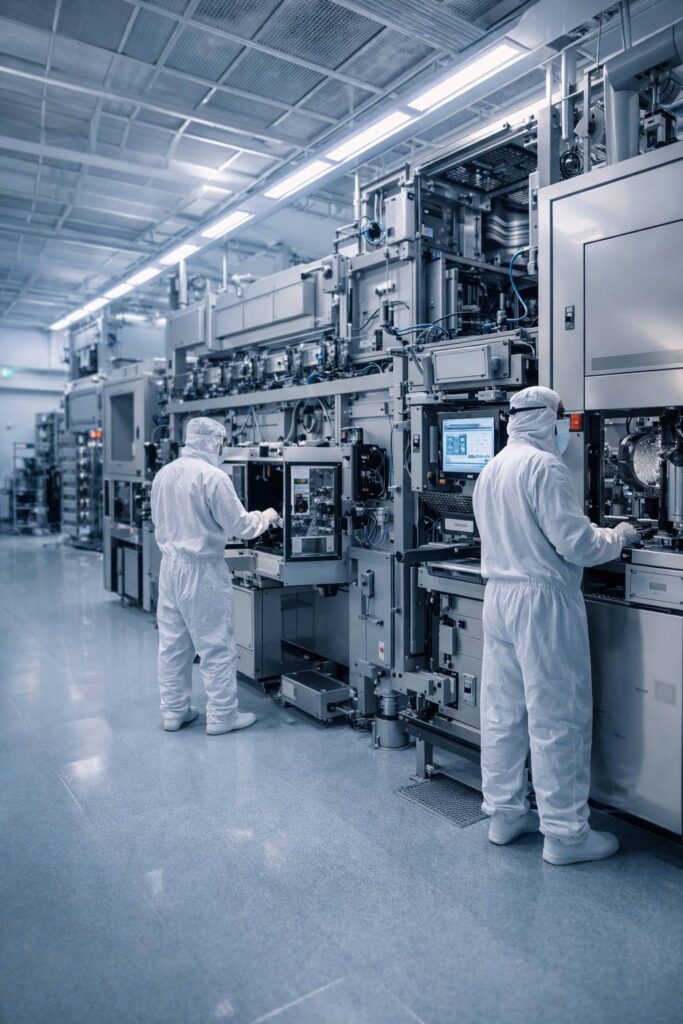

ASML Holding NV has given investors one of the strongest signals yet that demand for advanced artificial intelligence chips remains resilient. The Dutch semiconductor equipment company reported record net bookings of €13.2 billion for the final quarter of 2025, suggesting that major chip manufacturers are still committing billions of euros to expand production despite broader uncertainty in the technology sector.
The figures matter well beyond ASML itself. The company is the world’s only supplier of extreme ultraviolet (EUV) lithography systems, machines required to manufacture the most advanced processors used in AI data centres, high-end smartphones and next-generation computing. When customers increase orders for ASML equipment, it often reflects confidence in long-term semiconductor demand rather than short-term market sentiment.
The latest results also reinforce the broader investment trend surrounding artificial intelligence infrastructure. Companies building AI chips continue to expand manufacturing capacity, while cloud providers are investing heavily in computing power to support increasingly complex AI models. That spending flows directly through the semiconductor supply chain.
Investors following the wider chip sector may also find context in developments across the semiconductor industry, where demand for AI hardware continues to influence long-term investment decisions.
Why ASML’s order book attracts global attention
Unlike many technology suppliers, ASML occupies a unique position in the semiconductor industry. Its EUV lithography systems are essential for producing leading-edge chips, and there is currently no direct commercial alternative capable of matching their performance. These machines cost hundreds of millions of euros, require years of planning and are typically ordered well before new chip factories become operational.
That makes quarterly bookings an important indicator of future industry investment. A sharp increase usually means manufacturers are preparing for production several years ahead rather than reacting to immediate demand.
Highlights from ASML’s latest results
- Q4 2025 net bookings: €13.2 billion
- EUV system bookings: €7.4 billion
- Full-year 2025 net sales: €32.7 billion
- Full-year 2025 net income: €9.6 billion
- 2026 expected net sales: €34 billion to €39 billion
Management expects revenue to continue growing during 2026, forecasting annual net sales between €34 billion and €39 billion. That outlook suggests demand for advanced chip manufacturing equipment remains healthy despite ongoing concerns about the pace of global economic growth.
Much of that optimism is linked to artificial intelligence. Technology companies continue expanding AI infrastructure, while semiconductor manufacturers are investing in the production capacity needed to meet expected demand over the coming years. Because advanced fabrication plants take years to build and equip, many investment decisions are made well before chips reach customers.
At the same time, ASML announced plans to reduce approximately 1,700 positions. The company described the move as part of an organisational restructuring designed to improve efficiency and focus resources on manufacturing, engineering and customer support. While layoffs and record orders may appear contradictory, technology companies often adjust support functions while continuing to expand production capabilities.
Another factor investors continue to monitor is international trade policy. Export restrictions affecting advanced semiconductor technology remain an important consideration for ASML, particularly as governments seek tighter controls over cutting-edge chip manufacturing equipment. Even with those geopolitical challenges, recent bookings indicate that customers across multiple regions continue making substantial long-term investments.
What the results could mean for the semiconductor industry
Record bookings do not guarantee uninterrupted growth, but they provide one of the clearest indicators available that semiconductor manufacturers still expect robust demand for advanced chips. Because ASML equipment sits at the beginning of the manufacturing process, its order pipeline often provides an early view of industry spending before additional production capacity comes online.
For investors, technology companies and businesses tracking artificial intelligence infrastructure, the latest results reinforce a broader trend: leading chipmakers continue committing significant capital to future production, signalling confidence that AI-driven computing demand will extend well beyond the current market cycle.
ASML’s complete financial statements and forward guidance are available in the company’s official Q4 2025 financial results and 2026 outlook.

Make Swikblog your go-to source on Google for reliable updates, smart insights, and daily trends.