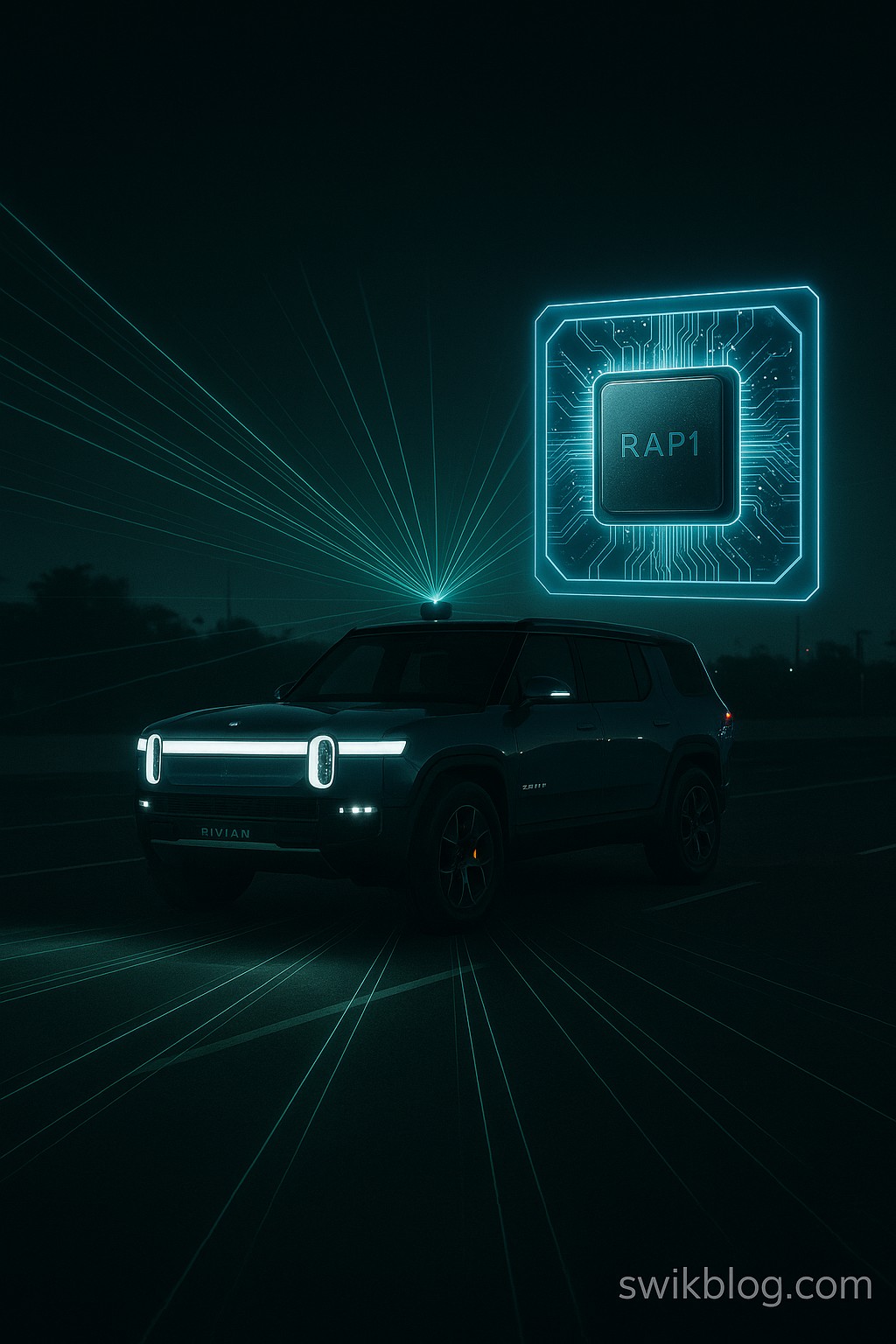
Rivian’s push to control more of the technology behind its electric vehicles has moved well beyond a chip announcement. In 2026, the EV maker is rolling out its Autonomy+ driver-assistance platform, expanding hands-free driving across millions of miles of roads and preparing its custom Rivian Autonomy Processor 1 (RAP1) for a new generation of R2 vehicles.
The strategy is significant because Rivian is moving toward an increasingly vertically integrated autonomy system rather than relying indefinitely on off-the-shelf computing hardware. But there is an important distinction: the transition is still underway. Rivian’s newest RAP1-based Gen 3 autonomy hardware is expected to reach R2 vehicles beginning toward the end of 2026.
RAP1 Is Rivian’s Big Custom-Silicon Bet
RAP1 is a custom 5-nanometer autonomy processor designed specifically for Rivian’s vehicle AI workloads. The processor integrates computing and memory into a multi-chip architecture and powers the company’s third-generation Autonomy Compute Module 3 (ACM3).
Rivian says ACM3 can deliver up to 1,600 sparse INT8 TOPS and process about 5 billion pixels per second. RAP1 also incorporates RivLink, Rivian’s low-latency interconnect technology that allows processors to be linked to increase available computing power.
That matters because Rivian wants tighter control over the hardware and software used to run increasingly sophisticated AI driving models. Custom silicon can also give the company more freedom to optimize future vehicles around its own autonomy roadmap rather than designing around another chip supplier’s platform.
Rivian Is Adding LiDAR — But Not to Every R2 Immediately
One of the biggest clarifications since Rivian first unveiled its autonomy roadmap concerns LiDAR. Rivian plans to combine its Gen 3 autonomy computer with LiDAR on future R2 models, adding detailed three-dimensional sensing to its camera-and-radar strategy.
However, buyers should not assume every R2 immediately receives RAP1 and LiDAR. Rivian has said the Gen 3 autonomy hardware is undergoing validation and is expected to begin shipping on R2 vehicles at the end of 2026.
The approach puts Rivian on a different sensor path from Tesla, which has emphasized a vision-based strategy. Rivian sees LiDAR as another source of information and redundancy for difficult real-world driving situations.
Universal Hands-Free Is Now a Major Part of Autonomy+
The more immediate change for customers is Universal Hands-Free. Rivian says the technology enables hands-free, eyes-on assisted driving on more than 3.5 million miles of roads across the United States and Canada, dramatically expanding its usable footprint beyond selected divided highways.
Universal Hands-Free can operate where appropriate road markings are available, but it is still a driver-assistance system. Drivers must remain attentive and ready to take control. Rivian specifically warns that the system does not currently stop or slow the vehicle for traffic lights or stop signs.
Autonomy+ also includes features such as Lane Change on Command, Co-steer and selectable Drive Styles. Rivian lists Auto Parking and On-Ramp to Off-Ramp driving among additional capabilities coming during 2026.
Autonomy+ Costs $49.99 a Month
Rivian has retained the pricing originally announced for Autonomy+ in the United States: $49.99 per month or $2,500 as a one-time purchase. New eligible R1 and R2 deliveries include a 60-day Autonomy+ trial.
The one-time upgrade remains with the vehicle if ownership changes, although available capabilities depend on the hardware installed in that particular vehicle.
Point-to-Point Driving Is the Next Major Step
Rivian’s roadmap goes beyond today’s hands-free lane assistance. The company says a limited rollout of Point-to-Point assisted driving is planned for R2 and second-generation R1 vehicles later in 2026, followed by wider availability in 2027.
The goal is to allow a vehicle to follow a route while the driver continues supervising the system, taking Rivian beyond the largely lane-focused assistance available today.
Rivian’s longer-term ambitions extend further to eyes-off driving and ultimately personal Level 4 autonomy. Those capabilities remain future goals rather than features customers can use today.
Why Rivian’s AI Strategy Matters
The latest developments make Rivian’s original decision to develop its own autonomy silicon more consequential. RAP1 is no longer an isolated hardware project: it sits alongside Rivian’s driving AI models, sensor strategy, Autonomy+ software and R2 platform.
For customers, however, the most important distinction is between what is available now and what remains on the roadmap. Universal Hands-Free and Autonomy+ are already part of Rivian’s 2026 offering, while RAP1, LiDAR-equipped Gen 3 hardware and more advanced Point-to-Point capabilities are arriving in stages.
If Rivian can execute that roadmap, the company could gain substantially more control over the cost, performance and development pace of one of the most important technologies in its future vehicles.
You May Also Like

Make Swikblog your go-to source on Google for reliable updates, smart insights, and daily trends.