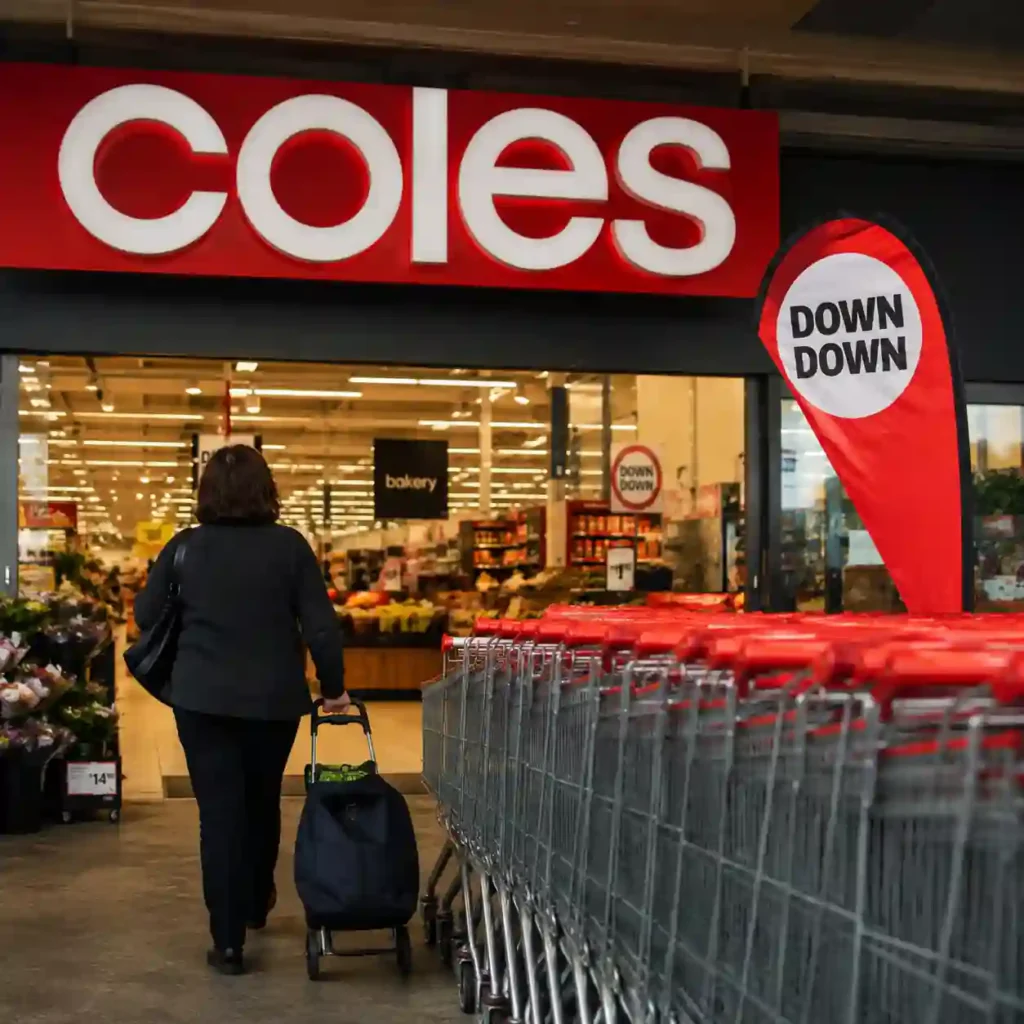

Coles has been dealt a major legal blow after the Federal Court found that its well-known “Down Down” campaign gave shoppers a misleading impression about supermarket savings. The ruling could expose the grocery giant to substantial penalties and may force Australia’s largest retailers to rethink how they advertise discounts on everyday products.
The decision was handed down by Justice Michael O’Bryan in a case brought by the Australian Competition and Consumer Commission. The regulator accused Coles of using short-term price increases to create the appearance of bigger discounts, even though many products were later sold at prices that remained above their earlier shelf prices.
For customers walking through the supermarket aisle, the issue was not just whether a price had technically fallen from a recent high. The court looked at the broader message created by the “Down Down” labels. A shopper seeing a “was” price and a lower promotional price would naturally expect a genuine saving, not a temporary price rise followed by a smaller reduction.
That distinction became central to the judgment. Justice O’Bryan found that 13 of the 14 sample “Down Down” tickets examined in the trial were misleading because the relevant products had not been sold at the higher “was” price for a reasonable period before the discount was advertised. The court said the promoted reductions were therefore not genuine in the way ordinary consumers would understand them.
Why Coles’ discount labels became a legal problem
The ACCC’s case focused on pricing practices used between 2021 and 2023, when grocery inflation was already putting pressure on household budgets. The watchdog alleged that Coles raised prices on hundreds of items for a short period and then promoted a lower price as a discount under its “Down Down” campaign.
Several products named during the case were familiar household staples, including Coca-Cola, Colgate toothpaste, Rexona deodorant, Karicare baby formula, Lurpak butter, Arnott’s Shapes and Nature’s Gift dog food. These were not obscure luxury items. They were the kinds of products families buy regularly, which made the court’s findings especially significant during a cost-of-living squeeze.
One example showed how the strategy could affect perception. A Coles-brand quince paste was lifted from $3 to $4.50 for four weeks, then reduced to $3.15 and promoted as a “Down Down” offer. Although the price had fallen from $4.50, it was still higher than the earlier $3 price shoppers had previously paid.
Another example involved Arnott’s Shapes, which had been sold at $5 before rising as high as $6.50 and later being promoted at $5.50. The court’s concern was not simply that prices had moved. It was that the presentation of the lower price risked telling consumers they were receiving a better bargain than they actually were.
Coles argued that the original price increases were driven by supplier costs and inflation. Justice O’Bryan accepted that the increases were commercially justifiable. But that did not save the discount claims. The legal problem was the way the later lower prices were marketed to shoppers.
The judgment also highlighted Coles’ own internal standard. Until March 2022, the supermarket had a policy that a product should not enter the “Down Down” campaign unless it had been sold at the previous higher price for at least 12 weeks. The court found that Coles later relaxed this policy under pressure from competition with Woolworths.
Justice O’Bryan said a 12-week period at the higher price would have avoided the misleading impression. In many cases, however, the higher price had been in place for only a much shorter time before Coles advertised the product as discounted.
The judge also made an important point about how real shoppers behave. Most customers do not stand in a supermarket aisle calculating how long a product has been at a particular price. They rely on the overall impression created by the label. If the ticket says the price is “down,” the ordinary customer expects the saving to be real rather than artificial.
What happens next for Coles and Woolworths
Coles now faces a separate penalty phase, where the court will decide how much the company should pay for the breaches. Legal experts have warned that the final amount could be extremely large because penalties may attach to each contravention. The court is expected to consider the scale of the conduct, Coles’ level of responsibility, how long the promotions ran and what steps the company took to reduce consumer harm.
The ACCC has made clear it will seek substantial penalties. Its chair, Gina Cass-Gottlieb, said the case was brought in the public interest because the regulator believed Coles’ pricing practices made it harder for customers to identify genuine value while buying essential supermarket items.
Read More
Coles said it is reviewing the judgment. The company also pointed to the court’s finding that the price increases themselves were linked to supplier cost increases. But the ruling leaves the retailer with a serious reputational challenge: one of its most recognisable marketing campaigns has now been found to have misled customers on an industrial scale.
The decision also places fresh attention on Woolworths, which is awaiting judgment in a similar ACCC case over its “Prices Dropped” campaign. That case involves comparable allegations that prices were raised briefly before products were promoted as discounted. Swikblog has covered the wider supermarket pricing battle in Woolworths vs ACCC: 12 Grocery Items at Center of Price Discount Case and the broader political pressure on grocery chains in Australia’s Supermarket Price Gouging Ban and Retail Pricing Pressure.
Investors also reacted to the ruling, with Coles shares slipping more than 2% after the decision. The market response reflects concern not only about potential penalties, but also the risk of further legal action. Coles is already facing a separate class action linked to the same discounting practices.
For Australian shoppers, the ruling is likely to strengthen expectations around clearer supermarket pricing. Discount tags are powerful because they influence quick buying decisions. When those tags compare a current price with a previous price, the comparison must reflect a meaningful saving rather than a short-lived pricing spike.
The case may become a turning point for retail promotions in Australia. It shows that courts are willing to look at the practical effect of price labels, not just the narrow technical accuracy of the numbers printed on them. For supermarkets, the message is direct: a discount must be more than a marketing slogan. It must represent real value for customers.

Make Swikblog your go-to source on Google for reliable updates, smart insights, and daily trends.