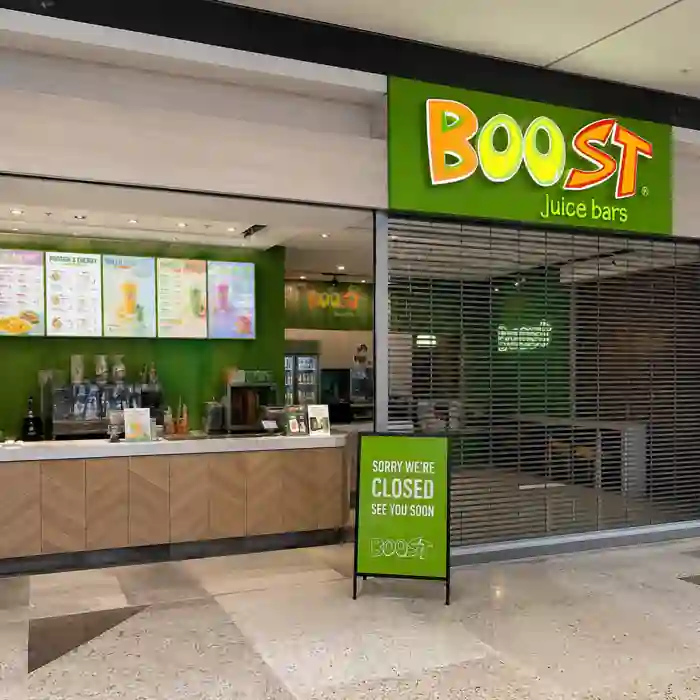

Four Boost Juice outlets across the Gold Coast have closed after the company operating the stores was placed into liquidation, turning a local franchise failure into a wider warning about the pressure building inside Australia’s food retail sector.
The affected stores were located at Robina, Australia Fair, Paradise Centre and Surfers Paradise, placing the closures across a mix of shopping centre, tourist and high-street retail locations. These were not quiet suburban sites. They sat in areas where daily foot traffic, tourism and repeat local customers usually play a major role in keeping food and beverage outlets alive.
The company behind the stores, Abadell Pty Ltd, was wound up by the Federal Court on May 1, 2026. An official ASIC insolvency notice confirms Helen Newman was appointed liquidator by court order and lists the trading name as Boost Juice at Robina, Australia Fair, Paradise Centre and Surfers Paradise 2.
The court action followed a winding-up application linked to the Deputy Commissioner of Taxation, with the company also ordered to pay legal costs. For customers, the change became visible when the four outlets were marked as temporarily closed online. For creditors, landlords and staff, the issue is now in the hands of the liquidator.
The liquidation does not mean Boost Juice has collapsed as a national brand. It means the franchise operator responsible for these four Gold Coast stores has failed. That distinction is important because major franchise brands can remain open across the country while individual operators struggle with rent, wages, supplier bills, tax debts and slowing consumer demand.
Boost Juice remains one of Australia’s most recognisable food and beverage names. Founder Janine Allis launched the business in Adelaide in 2000 after identifying demand for a healthier, faster alternative to traditional takeaway food. The brand later grew into a global chain with more than 580 stores across 13 countries, according to Boost Juice’s own company profile.
That scale gives Boost Juice strong public recognition, but franchise success still depends on the numbers working at store level. A busy logo above the door does not automatically protect an operator from cash-flow stress. Franchisees often face fixed rents, rostered wages, product costs, franchise obligations and tax liabilities even when daily sales soften.
The Gold Coast closures are particularly notable because of where the stores were based. Surfers Paradise and Paradise Centre rely heavily on visitors, entertainment traffic and seasonal spending. Robina and Australia Fair serve large local shopping catchments. If stores in these kinds of locations cannot continue under one operator, it points to how tight the economics can become in food retail.
There is also a property twist around the company’s directors, Karen and Steven Ackland. The couple have been linked to a luxury waterfront home on Clear Island Road in Broadbeach Waters, which is expected to go to auction on May 29. Property records cited in local reports show the home was bought for $1.43 million in 2004.
The mansion has attracted public attention because of its connection to the Gold Coast Suns. Several AFL players reportedly rented the home, including Mac Andrew, who described the property as a place where teammates gathered for barbecues, drinks and recovery sessions by the pool overlooking the canal.
The same Broadbeach Waters property was previously listed last year with expectations above $5 million, but the campaign did not secure a buyer after 118 days on the market. Its return to auction now adds another layer to a story that already combines franchise closures, tax pressure, court action and high-end real estate.
For employees of the affected stores, the main questions will be around unpaid wages, entitlements and whether another operator could eventually take over any of the sites. For landlords, the focus will be on recovering rent and finding new tenants if the stores do not reopen. For customers, the immediate impact is the loss of four familiar Boost Juice locations across the Gold Coast.
Read More
The case also fits a broader pattern across Australian franchise and retail businesses. Swikblog recently covered how franchise pressure has affected Priceline pharmacy operators, showing that even well-known retail brands can face disruption when individual franchisees come under financial strain.
Food and beverage operators are exposed to several pressure points at once. Ingredients have become more expensive, staffing costs have risen, energy bills remain high and consumers are more selective with small discretionary purchases. A smoothie or juice may be an everyday item for some shoppers, but during a cost-of-living squeeze, even small purchases can be cut back.
Tax debt can become one of the clearest signs that a business is under stress. When a company falls behind on obligations to the Australian Taxation Office, the problem can quickly move from a private cash-flow issue to formal court action. Once a winding-up order is made, control of the company shifts away from directors and into the liquidation process.
The next steps will depend on what the liquidator finds. That includes reviewing the company’s debts, assets, creditor claims and transactions before liquidation. It is not yet clear whether any of the four Boost Juice stores could reopen under different ownership or whether the sites will be permanently replaced by other retailers.
For Boost Juice, the wider brand story remains separate from Abadell Pty Ltd’s collapse. The company still has a strong footprint in Australia and overseas. But the Gold Coast closures show that the strength of a national brand does not remove the financial risk carried by local operators.
The collapse of Abadell Pty Ltd is therefore more than a simple store closure story. It is a snapshot of the pressure facing Australian franchisees in 2026: strong brands, expensive locations, tighter household budgets and creditors becoming less patient when debts build up.
For now, four prominent Gold Coast Boost Juice stores remain closed, a liquidator is in control of the failed operator, and the future of those retail sites is uncertain.

Make Swikblog your go-to source on Google for reliable updates, smart insights, and daily trends.