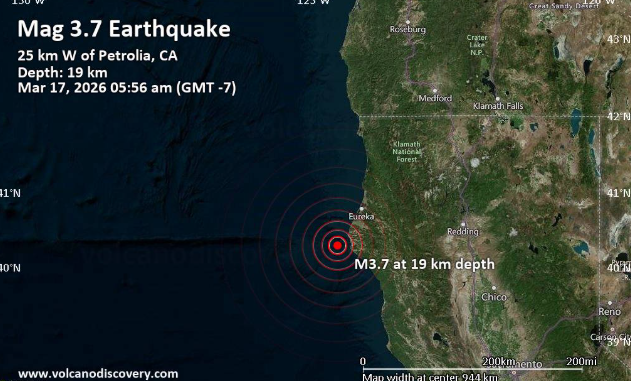

California’s seismic activity is back in the spotlight after a noticeable cluster of earthquakes struck Humboldt County and surrounding regions over the past week. The biggest of these tremors — a 3.7 magnitude earthquake near Eureka — has raised fresh attention as six earthquakes of magnitude 2.5 or higher were recorded in just seven days, signaling a short-term spike in activity across Northern California.
The strongest quake occurred early morning on March 17, 2026, at 5:56 AM local time, approximately 41 miles southwest of Eureka in Humboldt County. According to the U.S. Geological Survey (USGS), the earthquake struck at a depth of around 12 miles (19.33 km), with coordinates measured at 40.31°N latitude and 124.58°W longitude.
The event was consistently recorded as magnitude 3.7 by multiple global seismic agencies, including IRIS and the European-Mediterranean Seismological Centre (EMSC), confirming its accuracy. Although relatively small, the quake was widely discussed due to its timing within a series of nearby tremors.
Where the earthquake was felt
The quake produced very weak shaking across several nearby towns. Residents in Ferndale (25 miles away), Rio Dell (28 miles), Fortuna (30 miles), Hydesville (31 miles), Humboldt Hill (36 miles), and Eureka (41 miles) may have felt light vibrations. However, in slightly farther locations such as Bayside, Arcata, and McKinleyville, the shaking was likely too weak to notice.
No structural damage or injuries were reported, which aligns with typical earthquakes in the 2.5–4.0 magnitude range, where tremors are often felt but rarely destructive.
6 earthquakes in 7 days: A closer look
The 3.7 magnitude quake was not an isolated event. Data shows that six earthquakes above magnitude 2.5 occurred in the Humboldt region within one week. The most notable recent quakes include:
- 3.7 magnitude — near Petrolia (March 17)
- 3.3 magnitude — near Hydesville (March 20, 10:35 PM, depth ~18 miles)
- 3.1 magnitude — west of Petrolia (March 14)
- 2.8 magnitude — west of Petrolia (March 15)
- 2.7 magnitude — west of Petrolia (March 17)
- 3.3 magnitude — west-southwest of Rio Dell (March 15)
This clustering suggests a short-term rise in seismic activity in the region, though experts note this is not unusual for Northern California.
Why Humboldt County is so active
Humboldt County sits near the Mendocino Triple Junction, one of the most geologically complex areas in North America. This is where the Pacific Plate, North American Plate, and Gorda Plate meet, creating constant tectonic stress.
This unique positioning makes the region one of the most earthquake-prone zones in the United States. Frequent low-magnitude quakes occur as pressure is gradually released along fault lines beneath the surface. While most of these tremors are harmless, they play a key role in shaping the region’s seismic behavior.
Southern California also sees minor tremors
While Northern California experienced the most noticeable activity, Southern California was not completely quiet. Malibu recorded a 2.4 magnitude earthquake near Catalina Island, along with additional minor tremors ranging between 2.4 and 2.6 magnitude.
These smaller earthquakes are extremely common and often go unnoticed. In fact, according to seismic data, Southern California experiences around 10,000 earthquakes annually, the vast majority of which are too weak to be felt.
What experts say about small earthquake clusters
One of the biggest concerns among residents is whether a cluster of small quakes signals a larger earthquake ahead. The reality, according to seismologists, is that small earthquakes do not reliably predict major ones.
While clusters can sometimes precede larger events, most often they simply represent normal tectonic adjustments. According to USGS earthquake monitoring data, California experiences hundreds of detectable earthquakes each week, with only a tiny fraction leading to significant events.
Globally, scientists estimate that around 500,000 earthquakes occur each year, with about 100,000 being felt and only around 100 causing damage.
What to do during an earthquake
Even though the recent quakes were minor, experts stress the importance of preparedness. If an earthquake strikes:
- Indoors: Stay inside, drop to the ground, take cover under sturdy furniture, and hold on
- In bed: Turn face down and protect your head with a pillow
- Outdoors: Move away from buildings, trees, and power lines
- Driving: Pull over safely and stop the vehicle
The most recommended safety technique remains: Drop, Cover, and Hold On.
Outlook: Normal activity or early signal
For now, the recent sequence of earthquakes in Humboldt County appears to be part of normal seismic patterns for the region rather than a clear warning of a major event. However, the concentration of six quakes in a single week highlights how active the area remains.
As seismic monitoring continues, residents across California — especially in high-risk zones like Humboldt, San Francisco, and Los Angeles — are reminded that earthquakes are not a matter of “if,” but “when.” Even small tremors like the recent 3.7 magnitude quake near Eureka serve as a timely wake-up call to stay alert and prepared.

Make Swikblog your go-to source on Google for reliable updates, smart insights, and daily trends.