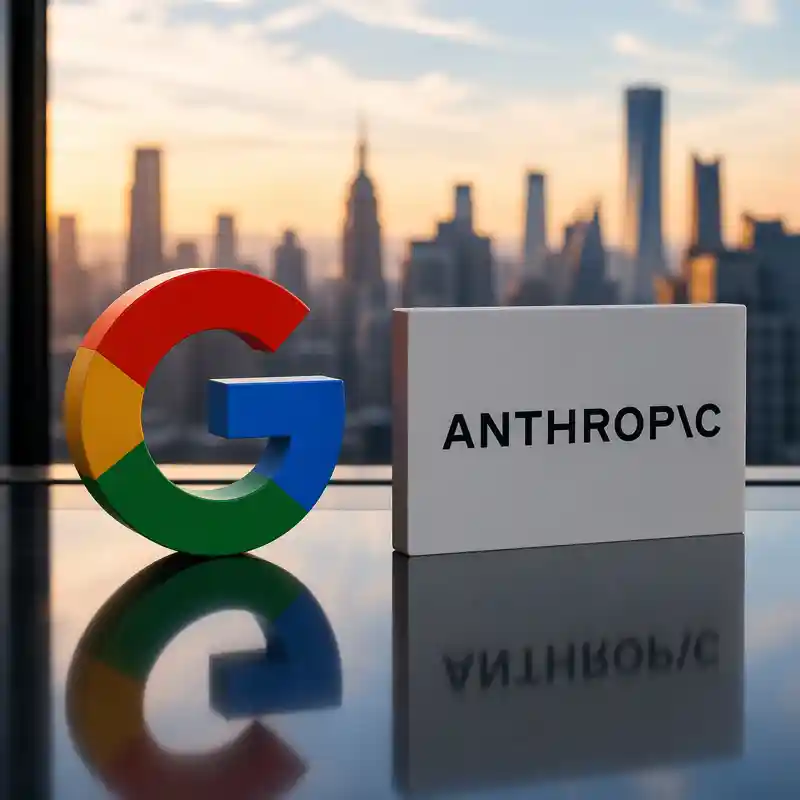

Google’s plan to invest up to $40 billion in Anthropic marks one of the clearest signs yet that the artificial intelligence race is moving from model launches to infrastructure dominance. The proposed investment, tied to a reported $350 billion valuation, would deepen Google’s relationship with the maker of Claude at a time when AI companies are competing not only on product quality, but also on access to chips, cloud capacity and energy.
Under the proposed structure, Google would put $10 billion into Anthropic upfront, with another $30 billion available if the startup reaches agreed performance milestones. That staged approach gives Google a larger strategic position in one of the most important AI labs while limiting some risk in a market where valuations have climbed rapidly.
For Anthropic, the funding would arrive at a critical moment. Demand for Claude has grown across businesses, developers and enterprise customers, helped by the rise of Claude Code, an AI coding assistant that has become one of the company’s most important products. The tool has gained attention because it can help engineers write, review and improve software faster, making it a valuable product in a sector where companies are searching for measurable returns from generative AI.
The deal also shows how closely AI investment is now tied to computing infrastructure. Anthropic is already a major user of Google Cloud and Google’s tensor processing units, known as TPUs. These custom AI chips have become an important alternative to Nvidia’s GPUs, which remain in high demand across the industry. Google’s ability to offer cloud capacity and specialized chips gives it a powerful role in the AI supply chain.
A key part of the expanded relationship is expected to include large-scale computing support from Google Cloud over several years. The reported agreement includes 5 gigawatts of computing capacity over five years, with the possibility of additional capacity later. That scale highlights how energy-intensive frontier AI development has become, as leading labs require huge data centers to train and operate advanced models.
Why the Google-Anthropic Deal Matters
The investment is important because Anthropic sits at the center of several major AI trends. Its Claude models compete with OpenAI’s ChatGPT and Google’s Gemini, while its enterprise tools are increasingly being used for coding, automation, research and workplace productivity. That makes Anthropic both a rival and a valuable partner for Google.
This dual role is becoming common in the AI industry. Large cloud companies are backing AI startups that later spend heavily on their infrastructure. Microsoft has built its AI strategy around OpenAI, Amazon has invested billions in Anthropic, and Google is now strengthening its own position with the same startup. These deals show that cloud platforms are becoming just as important as model performance in determining who leads the AI market.
Google’s motivation is also tied to the future of its own business. The company remains highly profitable through search advertising, but AI is changing how people access information, write code and complete work tasks. As AI tools become more integrated into business software, Google needs to ensure it has strong exposure to both its own Gemini ecosystem and outside AI platforms that are gaining adoption.
Anthropic’s growth in AI coding is especially important. Coding assistants have become one of the clearest commercial uses of generative AI because they can save time for developers and help companies ship software more quickly. If Claude Code continues to grow, Anthropic could become one of the most influential companies in developer productivity, a market that Google cannot afford to ignore.
Amazon’s recent commitment to Anthropic adds another layer to the story. The startup has already attracted major support from Amazon, including a fresh multi-billion-dollar investment and the option for more funding over time. That means Anthropic is now backed by two of the world’s most powerful cloud companies, a rare position that gives it access to capital, infrastructure and enterprise distribution.
At the same time, this creates competitive tension. Google and Amazon both want to benefit from Anthropic’s growth, while also competing in cloud services and AI products. Anthropic, meanwhile, must manage partnerships with multiple giants without becoming too dependent on any single one.
Opportunity, Risk and What Comes Next
The potential $350 billion valuation shows how strongly investors believe in the future of AI, but it also raises questions. Anthropic has grown quickly, yet the cost of building and running frontier models remains extremely high. The company needs enormous spending on chips, data centers and engineering talent before it can prove whether its business can support such a valuation over the long term.
Another concern is the rise of so-called circular AI deals. In these arrangements, a cloud provider invests in an AI startup, and that startup then uses the capital to buy cloud services or chips from the same provider. Supporters argue this is a practical way to finance the infrastructure required for advanced AI. Critics say it can make revenue growth harder to interpret because investment money may flow back into the investor’s own cloud business.
Anthropic is also operating under growing scrutiny from governments and regulators. As AI systems become more capable, policymakers are paying closer attention to safety, national security, military use and supply-chain risks. Any company reaching this level of valuation will face tougher questions about oversight, transparency and how its technology is deployed.
The company is also said to be considering a future public listing, which would bring even more attention to its financial performance. An initial public offering would force Anthropic to explain its revenue, spending, customer concentration and infrastructure commitments in much greater detail. For investors, that could become a major test of whether today’s AI valuations are supported by sustainable business fundamentals.
For Google, the investment offers several strategic advantages. It strengthens Google Cloud’s position in AI infrastructure, increases demand for TPUs, gives the company financial exposure to Anthropic’s growth and helps protect Google from falling behind in developer-focused AI tools. Even though Anthropic competes with Gemini, Google may benefit if Claude continues to gain enterprise users who rely on Google’s cloud systems behind the scenes.
Readers can explore Anthropic’s official work on Claude through Anthropic, while Google’s cloud-based AI services are detailed at Google Cloud AI.
The larger message is clear: the next stage of the AI boom will be decided by more than clever chatbots. It will depend on who can fund the data centers, secure the chips, provide the cloud capacity and deliver tools that businesses use every day. Google’s planned investment in Anthropic shows that the AI race is becoming a contest of capital, infrastructure and long-term strategic positioning.
You may like: Nvidia (NVDA) Stock Rises But Lags AMD and Micron in AI Rally

Make Swikblog your go-to source on Google for reliable updates, smart insights, and daily trends.