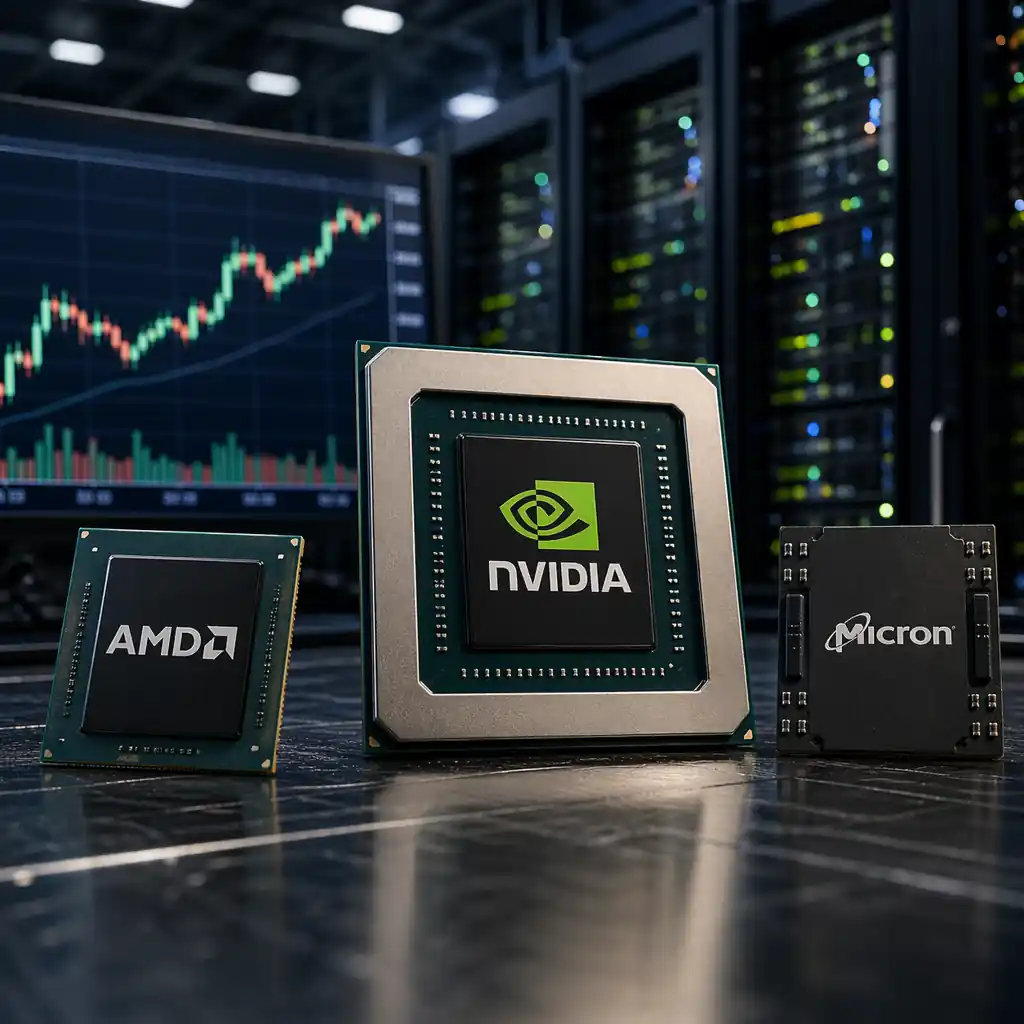

NVIDIA (NVDA) climbed 4.5% in Friday trading, moving back toward the $200 mark, but the stock’s rebound has not changed the bigger debate on Wall Street: why is the most important name in artificial intelligence hardware still trailing other chip stocks in 2026?
The answer is not that investors have suddenly lost faith in NVIDIA. The company remains the dominant supplier of AI accelerators, and its chips continue to sit at the center of hyperscaler data center spending. But the market has started treating the AI boom as a broader semiconductor cycle rather than a single-stock story. That shift is helping rivals and suppliers such as Advanced Micro Devices (AMD), Micron Technology (MU), Marvell Technology (MRVL), Taiwan Semiconductor Manufacturing (TSM), and Broadcom (AVGO) attract fresh money.
NVIDIA shares have gained only about 7% year-to-date, according to the figures cited in recent market data, while several peers have moved much faster. Marvell (MRVL) has jumped around 95%, Micron (MU) has risen roughly 69%, AMD (AMD) has advanced about 43%, Taiwan Semiconductor (TSM) is up nearly 26%, and Broadcom (AVGO) has gained around 22%.
That performance gap is striking because NVIDIA is still delivering huge growth. The company reported fourth-quarter fiscal 2026 revenue of $68.13 billion, up 73% from a year earlier. In most industries, that kind of growth would send a stock sharply higher. For NVIDIA, however, expectations are already extremely high, which means even strong results can be met with a muted market reaction.
Why NVIDIA’s rally looks slower than AMD and Micron
The first issue is size. NVIDIA’s market value is near $4.9 trillion, making it one of the largest companies in the world. When a company is already that big, every additional percentage point requires a massive amount of new investor capital. A move from roughly $200 to $300 would require about a 50% rally, adding trillions of dollars in market value.
That is a very different setup from AMD, Micron, or Marvell. These companies are large, but they are not carrying the same valuation weight as NVIDIA. As investors look for the next phase of the AI trade, smaller or less crowded semiconductor names can move faster because expectations are lower and the valuation base is smaller.
AMD (AMD) is benefiting from investor interest in AI alternatives, server CPUs, and accelerator competition. The company is increasingly seen as a way to gain exposure to AI infrastructure without paying NVIDIA’s premium valuation. Even if AMD remains behind NVIDIA in AI GPUs, the stock can still outperform if investors believe its opportunity is expanding.
Micron (MU) is riding a different part of the same trend. AI servers require large amounts of advanced memory, especially high-bandwidth memory used alongside powerful processors. That has made memory suppliers more attractive as investors search for companies that can benefit from AI spending without depending entirely on GPU sales.
Marvell (MRVL) and Broadcom (AVGO) are also part of this widening trade. Both companies are tied to custom silicon, networking, and data center infrastructure. As large cloud providers invest in their own AI chips and specialized networking systems, Wall Street is rewarding companies that support the wider AI supply chain.
Taiwan Semiconductor Manufacturing (TSM) adds another layer to the story. TSMC manufactures advanced chips for many leading semiconductor companies, which gives investors exposure to AI demand across multiple customers. Whether the end buyer is NVIDIA, AMD, Broadcom, or another chip designer, advanced manufacturing capacity remains essential.
China restrictions remain a real concern for NVDA
NVIDIA also faces a geopolitical overhang that many peers do not carry in the same way. U.S. export restrictions have limited the company’s ability to sell certain advanced AI chips into China. NVIDIA has already taken a $4.5 billion inventory-related charge tied to its H20 chips, and the company’s guidance excludes China data center compute revenue.
That matters because China had been an important market for AI data center hardware. Even if U.S. cloud providers continue spending heavily, investors must consider whether lost China demand can be fully replaced by hyperscalers, sovereign AI projects, enterprise adoption, and other international markets.
For official company updates, investors can review NVIDIA’s financial releases and quarterly reports through its investor relations page.
Another reason NVIDIA has not surged toward $300 is that the market already understands the bull case. Investors know NVIDIA dominates AI GPUs. They know data center demand remains powerful. They know Blackwell and future Rubin architecture could extend the company’s lead. The problem is that much of that optimism is already reflected in the stock price.
That is why NVIDIA can report huge revenue growth and still see limited upside. When a stock becomes the center of a global investment theme, the bar rises. Good numbers are no longer enough. Investors want upside surprises, stronger-than-expected margins, faster product ramps, and clearer evidence that growth can remain elevated for longer.
Insider selling has also added to investor caution. Recent sales by senior figures, including CFO Colette Kress, EVP Ajay Puri, and director Mark Stevens, took place in March at prices between roughly $172 and $185. Insider selling does not automatically mean a stock is overvalued, but it can make traders less confident about a near-term push to aggressive price targets.
For NVIDIA to regain stronger momentum, several things likely need to happen at the same time. Blackwell Ultra demand must come in stronger than expected, Rubin commentary needs to support confidence in the next product cycle, gross margins should remain near premium levels, and management must show that lost China-related revenue can be offset elsewhere.
The stock also needs analysts to become more comfortable with targets above $300. Current market expectations appear more cautious, with many forecasts pointing to upside from current levels but not necessarily a rapid move to $300. That makes NVIDIA’s near-term setup more about execution than hype.
The broader lesson for investors is that AI leadership in technology does not always translate into the fastest stock performance. NVIDIA remains the benchmark company in AI chips, but the market is now rewarding the suppliers, challengers, and infrastructure names around it. AMD offers a catch-up story, Micron offers memory exposure, Marvell and Broadcom offer custom silicon and networking upside, and TSMC offers manufacturing leverage.
NVIDIA’s 4.5% move shows buyers are still present. But compared with the stronger gains in AMD, Micron, and Marvell, NVDA is trading more like a mature mega-cap leader than an early-stage AI breakout. The company is still central to the AI boom, but the stock now needs more than strong headlines to deliver another major leg higher.
Feature image prompt: A premium financial news image showing NVIDIA (NVDA), AMD (AMD), and Micron (MU) stock tickers on a glowing market screen, NVIDIA rising modestly while AMD and Micron show stronger green momentum arrows, AI chips and data center servers in the background, Wall Street trading desk style, realistic lighting, high-detail, 1:1 ratio.
You may like: Intel Stock Surges 22% As AI Earnings Fuel 2026 Rally

Make Swikblog your go-to source on Google for reliable updates, smart insights, and daily trends.