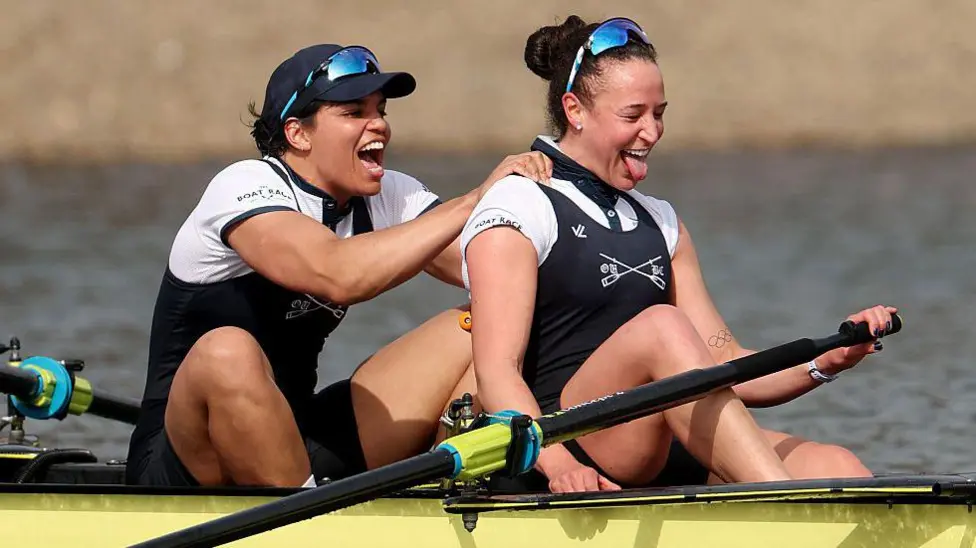

Cambridge powered to a fourth consecutive men’s Boat Race victory while Oxford’s women ended an eight-race losing streak with a landmark win on Saturday, as the 2026 Oxford-Cambridge Boat Race delivered a dramatic split in fortunes on the River Thames.
The races, held on 4 April 2026 along the 4.3-mile Championship Course from Putney to Chiswick in London, saw Cambridge’s men dominate late to win by 11.02 seconds, while Oxford’s women produced a commanding performance to secure their first victory since 2016 by 9.4 seconds.
The contrasting results have quickly pushed the event into trending territory, with surging searches around race timings, results, and Channel 4’s new broadcast coverage highlighting renewed national interest in one of Britain’s oldest sporting traditions.
Cambridge men deliver again as race turns decisive late
The 171st men’s Boat Race unfolded much as pre-race expectations suggested, but not without tension. Oxford stayed competitive through the opening half despite rough and blustery conditions on the Thames, keeping Cambridge within reach as both crews navigated tight lines past Fulham and Hammersmith.
Cambridge initially took an early advantage after the start, but Oxford responded with disciplined rowing, maintaining a straight racing line and preventing the Light Blues from pulling away. As the crews passed Hammersmith Bridge, the gap remained marginal, keeping the contest open.
However, the defining moment came in the latter stages. Approaching Chiswick Eyot and Barnes Bridge, Cambridge began to stretch their lead, first to seven seconds and then beyond eight as their superior endurance and coordination took control.
By the finish, Cambridge clocked 17:56.84, sealing victory by 11.02 seconds. It marked their seventh win in eight years and confirmed a period of sustained dominance in the men’s event.
For Oxford, the result reflected both resilience and limitation. They remained in contention for much of the race but lacked the final surge required to match Cambridge’s depth — a recurring theme in recent editions.
Oxford women seize moment with powerful front-running display
If the men’s race reinforced an existing hierarchy, the women’s race rewrote it.
In the 80th edition of the women’s Boat Race, Oxford delivered one of their most complete performances in years. From the moment the race began at 2.21pm BST, the Dark Blues surged into an early lead, immediately putting Cambridge under pressure.
The aggressive start proved decisive. By the time the crews approached Craven Cottage, Oxford had already established a clear advantage, extending it to more than four seconds. As the race progressed toward Hammersmith Bridge, that lead grew beyond six seconds.
Cambridge attempted tactical adjustments, shifting their line toward the Surrey side in search of smoother water and a potential comeback. But Oxford remained composed, matching every move and maintaining control through increasingly choppy conditions.
Passing Barnes Bridge, Oxford were firmly ahead, and there was little doubt about the outcome. They crossed the finish line 9.4 seconds clear, ending an eight-year losing streak and securing their 31st overall victory in the women’s event.
The win carries added emotional weight for a crew that has repeatedly fallen short in recent years. For athletes like Olympic medallist Heidi Long, the result represents both redemption and validation of long-term effort.
“This takes time… it’s years in the making,” Oxford’s coaching staff reflected in post-race reactions, underlining the sustained work behind the breakthrough.
The celebrations on the riverbank reflected that significance — a release after nearly a decade of frustration.
Beyond the margins, the race itself highlighted a shift in execution. Oxford’s ability to control the race from the front, rather than react, marks a notable change in approach that could influence future contests.
The 2026 Boat Race also carried broader significance beyond the water. This year marked the first edition broadcast by Channel 4, ending the BBC’s long-standing coverage and introducing a new presentation style aimed at modern audiences.
The change appears to have contributed to heightened engagement, particularly online, where viewers searched not only for results but also start times, race schedules and live updates.
At the same time, the growing presence of elite athletes within university crews continues to elevate the event’s profile. With Olympic-level rowers competing, the standard of racing increasingly reflects high-performance sport rather than purely student competition.
Weather conditions added another layer of complexity. The Thames presented choppy water throughout the afternoon, making steering decisions and crew synchronization critical. In such conditions, early control — as seen in Oxford’s women’s race — can be decisive, while endurance becomes crucial later, as demonstrated by Cambridge’s men.
The broader narrative emerging from this year’s race is one of contrast. Cambridge’s men remain firmly in control of their rivalry, operating with consistency and depth that few can currently match. Oxford’s women, meanwhile, have broken a cycle of defeat and may now be entering a more competitive phase.
That dual storyline is part of what has driven renewed attention. Rather than a one-sided narrative across both races, the rivalry now feels more balanced and unpredictable — a shift that could define the next era of the Boat Race.
For full historical records and race details, visit the official Boat Race website, as focus gradually turns to whether Oxford’s resurgence can continue and whether Cambridge’s dominance can be challenged in the years ahead.

Make Swikblog your go-to source on Google for reliable updates, smart insights, and daily trends.