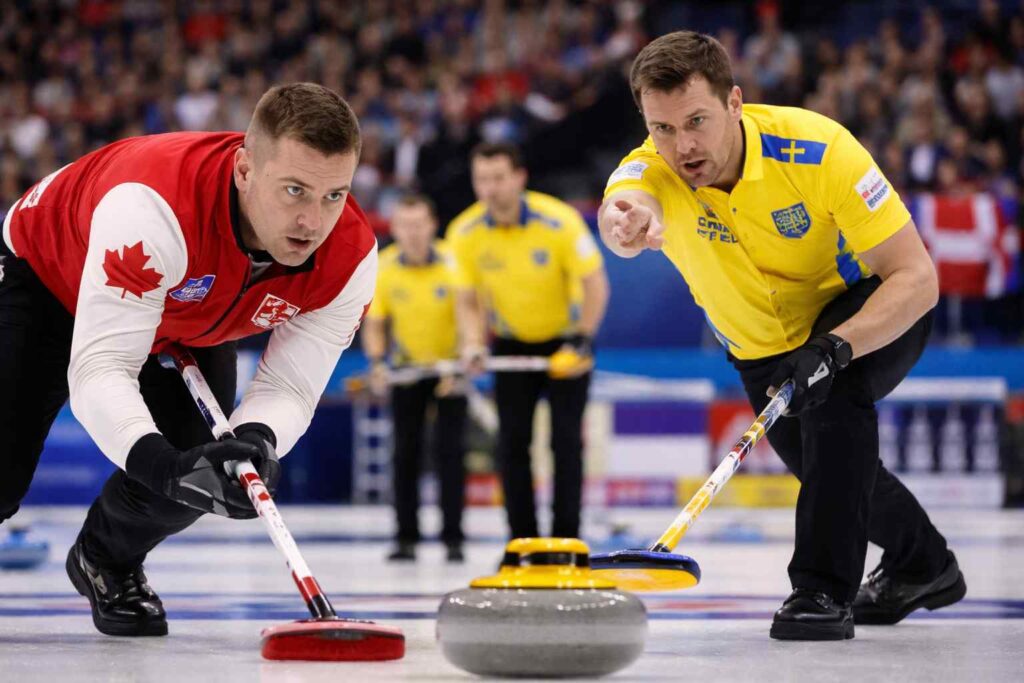

A simmering Olympic dispute between Canada and Sweden has erupted again, after Swedish curler Oskar Eriksson released a new video demonstrating a controversial “double-touch” technique — reigniting accusations, backlash and fresh scrutiny just as Sweden clinched gold at the men’s world curling championship.
The video, aired by Swedish broadcaster SVT and now widely circulated online, shows Eriksson lightly tapping a curling stone after release to illustrate how even a subtle contact could shift its path by centimetres. The timing has amplified its impact, arriving days after Sweden defeated Canada 9–6 in the world championship final, with Eriksson part of Niklas Edin’s winning team.
The issue traces back to February’s Milano-Cortina Winter Olympics, where Eriksson accused Canadian vice Marc Kennedy of committing a “double-touch” — a potential rule violation involving contact with the stone after release. Kennedy strongly denied any intent to cheat, responding angrily during the match in a moment caught on live microphones.
That exchange quickly became one of the defining flashpoints of the Games, with both Canada’s men’s and women’s teams facing similar allegations. While no formal sanctions followed, the episode exposed tensions in how curling’s rules are interpreted at the highest level.
Video fuels debate over rules and advantage
In the newly released demonstration, Eriksson argues that even a minimal touch can influence a stone’s trajectory — a claim that has divided the curling world. “Altering a stone by just a few centimetres is enough at this level,” he suggests in the video, framing the act as a measurable skill rather than an incidental motion.
But several Canadian experts have pushed back strongly. Veteran coach Eugene Hritzuk, with more than six decades in the sport, argues the premise misunderstands the rules. Under World Curling regulations, incidental contact during delivery — particularly before the hog line — is not automatically considered a violation.
He adds that adjustments to speed and direction often occur naturally through the wrist or fingers during release, and attempting a deliberate touch could just as easily disrupt a shot as improve it.
Canadian commentator John Cullen echoed that skepticism, describing the reaction to Eriksson’s video as overblown and suggesting parts of the Swedish curler’s remarks — including a comment that “evil wins sometimes” — may have been misunderstood in translation.
The footage itself has also been questioned. Critics argue Eriksson’s demonstration exaggerates the motion compared with the Olympic incident, making it difficult to draw a direct comparison with Kennedy’s delivery.
Sport’s image tested as controversy spreads
The dispute has exposed a deeper tension within curling — a sport long defined by etiquette and self-regulation. Traditionally, players are expected to call their own fouls, relying on mutual trust rather than strict officiating.
That model is increasingly under pressure. High-definition broadcasts, slow-motion replays and viral clips have turned subtle technical moments into global talking points, often before officials can provide clarity.
The result is a widening gap between perception and rule enforcement. What one side views as gamesmanship, the other sees as a misunderstanding of mechanics — and without consistent interpretation, those disagreements quickly escalate.
There are signs the governing body may need to respond. Calls are growing for clearer guidelines or more active officiating, particularly as curling expands globally and attracts larger audiences unfamiliar with its nuances.
For now, the fallout has been mixed. While the controversy has drawn criticism from both sides — with some arguing Canada’s reaction was overly heated and others accusing Sweden of exaggeration — it has also brought unprecedented attention to the sport.
Participation interest has reportedly surged in some regions following the Olympics, suggesting that even negative headlines can translate into visibility.
Yet the rivalry remains unresolved. With Sweden holding the latest world title and Canada still contesting the narrative around the Olympic incident, the debate over “double-touch” has moved beyond a single shot — becoming a test of how curling balances tradition with the demands of modern scrutiny.
Brisbane Hermes Ram Raid: 5 Suspects Linked to 3am Heist
Make Swikblog your go-to source on Google for reliable updates, smart insights, and daily trends.