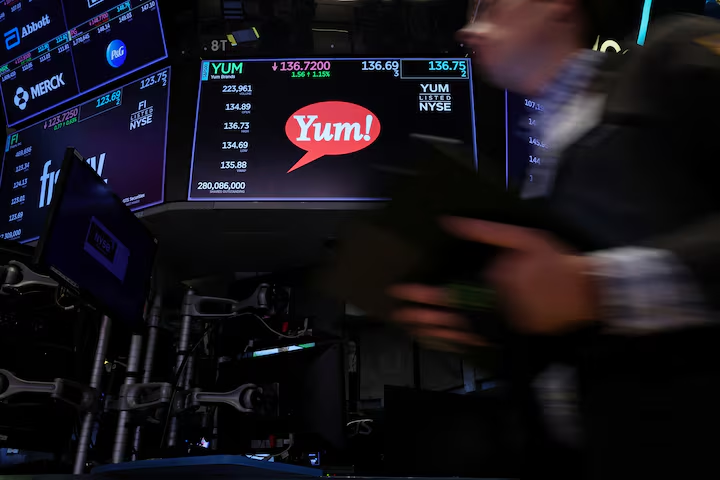

Australia’s Collins Foods has taken a decisive step to exit its struggling Taco Bell business, transferring 20 of its 27 outlets to an affiliate of Yum Brands and Restaurant Brands, while preparing to shut the remaining seven locations in the coming weeks. The move, announced Tuesday, marks the final phase of a strategy the company had already signaled — stepping away from a loss-making segment and doubling down on its core KFC operations.
The deal itself highlights the challenges Taco Bell faced in Australia. The 20 restaurants are being transferred at a nominal purchase price, with the incoming operator assuming lease liabilities. That structure underscores the reality that Collins Foods is prioritizing a clean exit over financial gain. Rather than attempting to turn around an underperforming business, the company is choosing to redeploy resources toward areas where it sees stronger long-term returns.
Investors reacted swiftly. Shares of Collins Foods fell 3.8% to A$8.450, their lowest level since June 24, 2025, reflecting mixed sentiment around the announcement. While the exit removes a drag on earnings, the minimal value attached to the transaction signals how weak Taco Bell’s contribution had become. For the market, the question now shifts from what Collins is exiting to how effectively it can execute its next phase of growth.
Exit strategy signals shift back to KFC strength
The decision to exit Taco Bell is closely tied to Collins Foods’ broader strategic pivot toward KFC, its largest and most profitable business. The company has been gradually reducing its exposure to Taco Bell, and Tuesday’s announcement confirms that the turnaround hopes for the brand in Australia have effectively ended.
KFC continues to be the backbone of Collins Foods’ revenue. In its latest update, KFC Australia reported interim revenue of A$563.8 million (around $385.6 million), significantly outperforming Taco Bell, which recorded a nearly 4% decline in revenue for the half-year ended October 12, 2025. The contrast between the two brands could not be clearer — one delivering scale and stability, the other struggling to gain traction in a competitive quick-service restaurant market.
Collins Foods has already outlined ambitious expansion plans for KFC, particularly in Europe. Last year, the company said it intends to open between 40 and 70 new KFC outlets in Germany over the next five years, arguing that the market remains under-penetrated for the brand. By exiting Taco Bell, Collins is effectively freeing up capital and management bandwidth to accelerate that growth strategy.
The broader Yum Brands ecosystem also plays a role here. Yum, which owns KFC, Pizza Hut and Taco Bell, is better positioned to oversee Taco Bell’s future in Australia through its affiliates. Restaurant Brands, formerly listed in New Zealand and now owned by Mexico’s Finaccess, brings additional operational backing. This transition suggests a shift toward a structure where brand owners take more direct control in markets where franchise performance has lagged.
Market reaction and analyst view
Despite the share price decline, analysts see some positives in the move. RBC Capital Markets analyst Michael Toner described the transfer of the 20 Taco Bell stores for a nominal amount as a “slight positive,” noting that the move helps simplify the business and remove ongoing losses. Attention now turns to how efficiently Collins Foods can deal with the remaining seven locations, where heightened competition among quick-service restaurant operators to secure prime sites could allow the company to dispose of leases relatively cleanly.
The Australian fast-food landscape remains highly competitive, with established players aggressively securing high-traffic locations and consumer loyalty. Taco Bell’s inability to scale profitably in such an environment highlights the difficulty even global brands face when adapting to local market dynamics. For Collins Foods, continuing to operate in that segment would likely have required further investment with uncertain returns.
Instead, the company appears to be choosing clarity over complexity. By narrowing its focus to KFC, Collins is aligning its business with a brand that already demonstrates strong performance and clear growth potential. That kind of strategic discipline is often viewed favorably over the long term, even if the short-term market reaction remains cautious.
The deal also reflects a broader trend within the quick-service restaurant industry, where operators are increasingly concentrating on core brands and shedding underperforming assets. Investors are paying closer attention to efficiency, margins and return on capital, making it harder for companies to justify prolonged support for weaker segments.
For Collins Foods, the next phase will be closely watched. The exit from Taco Bell removes a known weakness, but it also raises expectations around execution in its KFC business, particularly in international markets like Germany. If the company can deliver on its expansion plans and maintain strong performance in Australia, the decision to walk away from Taco Bell may, over time, be seen less as a retreat and more as a necessary reset.
For more details on Collins Foods’ strategy and operations, visit the company’s official website here.
You may like: Wordle Today March 31, 2026 Answer, Hints and Clues
About Author
Ankit is an experienced digital writer with more than 9 years of professional writing experience in business, technology, entertainment, finance, and online news coverage. He specializes in building concise, informative, and engaging content designed for modern readers. His work reflects a strong understanding of fast-paced publishing, editorial clarity, and content performance across digital platforms.

Make Swikblog your go-to source on Google for reliable updates, smart insights, and daily trends.