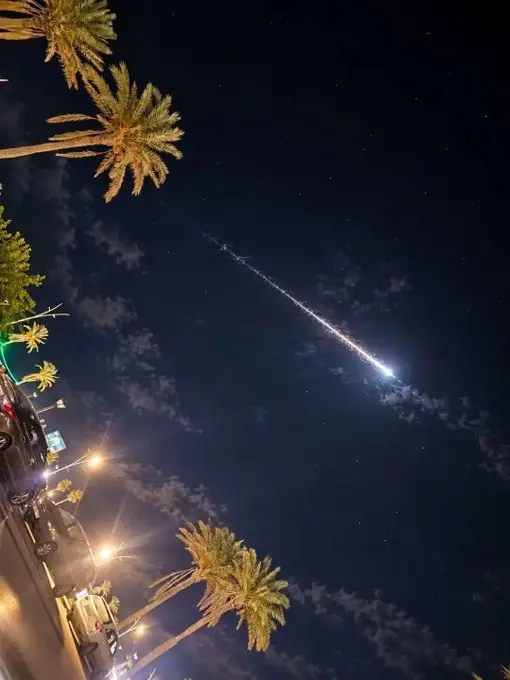
If your feeds are suddenly full of “interstellar comet” chatter, there’s a real reason: Comet 3I/ATLAS is reaching its closest approach to Earth on December 19, 2025. It’s not a doomsday scenario — the flyby is completely safe — but it is a rare scientific moment. This object arrived from outside our solar system, and researchers are treating this week as one of their best chances to study what’s essentially a frozen time capsule from another star system.
At a glance
- Closest approach: Dec 19, 2025
- Closest distance: ~1.8 AU (about 170 million miles / 270 million km)
- Risk to Earth: None — it will not come “near” Earth in astronomical terms
- What it is: A comet — and the third confirmed interstellar object observed in our solar system
What’s happening on Dec 19 — and how close is “close”?
3I/ATLAS will be about 1.8 astronomical units from Earth at closest approach — roughly 170 million miles (270 million kilometers). That’s nearly twice the average Earth–Sun distance, meaning this is a “close pass” only by cosmic standards. NASA’s official guidance is clear: the comet is not a threat and it won’t approach Earth in any dangerous way.
If you want the cleanest, most reliable reference for the key numbers (distance, speed, and common questions), use NASA’s official explainer here: NASA’s 3I/ATLAS Facts & FAQs .
Why scientists are treating it like an “early Christmas gift”
Comets are already valuable because they carry primitive material from the earliest days of planetary formation. An interstellar comet is even more exciting: it likely formed around a different star, then spent eons drifting through the Milky Way before crossing our path. That makes 3I/ATLAS a rare opportunity to compare what our solar system is made of with what exists beyond it — using telescopes, spectra, and imaging while the object is still bright enough to measure.
The timing matters. As the comet passes this week, astronomers can more easily detect faint features — changes in the coma, dust activity, and subtle jets — that are harder to confirm when it’s farther away. And because 3I/ATLAS is on an open trajectory, it will eventually exit the solar system and won’t return.
Is 3I/ATLAS “really” a comet?
Yes. The internet did what it always does: speculation about strange motion, hidden propulsion, or “alien probes” surged as soon as the discovery went mainstream. But NASA and observing teams have consistently described the object as behaving like a comet — a body shedding gas and dust as sunlight warms its surface and interior. In other words: fascinating, unusual, and scientifically important — but not mysterious in a sci-fi sense.
Can you see Comet 3I/ATLAS with your own eyes?
For most people, the honest answer is: not without help. 3I/ATLAS is expected to remain too faint for naked-eye viewing. Under dark skies, a larger backyard telescope may reveal it as a dim, fuzzy patch rather than a dramatic “tail comet” Hollywood image.
Practical viewing expectations
- Naked eye: Not likely
- Binoculars: Unlikely for most observers
- Telescopes: Better odds with larger apertures and darker skies
- Best alternative: Track it digitally or watch a livestream from observatories
How to track 3I/ATLAS (the simplest way)
If you want “where is it right now?” without wading into complicated astronomy software, the easiest route is NASA’s interactive tracking tools. Look for NASA’s Eyes on the Solar System experience, which can help visualize positions and distances in real time. Even if you never step outside, seeing its path relative to Earth makes the scale of the flyby click instantly.
Timing: when the closest moment happens
Because readers follow this story worldwide, here’s the timing in two commonly used zones. (Exact timing can vary slightly as tracking solutions update.)
Closest-approach timing (reference)
- U.S. Eastern (ET): early hours of Dec 19
- GMT/UTC: morning of Dec 19
If you’re watching via livestream, hosts often start before the closest moment to allow time for setup, weather checks, and calibration.
What happens after Dec 19?
After this week’s close approach, 3I/ATLAS continues outbound. Over time, it will fade beyond the reach of all but the largest telescopes, and eventually it will disappear back into interstellar space. That’s why astronomers are rushing to collect as much data as possible now: the window for strong observations is limited, and the “next” interstellar visitor could arrive next year — or decades from now.
Written by Swikblog Desk

Make Swikblog your go-to source on Google for reliable updates, smart insights, and daily trends.