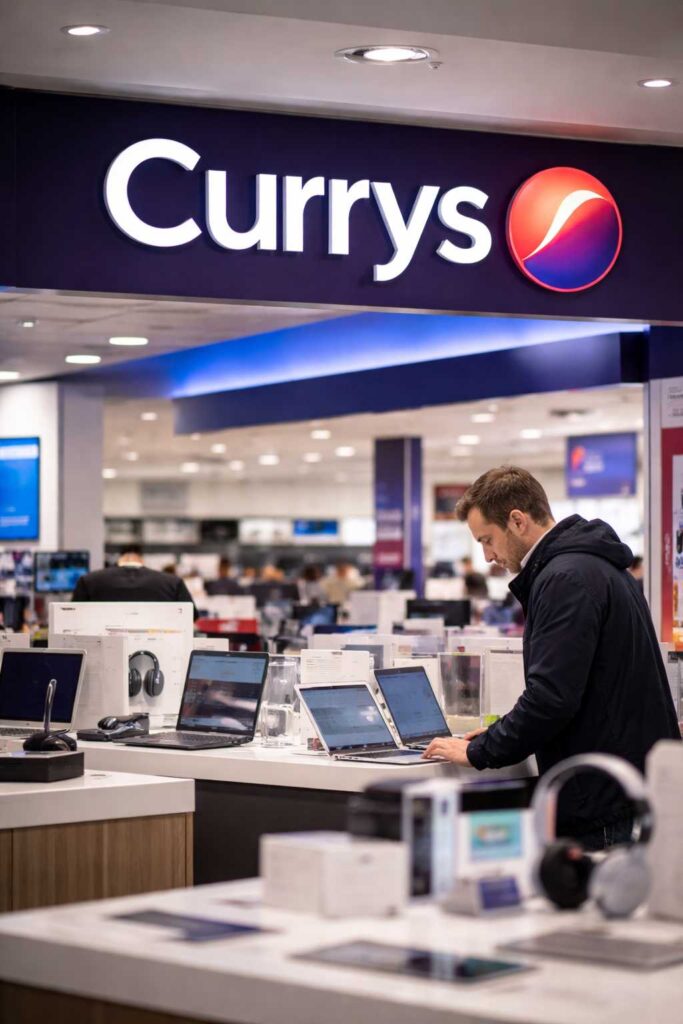

Currys plc (LSE: CURY) shares fell to 143.50p, down 1.24% today, after the electricals retailer’s leadership warned that the global boom in artificial intelligence could create future pressure on chip supplies and potentially push up prices across the consumer technology market.
The comments came from Currys chief executive Alex Baldock, who said the group is “quite concerned” about how AI demand is affecting memory supply. His remarks are notable because they do not point to an immediate shortage for Currys customers, but they do highlight a growing risk that the rapid expansion of AI infrastructure could eventually make some consumer electronics more expensive.
The warning adds another layer to the broader challenges facing retailers in 2026, as businesses continue to navigate cautious shoppers, macroeconomic uncertainty, and geopolitical tensions that could still affect sentiment and spending patterns.
Currys CEO says AI is soaking up memory supply
Speaking at an event in Reading, Berkshire, earlier this week, Baldock made clear that Currys is actively tracking the impact of AI on global technology supply chains. He said the company recently met partners on the west coast of California specifically to discuss the issue, underlining that this is not a passing observation but a risk Currys is already examining with major industry players.
Baldock said: “It is something we are quite concerned about.” He then explained the pressure more directly, saying that “AI is hoovering up the supply of memory and that means there is less for the stuff that we sell, and that’s the reality at the moment.”
That statement captures the core concern for Currys. As AI data centers and advanced computing systems require more memory and semiconductor capacity, the amount of supply available for everyday consumer electronics may tighten. Since Currys sells a broad range of technology products that depend on those components, the retailer is watching closely for any knock-on effects.
No immediate supply issue, but inflation risk remains
Despite that warning, Baldock also said Currys currently has enough product in its pipeline to stay supplied until the back-to-school period this year. That is a major detail because it suggests the company does not expect any near-term disruption to product availability across key categories.
Still, the reassurance came with a note of caution. Baldock said the business “might have to see some price inflation” because of the competitive environment in the market. In other words, even if Currys can secure enough stock, the cost of that stock could rise if chip and memory competition intensifies.
For consumers, that could eventually mean higher prices on products such as laptops, tablets, gaming devices, and other electronics if manufacturers and retailers face increased input costs. For investors, it means a new margin question: whether Currys can protect profitability while also staying competitive on price.
Currys believes UK market strength gives it an advantage
Baldock also suggested that Currys’ position in the UK market could help the company handle any supply or pricing pressure better than weaker rivals. He indicated that the retailer’s market dominance would put it in a strong position to secure technology products even if broader supply tightens or cost pressures build.
That matters because scale often becomes a major advantage during supply disruptions. Larger retailers generally have stronger supplier relationships, bigger purchasing volumes, and more leverage when negotiating stock access. In a market where chip availability becomes more competitive, Currys appears to believe its size will help it stay ahead.
Even so, the company is not dismissing the risk. The tone from management was cautious rather than alarmist: enough inventory is secured for now, but the supply backdrop is becoming more complicated as AI consumes a larger share of critical components.
Middle East conflict seen as limited direct risk to supply chain
Alongside the AI-related warning, Currys executives also addressed whether the conflict in the Middle East could disrupt the company’s supply chain. On that front, the retailer struck a more measured tone.
Chief operating officer Lindsay Haselhurst said there is very little direct impact for Currys because only a limited amount of product actually comes out of that region. That suggests the business does not currently see the conflict as a major direct threat to product flow.
Haselhurst also revealed that Currys had been considering rerouting certain shipments that currently travel around the Cape of Good Hope so they could instead pass through the Middle East. However, she said that potential upside has now been knocked back. This detail is important because it shows Currys has been evaluating alternative logistics routes to improve efficiency, but the latest geopolitical backdrop has limited those options.
So while direct supply disruption may be small, the wider operating environment remains uncertain. Route decisions, freight conditions, and regional instability can still shape costs and timing, even when direct sourcing exposure is limited.
The bigger threat may be weaker consumer demand
Perhaps the most important point from Baldock was that the “biggest risk” to Currys may not be supply itself, but what wider geopolitical and inflationary pressures do to shoppers.
He warned that war, volatile energy prices, higher inflation, and weaker consumer purchasing power are all negative for confidence and spending. That is a critical point for a retailer like Currys, where many purchases are discretionary and often depend on households feeling comfortable enough to upgrade electronics or buy new technology products.
Baldock said that “war and spiky energy prices feeding through into higher inflation and lower consumer purchasing power isn’t great for consumer confidence and spending.” That comment broadens the story well beyond chips. It shows Currys is balancing two separate but related risks at once: the possibility of higher product costs from tighter semiconductor supply, and the possibility of softer sales if household budgets come under pressure.
This is what makes the current backdrop especially challenging. Even if Currys manages inventory effectively and uses its market position to secure supply, the retailer still has to contend with the risk that customers become more cautious if inflation and economic uncertainty worsen.
Why today’s share move matters
With Currys shares at 143.50p, down 1.24% today, the market reaction appears to reflect caution over these combined pressures rather than panic over an immediate operational problem. The company has not said it is short on stock today. It has not suggested that a major disruption is already hitting shelves. Instead, management has flagged an emerging risk that could become more visible later in the year if AI-driven memory demand remains intense and inflation pressures continue to affect consumers.
That makes today’s decline significant because it captures investor concern over what could come next. Currys is effectively saying that it has near-term supply visibility through back-to-school season, but beyond that, there may be tougher pricing dynamics in the consumer technology market. At the same time, the group is warning that broader economic weakness remains a serious threat to spending demand.
For shareholders, the next phase will likely depend on whether chip and memory pressures deepen, whether Currys can continue to use its UK scale to secure products, and whether the consumer environment stabilizes enough to support demand. For now, the retailer’s message is clear: supply is manageable in the short term, but the AI boom, inflation risk, and fragile consumer sentiment are all factors that deserve close attention.
You May Like

Make Swikblog your go-to source on Google for reliable updates, smart insights, and daily trends.