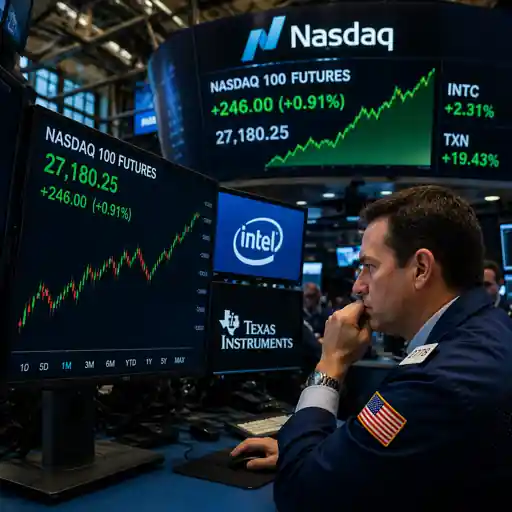
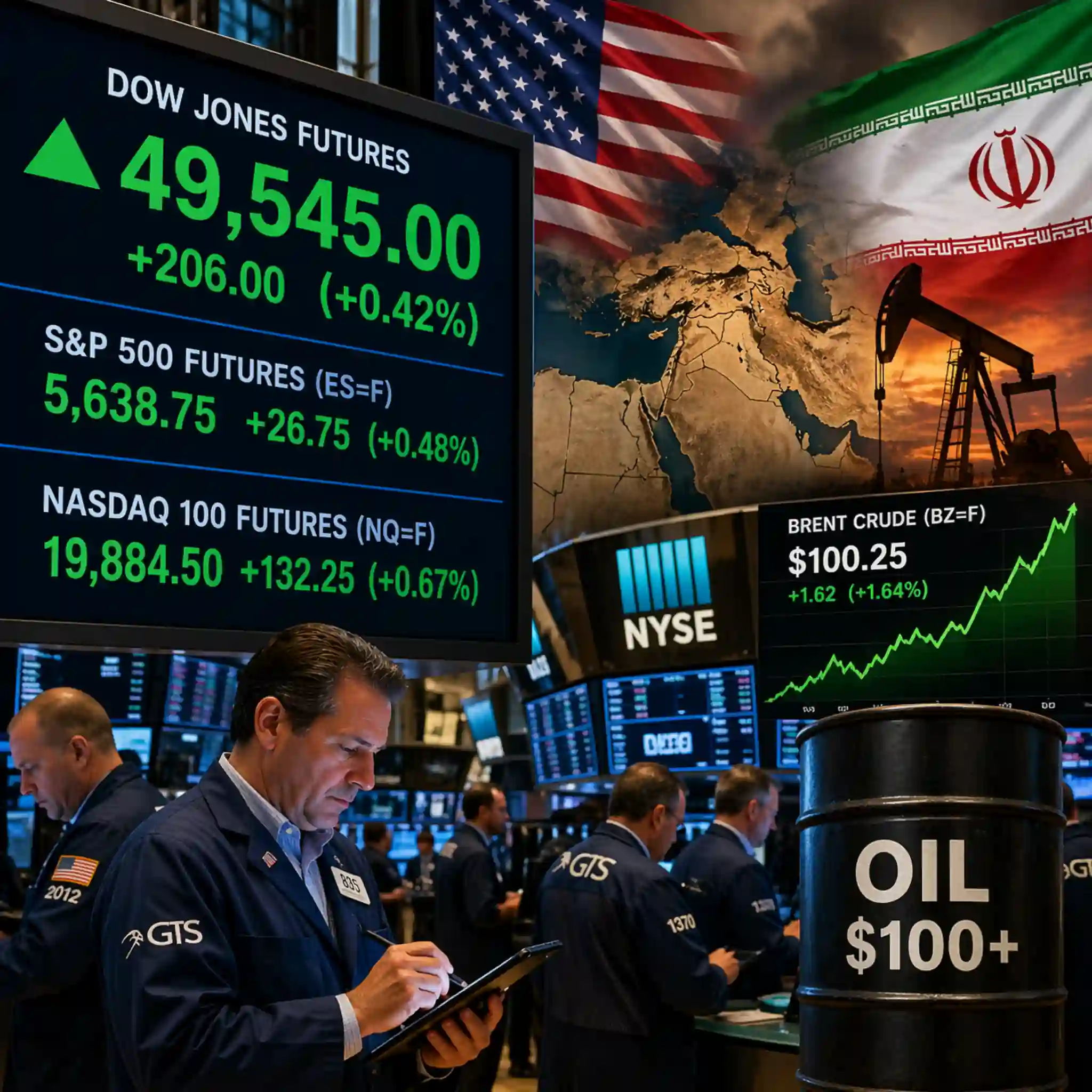
A rotation into blue-chip names lifted the Dow even as tech-heavy benchmarks weakened, with investors weighing a fresh wave of earnings and the latest jitters around AI-driven disruption.
The Dow Jones Industrial Average pushed up to around 49,585 in Wednesday trading, holding firm while the rest of Wall Street struggled to regain its footing. The split was stark: the Dow climbed roughly 0.6% to 0.7%, while the S&P 500 slipped about 0.3% and the Nasdaq Composite fell more than 1%, extending a tech-led pullback that has dominated the week.
At the center of the divergence is a familiar market reflex—investors moving money away from the most crowded technology trades and into steadier, cash-generating companies. With AI-linked disruption fears again in focus and big earnings catalysts looming, buyers appeared more willing to pick up blue-chip names than add exposure to high-volatility software and chip stocks.
Market snapshot
Dow level
49,585.04
Move
+344.05 (+0.70%)
Open
49,323.59
Intraday range
49,254.80 – 49,649.86
The day’s high sat just a few points below the 52-week peak near 49,653, keeping traders attentive to whether the Dow can sustain a break into fresh highs.
The Dow’s composition helps explain its resilience. Unlike the Nasdaq, which is dominated by tech and growth names, the Dow leans into sectors that often benefit when investors turn more cautious—industrials, healthcare, consumer staples, and financials. When risk appetite narrows, that mix can make the Dow feel like a “safer” way to stay invested, even if the broader market is wobbling.
Wednesday’s tape carried plenty of signals that the market’s confidence remains selective. Nvidia slid about 2.8% and AMD dropped roughly 15%, underscoring how quickly sentiment can flip in AI-adjacent pockets. Microsoft was down modestly, while Eli Lilly surged around 10%, giving a reminder that index-level moves can mask very different stories underneath.
| What investors are reacting to | Why it matters for the Dow vs Nasdaq split |
|---|---|
| AI disruption fears spilling out of software and into broader tech | Pressure concentrates in tech-heavy benchmarks; money rotates into blue-chip, non-tech exposure |
| Earnings calendar, with major reports holding markets in wait-and-see mode | Traders reduce risk ahead of catalysts; the Dow often benefits as a “defensive risk-on” alternative |
| Positioning and momentum after recent tech drawdowns | Tech unwind can be sharp; Dow strength can reflect rebalancing rather than broad optimism |
The intraday chart showed choppy swings early, followed by a steady grind higher that kept the index near the upper end of its day’s range. That pattern often shows up during rotations: investors aren’t rushing into everything, but they’re steadily reallocating into a narrower set of names that feel more durable if growth expectations cool.
Another detail worth noting is participation. The displayed volume was running below the average volume figure, a reminder that headline index gains don’t always come with broad conviction. When fewer shares change hands, it can take less capital to move prices—up or down—especially when the market is being steered by sector flows rather than a unified macro narrative.
For readers tracking the Dow’s record chase, the key levels are visible in the day’s range: roughly 49,650 as the ceiling that traders keep bumping into, and 49,255 as the lower bound that buyers defended during the morning’s volatility. If the Dow keeps holding closer to its highs while the Nasdaq remains under pressure, it signals a market that’s still investing—but doing so more cautiously, with a preference for earnings durability over blue-sky growth.
The bigger takeaway from Wednesday’s split is simple: the Dow’s strength is less about a broad risk-on mood and more about what investors are choosing to avoid. As AI-related uncertainty weighs on tech leadership, blue-chip demand can lift the Dow even when the market’s most growth-sensitive benchmark is sliding.

Make Swikblog your go-to source on Google for reliable updates, smart insights, and daily trends.