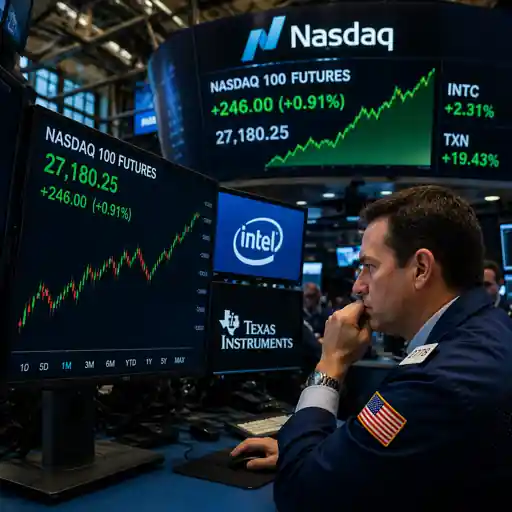

Nasdaq futures climbed on Friday as investors returned to technology and semiconductor stocks, with fresh strength in Intel and Texas Instruments giving Wall Street another reason to lean into the artificial intelligence trade. Nasdaq 100 futures rose 246 points, or 0.9%, to around 27,180.25, outperforming the broader market as chip names helped offset concerns over rising oil prices and geopolitical tension.
The move showed a clear split in US stock futures. While Nasdaq futures (NQ=F) advanced, S&P 500 futures (ES=F) were little changed and Dow Jones futures (YM=F) fell about 129 points, or 0.3%, to nearly 49,361. That gap suggests investors are still rewarding companies tied to AI, cloud infrastructure and semiconductor demand, even as they remain cautious on economically sensitive sectors.
AI and chip earnings lift Nasdaq futures
Intel (INTC) became one of the key names behind the tech-led move after shares gained around 2.31%. The company delivered a stronger profit update and gave investors a better outlook than expected, helping improve confidence in its turnaround story. Intel has been working to regain ground in advanced chips and manufacturing, and any sign of stronger demand from data centers can quickly lift sentiment around the stock.
Texas Instruments (TXN) added even more momentum to the semiconductor group. TXN shares jumped nearly 19.43% after a major earnings beat, marking one of the stock’s strongest moves in roughly 25 years. The reaction was important because Texas Instruments is not usually treated as a pure AI stock. Its strength signals that the chip recovery may be spreading across industrial, automotive and broader hardware demand.
The broader AI trade also received support from global semiconductor names. Taiwan Semiconductor Manufacturing Company (TSM), a key supplier of advanced chips, and SK Hynix, a major high-bandwidth memory supplier, reached record levels during the week. That matters for Nasdaq sentiment because AI infrastructure depends on a wide supply chain, from processors and memory to data center hardware.
Fund flows added another bullish signal. Global equity funds attracted about $48.72 billion in weekly inflows, the strongest level in nearly 17 months. US equity funds pulled in roughly $27.98 billion, while European funds drew about $18.41 billion. Strong inflows suggest large investors are still willing to buy stocks, especially where earnings growth and AI demand remain visible.
Oil prices and Hormuz risks keep markets cautious
The Nasdaq rally came despite a sharp move in crude oil. Brent crude (BZ=F) traded above $100 and was reported near $106 per barrel, while West Texas Intermediate (CL=F) moved close to $97. Oil has risen for five straight sessions, with supply concerns linked to tensions around the Strait of Hormuz keeping energy markets under pressure.
Higher oil prices are a risk for stocks because they can push inflation expectations higher, raise business costs and reduce consumer spending power. That is one reason Dow futures lagged while Nasdaq futures gained. Investors appear more willing to buy companies with strong earnings momentum than stocks exposed to transportation, manufacturing and consumer pressure.
Geopolitical uncertainty remains a major part of the market story. A three-week extension of the Israel-Lebanon ceasefire offered some relief, but investors are still watching US-Iran talks and the situation around Iranian ports. Any further disruption near Hormuz could keep oil elevated and make the inflation outlook harder for markets to price.
Friday’s earnings calendar may also shape the next move. Procter & Gamble (PG), HCA Healthcare (HCA) and Norfolk Southern (NSC) are among the key companies in focus. Their results will give investors a better read on consumer demand, healthcare spending and freight activity outside the technology sector.
The final April reading of the University of Michigan consumer sentiment index is another important data point. If confidence weakens while oil prices rise, traders may become more cautious about the strength of the US economy. A stronger reading, however, could support the view that consumers are holding up despite inflation pressure.
For now, Nasdaq futures are being driven by a powerful combination of AI optimism, chip earnings and strong equity inflows. The 246-point gain shows that technology remains the market’s preferred trade, even as oil and geopolitical risks limit enthusiasm across the broader indices.
The key question for investors is whether semiconductor strength can continue to outweigh macro risks. If Intel, Texas Instruments and other chip stocks keep delivering stronger numbers, Nasdaq futures may hold their leadership. But if Brent crude stays above $100 or geopolitical tensions intensify, the rally could become more volatile.
Nasdaq futures’ latest rise shows Wall Street is still willing to buy growth when earnings support the story. AI remains the strongest theme in the market, and for now, that has been enough to keep tech stocks ahead of the Dow and S&P 500.
External reference: For live market data, investors can track Nasdaq futures and major index updates on Yahoo Finance.
You may also like: Nasdaq Futures Fall 80 Points as Oil Tops $100 and Tesla Slides

Make Swikblog your go-to source on Google for reliable updates, smart insights, and daily trends.