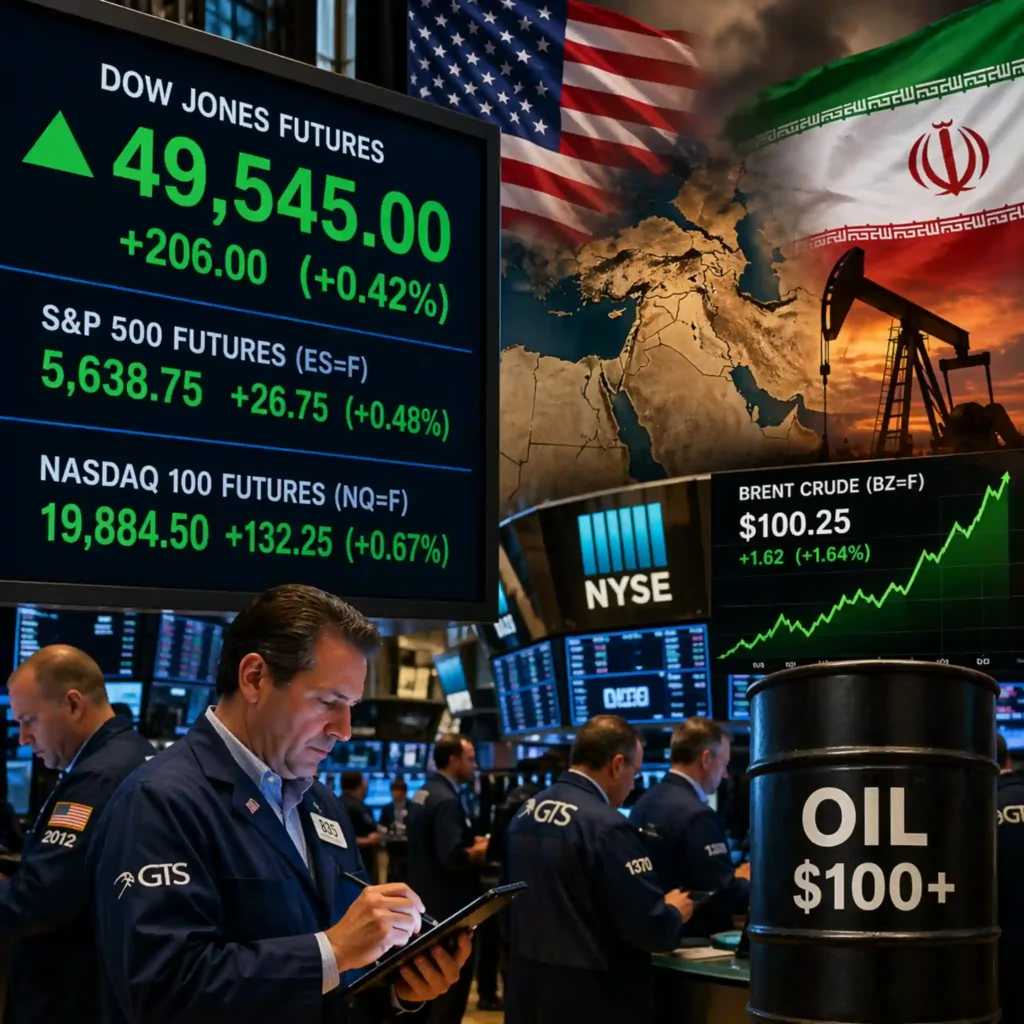

Dow futures jumped more than 200 points early Wednesday after President Donald Trump extended the US-Iran ceasefire, giving Wall Street a short-term catalyst after a shaky session for major indexes. The relief move pushed futures higher across the board, even as crude oil stayed elevated and traders continued to weigh the risk of renewed disruption around the Strait of Hormuz.
Contracts tied to the Dow Jones Industrial Average rose about 0.4%, with Mini Dow Jones futures (YM=F) trading near 49,545, up roughly 206 points. S&P 500 futures (ES=F) gained about 0.5%, while Nasdaq 100 futures (NQ=F) climbed around 0.7%, signaling stronger appetite for growth names after the prior market pullback.
The futures rebound came after a weaker regular session for the major benchmarks. The S&P 500 (^GSPC) fell 0.63%, the Nasdaq Composite (^IXIC) slipped 0.59%, the Dow Jones Industrial Average (^DJI) lost 0.59%, and the Nasdaq 100 (^NDX) eased 0.42%. That set up Wednesday’s bounce as traders reacted to the ceasefire extension and an immediate easing in worst-case geopolitical fears.
Trump Extends US-Iran Ceasefire, Giving Futures a Lift
The market’s early move higher was tied directly to the White House decision to extend the US-Iran ceasefire indefinitely. That reduced, at least for now, fears of an imminent escalation in the region. For equity traders, the announcement was enough to bring buyers back into index futures after a risk-off stretch driven by uncertainty over diplomacy, oil supply, and shipping conditions in the Gulf.
Still, the relief was limited rather than absolute. Reports in the market suggested that talks between Washington and Tehran remain fragile, and neither side appears close to a durable breakthrough. That matters because investors are not pricing in a full resolution. They are pricing in a temporary pause. In other words, Wednesday’s rally setup looked more like a sentiment reset than a clean all-clear for risk assets.
Oil Prices Stay Hot With Brent Above $100
Crude remained one of the most important market drivers. Brent crude (BZ=F), the global benchmark, moved above $100 per barrel, while West Texas Intermediate (CL=F) traded around $91 per barrel. Those are still elevated levels for an equity market trying to balance cooling inflation hopes with the possibility of a fresh energy shock.
The price action in oil reflects continued concern over shipping through the Strait of Hormuz, one of the world’s most critical energy chokepoints. Even with the ceasefire extension, traffic disruptions and political uncertainty have kept supply worries in play. For stocks, that creates a more complicated backdrop. Lower immediate war risk helps sentiment, but oil above $100 can feed inflation concerns, pressure margins, and revive worries about interest-rate sensitivity across the broader market.
Nasdaq Futures Lead as Traders Eye Growth Stocks
The strongest early move came from Nasdaq 100 futures (NQ=F), which outpaced both the Dow and S&P 500. That leadership suggested traders were rotating back into higher-beta tech and growth names after recent volatility. When the Nasdaq leads in premarket futures, it often points to stronger risk appetite, especially if investors believe geopolitical headlines may stabilize long enough for earnings and corporate news to retake center stage.
Several widely followed companies were also on the radar. Tesla (TSLA), AT&T (T), and Boeing (BA) were among the key names expected to report earnings on Wednesday, giving traders another major catalyst beyond geopolitics. In a market this headline-sensitive, earnings from large-cap names can quickly reshape sector leadership and determine whether a futures bounce turns into a durable cash-session rally.
Stocks and Themes in Focus
Beyond the scheduled earnings slate, traders were also watching developments tied to artificial intelligence and private-market dealmaking. That kept attention on enterprise software, AI infrastructure, and high-growth technology names. While the broader market story was dominated by the Middle East and oil, the underlying tape still showed that investors remain willing to chase opportunities in areas tied to long-term secular growth when macro pressure briefly eases.
That dynamic is especially important for the Nasdaq. If energy prices stay firm but do not spiral higher, growth stocks may continue to find support from investors who see recent weakness as a reset rather than the start of a deeper unwind. But if crude accelerates again, that same trade could come under pressure quickly.
Key Levels for the Market Open
From a trading perspective, the move in YM=F back toward 49,545 put the Dow futures contract back on watch for a stronger opening tone. For bulls, holding gains above the early premarket range would be an encouraging sign that the market is willing to look beyond the prior session’s weakness. For bears, the test will be whether oil stays contained enough to prevent another round of defensive selling after the opening bell.
The bigger picture remains balanced between relief and caution. The ceasefire extension helped restore some confidence, and futures reacted accordingly, but the market is still dealing with oil above $100, unresolved diplomatic risk, and a busy earnings calendar. That combination means traders are likely to stay highly reactive, with headlines on Trump, Iran, BZ=F, CL=F, and major earnings names such as TSLA, T, and BA continuing to drive price action through the session.
For now, the early signal is clear: Dow futures are bouncing, Nasdaq futures are leading, and oil remains the wildcard. That is the setup investors are walking into as Wednesday trading gets underway.
For broader market context and live coverage, investors can also track updates through Yahoo Finance market coverage.

Make Swikblog your go-to source on Google for reliable updates, smart insights, and daily trends.