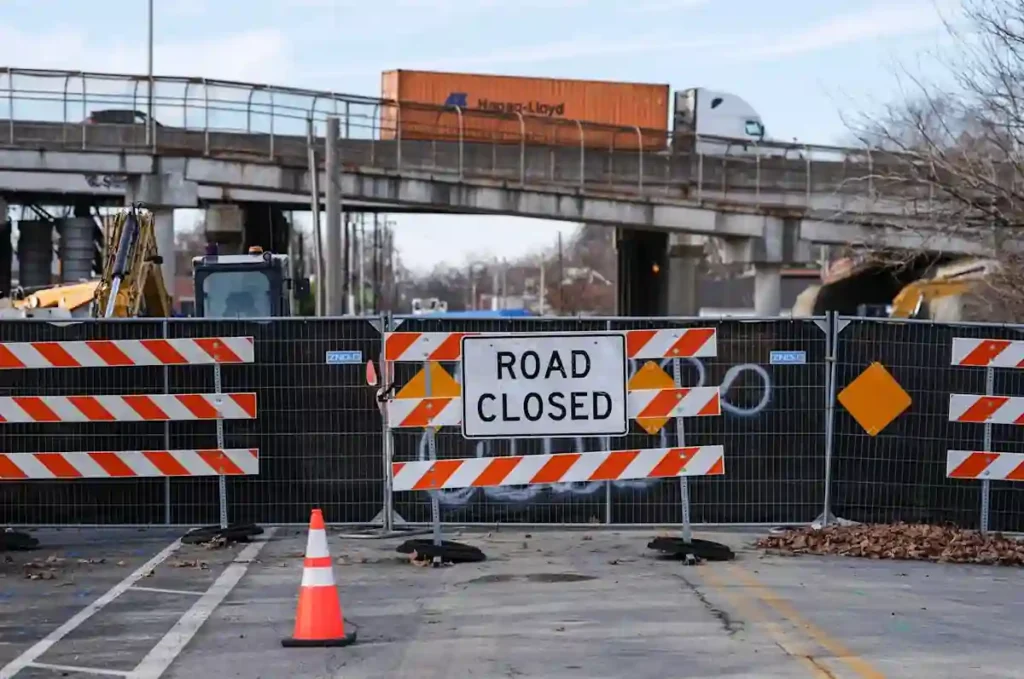

Interstate 65 has now shut down in both directions through central Louisville, forcing drivers to rethink one of the city’s most important travel routes for the next two months. The closure began at 12:01 a.m. on June 1 and affects the stretch between Jefferson Street downtown and the Interstate 264/Watterson Expressway interchange.
The shutdown is not linked to a crash or emergency. It is part of Kentucky’s I-65 Central Corridor Improvement Project, a major bridge replacement program designed to update aging interstate infrastructure that has carried Louisville traffic for decades.
According to the Kentucky Transportation Cabinet, crews are replacing three bridges along the corridor. The bridges sit over Kentucky and Brook streets, a CSX rail line near Burnett Avenue, and Bradley Avenue. Officials say the structures date back to the original I-65 buildout in the 1950s and need full replacement to keep the route safe and reliable for future traffic.
What changes for Louisville drivers?
For daily commuters, the biggest change is the loss of a direct north-south interstate route through the urban core. Traffic that normally uses I-65 will be pushed toward signed detours, including westbound I-264 and westbound I-64. That means drivers should expect heavier traffic on surrounding highways, longer merge times and slower trips near downtown Louisville, the airport corridor and the Watterson interchange.
The closure also changes access to Louisville Muhammad Ali International Airport and the Kentucky Exposition Center. Drivers who usually depend on I-65 to reach those destinations will need alternate routes. Anyone heading to the airport should build in extra time, especially during early morning departures, evening travel windows and major event days near the fairgrounds.
Kentucky transportation officials chose a full closure because some bridge sections are too narrow to safely keep traffic moving on one side while crews rebuild the other. Closing both directions at once creates a difficult summer for drivers, but it allows construction crews to work faster and is expected to avoid at least one additional year of traffic restrictions.
The reopening plan is staged. Two southbound lanes between University Boulevard and I-264 are expected to reopen by July 1. The rest of the affected corridor is scheduled to reopen with two lanes in each direction by Aug. 1. Work on the wider I-65 program will continue into 2027, but officials have said there are no plans for another full two-way I-65 shutdown after Aug. 1.
Why this project matters beyond the summer closure
The current bridge replacement work is estimated to cost about $150 million. It is one phase of a larger corridor investment expected to total roughly $370 million. Six additional I-65 bridges are planned for replacement through 2027, including structures over Broadway, Gray Street, Jacob Street, Chestnut Street, Floyd Street, Liberty Street and areas near Muhammad Ali Boulevard.
The project is being handled by Kiewit Infrastructure South Co., and state officials have said the contract includes significant penalties if scheduled reopening targets are missed. That detail matters because the closure affects not only commuters but also airport travelers, event traffic, delivery routes and businesses that depend on predictable movement through Louisville.
The I-65 shutdown is also happening during a busy construction period across the region. Lane restrictions are expected at times on the John F. Kennedy Memorial Bridge, Interstate 71 and the Watterson Expressway. Surface streets, including parts of Main Street and River Road, may also see roadwork, which could limit backup routes when traffic is already heavy.
Read More
Drivers can reduce delays by checking official traffic alerts before leaving, avoiding peak hours when possible and following posted detour signs instead of relying only on familiar shortcuts. Similar major road closures, including highway shutdowns that caused heavy regional delays, show how quickly congestion can spread when a primary route is removed from the network.
For now, the best advice is simple: do not treat summer travel through Louisville like a normal commute. Until lanes begin reopening, drivers should expect I-65-related delays to shape trips across the city, particularly around downtown, the airport, I-64 and I-264.

Make Swikblog your go-to source on Google for reliable updates, smart insights, and daily trends.