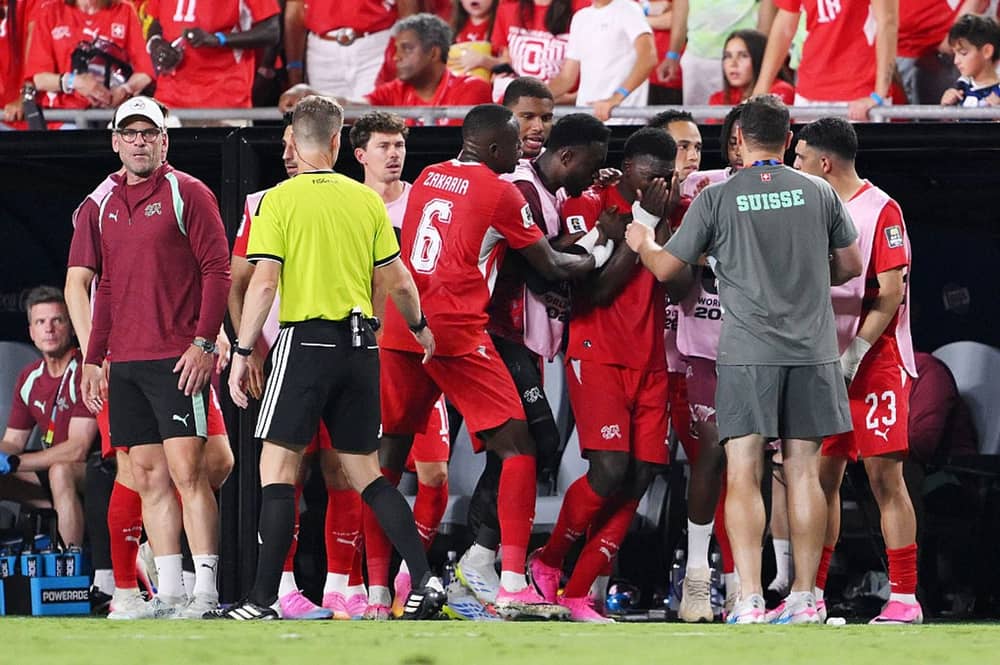

Breel Embolo was sent off during Switzerland’s World Cup quarter-final against Argentina after referee João Pinheiro ruled that the striker had attempted to deceive him by going to ground without being fouled by Leandro Paredes. The decision came after a pitchside video review and left Switzerland with 10 players shortly after Dan Ndoye had equalised.
Although Pinheiro eventually displayed a red card, Embolo was not dismissed for a straight-red offence. He received a yellow card for simulation, which became his second caution of the match and therefore triggered the red card.
What happened between Embolo and Paredes?
The decisive incident occurred around the 70th minute with the score level at 1-1. Embolo attempted to move past Paredes before falling to the ground as the Argentina midfielder challenged him.
Pinheiro initially appeared to believe Paredes had caught the Swiss striker. The Argentina midfielder was shown a yellow card as tempers rose between the two teams. Switzerland midfielder Remo Freuler was also visibly unhappy during the confrontation.
The referee was then advised to review the incident on the pitchside monitor. Replays indicated that Paredes had not made the level of contact initially suspected and that Embolo’s fall may have created a misleading impression of a foul.
After completing the review, Pinheiro rescinded the caution shown to Paredes and instead booked Embolo for simulation. Because Embolo had already received a yellow card earlier in the match, the referee immediately followed the second caution with a red card.
Why had Embolo already been booked?
Embolo received his first yellow card during the first half following a late challenge on Paredes. That earlier booking made the striker vulnerable to dismissal for any further cautionable offence.
The official sequence was therefore a first yellow for the earlier challenge, followed by a second yellow for simulation. It was not a direct red card for diving.
As Pinheiro prepared to announce the outcome, a player could be heard saying, “No, no!” through the referee’s microphone. The reaction reflected Switzerland’s disbelief as the team had initially expected Paredes to be punished.
Why was VAR allowed to review a yellow card?
The VAR intervention may have confused viewers because video officials have traditionally been unable to review ordinary yellow-card decisions.
Football’s rules now permit VAR involvement when there is clear evidence concerning an incorrect second caution that would result in a player being sent off. The updated IFAB VAR protocol lists a clearly incorrect second caution among the red-card situations that can be reviewed.
VAR did not make the final decision. The video officials identified a possible error and recommended an on-field review, but Pinheiro remained responsible for examining the footage and deciding whether Embolo had attempted to deceive him.
Does no contact automatically mean simulation?
A player falling without contact is not automatically guilty of simulation. Footballers may lose balance, take evasive action or jump to avoid a potentially dangerous challenge.
For a caution to be justified, the referee must believe that the player deliberately attempted to mislead the officials. Pinheiro decided Embolo had presented the incident as a foul despite Paredes not making meaningful contact.
The judgment will still be debated because slow-motion footage can make natural movements appear exaggerated. Supporters of Switzerland may argue that Embolo was attempting to avoid Paredes’ challenge rather than intentionally diving.
How the red card changed Argentina vs Switzerland
The dismissal arrived only minutes after Ndoye had brought Switzerland level. Losing Embolo removed Switzerland’s primary centre-forward and its strongest outlet for holding up long passes against Argentina’s defence.
With 10 players, Switzerland had to reorganise its defensive structure while also finding a way to threaten Argentina without its main striker. The decision therefore changed both the numerical balance and Switzerland’s ability to counterattack.
The controversy also added to the major refereeing debates surrounding the knockout rounds. Another World Cup dispute recently developed after Kylian Mbappé criticised comments linked to the Paraguay racism row, showing how incidents involving players, officials and public figures have continued to shape discussion away from the action itself.
For Embolo, however, the explanation is technical but straightforward: Pinheiro judged the fall to be simulation, issued a yellow card and then dismissed the striker because it was his second caution.

Make Swikblog your go-to source on Google for reliable updates, smart insights, and daily trends.