
A 13-year-old boy has died after part of a stone fountain collapsed during celebrations of Spain’s 2026 FIFA World Cup victory in Ciudad Rodrigo, leaving other people injured and prompting three days of official mourning.
The accident happened at about 12:33 a.m. local time on Monday, July 20, as hundreds of residents gathered at the Glorieta del Árbol Gordo. A night celebrating Spain’s second men’s World Cup title quickly became a tragedy for the small western Spanish city.
What happened at the fountain?
Supporters had assembled at the Árbol Gordo fountain after Spain defeated Argentina in the World Cup final. Several young people were reportedly inside or standing on parts of the masonry structure when its upper section gave way.
A heavy piece of stone fell onto the 13-year-old, trapping him beneath the debris. Local Police officers and other responders removed collapsed material in an attempt to reach him.
Emergency workers treated the teenager and transferred him to the Ciudad Rodrigo health centre, where he died from his injuries. His identity has not been publicly released.
How many people were injured?
Initial reports have provided different casualty totals. Reuters reported two injured people in addition to the boy who died, while some Spanish reports citing Local Police sources placed the number of injured at three.
The Castilla y León 112 account said medical teams attended two people and took them to the local health centre, where one died. One local report said another injured person suffered a fractured leg.
Until authorities issue a consolidated update, the confirmed position is that the 13-year-old died and at least one other person was injured.
Emergency response in Ciudad Rodrigo
The regional 112 centre received several calls at approximately 12:33 a.m. reporting that part of the fountain had fallen onto people gathered nearby.
Ciudad Rodrigo Local Police, the Salamanca Civil Guard and firefighters from Salamanca Provincial Council responded. Emergencias Sanitarias-Sacyl deployed a mobile intensive-care unit, a basic life-support ambulance and medical staff from the local health centre.
The regional emergency coordination centre also activated a psychological intervention team to support the victim’s family. The fountain was later cordoned off while authorities examined the damaged structure.
Why were residents celebrating?
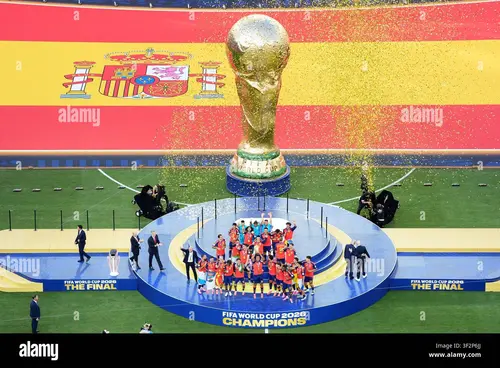
Spain had beaten Argentina 1-0 after extra time in the World Cup final at New York New Jersey Stadium. Substitute Ferran Torres scored the winning goal in the 106th minute.
The victory gave Spain its second men’s world championship, 16 years after its first title in 2010. The result is confirmed in FIFA’s official final report.
The match completed a 104-game tournament staged across Canada, Mexico and the United States. Results from the competition can be found in the FIFA World Cup 2026 schedule.
The tournament’s leading individual performers are listed among the FIFA World Cup 2026 award winners, including the Golden Ball, Golden Boot and Golden Glove recipients.
Where is Ciudad Rodrigo?
Ciudad Rodrigo is a historic walled city in Salamanca province, within Spain’s Castilla y León region. It lies close to the Portuguese border and has approximately 12,000 residents.
The Árbol Gordo area is a familiar local meeting place and has attracted crowds during festivals and major sporting occasions. The teenager’s death has deeply affected the close-knit community.
Read More:
- Why MetLife Stadium used natural grass for the 2026 FIFA World Cup final
- The Messi and Lamine Yamal baby photo explained: Why it went viral after the World Cup final
- Visit the Swikblog homepage for more latest news
Three days of official mourning
Ciudad Rodrigo Town Hall offered condolences to the boy’s relatives and friends and expressed support for the other people affected.
The municipality said an occasion intended to celebrate the national team’s victory had become a tragedy for the entire community.
Three days of official mourning were declared from July 20 to July 22, inclusive. Flags at municipal buildings were ordered to fly at half-mast during that period.
What caused the collapse?
The cause remains under investigation. Reports indicated that numerous people were gathered on and around the fountain, but officials had not released a technical assessment.
Investigators are expected to examine the condition of the masonry, the weight placed on the upper section and whether the structure had any previous weakness. It would be premature to conclude that the crowd alone caused the collapse.
Authorities had not announced whether other public monuments would be inspected or whether permanent barriers and additional crowd-control measures would be introduced.
A final injury total, the conditions of everyone hurt and the precise cause of the structural failure remained unconfirmed at the time of publication.

Make Swikblog your go-to source on Google for reliable updates, smart insights, and daily trends.