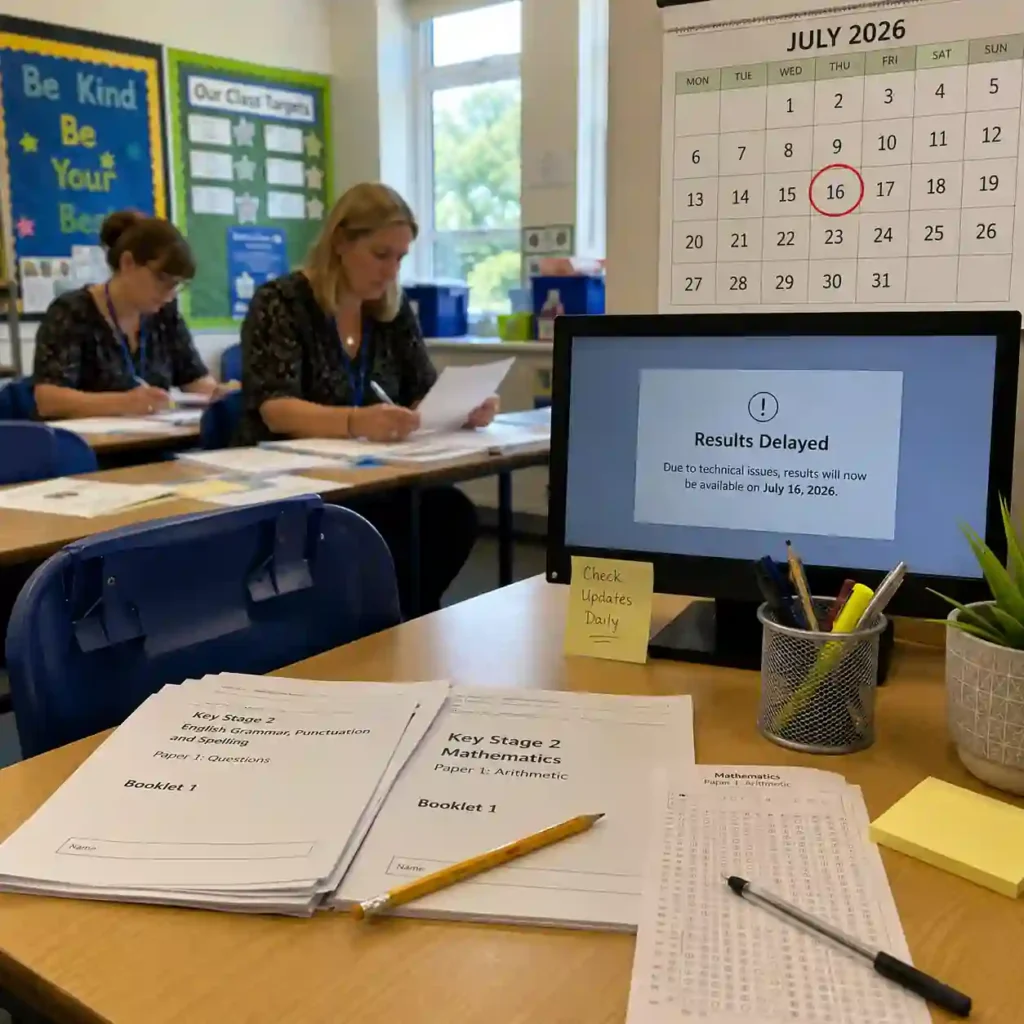

England’s Key Stage 2 (KS2) SATs results have been delayed until Thursday, 16 July 2026, after Pearson confirmed major technical failures disrupted this year’s marking and data processing systems. The results had originally been scheduled for release on 7 July, but hundreds of thousands of Year 6 pupils, parents and schools across England will now have to wait an additional nine days.
The delay marks the first year that Pearson has managed the national KS2 SATs programme after winning a four-year, £180 million contract from the Standards and Testing Agency (STA). Following the announcement, the Department for Education (DfE) confirmed it is considering financial penalties and even the cancellation of Pearson’s contract, while launching a review into how the failures occurred.
The disruption comes at a time when schools are already preparing for wider education reforms, including the new Ofsted inspection changes due to begin in September 2026, making dependable national assessment systems more important than ever.
Technical failures force nationwide KS2 SATs delay
Pearson said the postponement resulted from technical problems with its newly introduced SATs marking platform together with issues transferring pupil assessment data between its internal systems.
The company informed the Standards and Testing Agency on Wednesday evening that it would not be able to provide the complete data required for the planned publication date.
In a public statement, Pearson accepted full responsibility for the disruption and apologised “unreservedly” to pupils, families, schools and government partners. The company said specialist teams are working around the clock to complete the remaining processing while ensuring every school receives complete and accurate results.
Pearson also stressed that the issue affects only the 2026 KS2 SATs process. GCSEs, A-levels and vocational qualification results will continue as planned because they operate through separate technology platforms and marking systems.
Government considers financial penalties and contract review
Education Secretary Bridget Phillipson described the delay as “deeply frustrating” for schools planning pupils’ transition to secondary education, for parents waiting to understand their children’s progress and for pupils themselves.
The Department for Education said it is exploring every available option, including contractual action, financial penalties and the possible cancellation of Pearson’s agreement signed under the previous government.
Officials also confirmed that a full investigation will examine how the technical failures developed despite an 18-month transition period that was intended to prepare Pearson’s systems before taking over responsibility for KS2 SATs.
Importantly, the government has emphasised that the delay does not reflect concerns about the quality of the tests or the accuracy of marking itself. The standards maintenance process has already been completed, meaning the issue relates to processing and distributing the final results rather than how pupils’ papers were assessed.
Read More
Schools, pupils and parents face unexpected disruption
The revised publication date arrives during one of the busiest periods of the school year. Primary schools use KS2 SATs outcomes when preparing end-of-year reports, discussing pupil progress with parents and supporting Year 6 pupils moving into secondary education.
Many schools had organised transition activities around the original results day. Instead, parents and pupils will now receive results after many secondary transition events have already finished.
Schools in Leicester and Leicestershire are expected to receive results only after the end of term, leaving little opportunity for teachers to discuss outcomes before the summer holidays.
Meanwhile, the deadline for requesting reviews of marking has been pushed back to 24 July, prompting concerns that school leaders may need to work during the holiday period to complete appeals.
Education leaders describe the situation as unacceptable
The National Association of Head Teachers (NAHT) criticised the delay, with general secretary Paul Whiteman calling it “completely unacceptable”. He said schools had repeatedly raised concerns about changing suppliers but had been reassured that preparations were progressing as planned.
Whiteman said schools deserve “cast-iron assurances” that delayed results will be reliable, adding that Pearson should be held to the same high standards expected of schools during test administration.
The Association of School and College Leaders (ASCL) described the delay as a “complete shambles”, warning that staff would inevitably spend part of their summer holidays completing administrative work that should already have been finished.
Several headteachers have also called for a full public inquiry into the handling of this year’s assessment programme.
Markers reported weeks of glitches before the delay
The announcement follows weeks of reports from SATs markers describing technical problems with Pearson’s online marking platform.
Some markers said deadlines were repeatedly extended because of system failures. One experienced marker reported working until after 1 a.m. on several occasions trying to keep pace with revised schedules.
The same marker also raised concerns after noticing that a mark awarded to one question appeared to have been assigned to a different question within the system, prompting worries about whether similar errors could affect other scripts.
Earlier in the assessment cycle, schools also experienced difficulties accessing the National Curriculum Assessments (NCA) Portal on the opening day of testing, leading headteachers to warn that attendance records could be affected.
Schools Week also reported that Pearson later asked mathematics markers to help complete grammar, punctuation and spelling papers after marking backlogs developed.
Renewed debate over outsourcing national assessments
The latest disruption has revived questions about whether national assessments should continue to be outsourced to private contractors.
Previous SATs contracts have also experienced difficulties. Under Capita, schools faced missing papers, technical failures and lengthy helpline delays, while in 2008 ETS Europe repaid millions of pounds after serious delays in delivering national test results.
Education unions including NASUWT argue that high-stakes national assessments should instead be managed directly by the public sector. The debate has gained further attention after the government recently published guidance encouraging departments to review whether some outsourced services should return to in-house delivery.
Parents and schools can continue following official updates through the UK Government’s guidance on accessing KS2 test results and scripts.
Attention will now turn to 16 July, when schools are expected to receive the delayed results. Alongside delivering accurate data, Pearson faces the larger challenge of rebuilding confidence in England’s national assessment system after one of the most significant SATs disruptions in recent years.

Make Swikblog your go-to source on Google for reliable updates, smart insights, and daily trends.