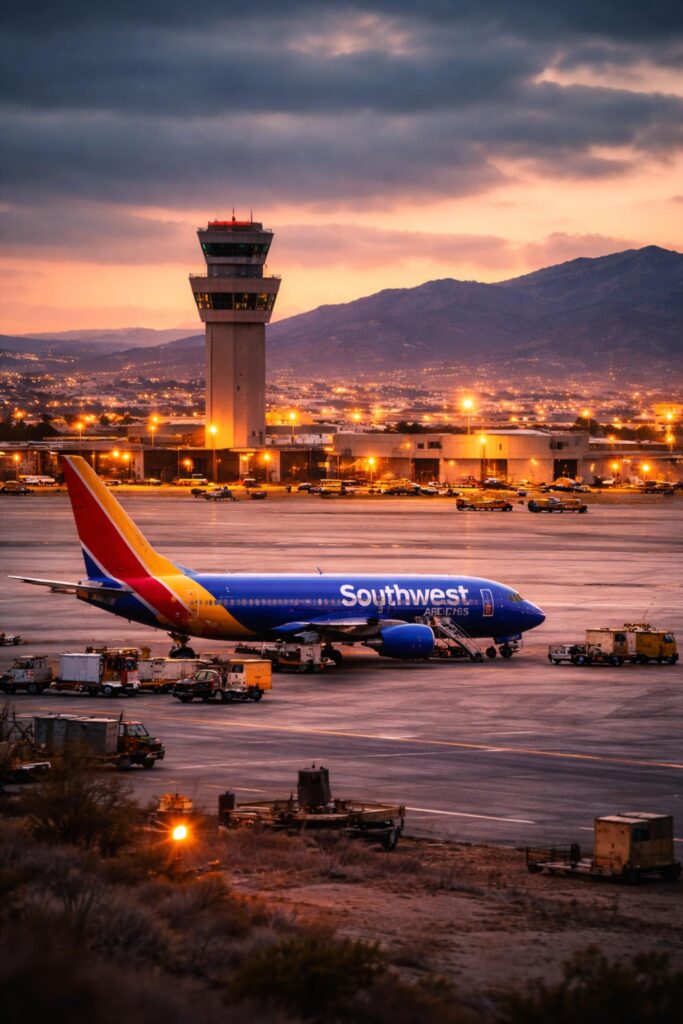

U.S. Aviation
The Federal Aviation Administration’s sudden closure of airspace around El Paso International Airport in February 2026 ended within hours, but later reporting revealed that concerns about a laser-based counter-drone operation played a central role in the disruption.
The FAA issued a temporary flight restriction late on February 10, citing “special security reasons.” It covered a 10-nautical-mile area around El Paso and extended from the ground to 17,999 feet, effectively stopping commercial, cargo, medical and general aviation flights.
The order was originally scheduled to remain in force until February 20. However, the FAA cancelled the El Paso restriction on the morning of February 11 and said there was no continuing threat to commercial aviation. Flights then began returning to normal.
Latest confirmed status: El Paso International Airport is operating normally, and the February restriction is no longer active. A related restriction around Santa Teresa, New Mexico, was removed on the evening of February 12.
“`Current restrictions can be checked through the FAA’s official temporary flight restriction system.
“`Restriction issued: Late February 10, 2026.
Original end date: February 20, 2026.
El Paso reopened: Morning of February 11.
Main disruption: More than a dozen flights were cancelled.
Counter-drone laser concerns were behind the shutdown
The Trump administration initially said Mexican cartel drones had entered U.S. airspace and were neutralised. Transportation Secretary Sean Duffy said the action had concluded and that commercial aircraft were no longer in danger.
Subsequent Associated Press reporting provided a more detailed explanation. According to people familiar with the operation, U.S. Customs and Border Protection deployed a laser-based counter-drone system without fully coordinating its use with the FAA.
The FAA reportedly grounded aircraft because of concerns about operating the laser system near civilian flight paths. Laser and other directed-energy systems can pose risks if they interfere with aircraft, pilots or onboard equipment, making close coordination essential near a commercial airport.
Homeland Security Secretary Kristi Noem later acknowledged that the agencies involved were working through communication issues arising from the joint operation. Officials did not release a complete public account identifying how many drones were involved or precisely where they were detected.
The new information means the closure should not be described simply as a direct response to cartel drones. The reported safety concerns surrounding the government’s own counter-drone equipment were an important part of the FAA’s decision.
Passengers and emergency flights were affected
The closure caused immediate confusion because airport officials and local leaders received little advance warning. Scheduled departures were cancelled, arriving aircraft were delayed or diverted, and passengers had to seek alternative flights.
El Paso Mayor Renard Johnson criticised the federal response, saying the restriction affected emergency medical aviation as well as normal airport operations. Representative Veronica Escobar also sought clearer information about why such a broad order had been issued with limited local coordination.
Even after the restriction was lifted, airlines needed time to restore their schedules. Aircraft and crews left in the wrong cities can delay later services, while flight crews may reach legal working-time limits during an extended ground stop.
Why the incident matters for U.S. aviation
The episode highlighted the growing challenge of defending sensitive locations from unauthorised drones without creating new risks for passenger aircraft. Counter-drone technology can include radar, radio-frequency interference, interception systems and directed-energy equipment.
Congress expanded federal authority to respond to rogue drones in late 2025, increasing the number of agencies that may conduct such operations when properly trained. The El Paso shutdown showed why shared procedures and real-time communication with aviation regulators remain necessary.
The issue has become more urgent as federal authorities prepare security plans for major events, including international football matches and other large public gatherings. Government figures cited by the Associated Press indicated more than 27,000 drone sightings were recorded near the southern border during a six-month period.
For passengers, the practical position is now clear: the El Paso and Santa Teresa restrictions have expired, and there is no continuing shutdown connected to the February incident. Travellers should check airline notifications and official airport updates for any new disruption.
More U.S. aviation and transport updates are available as airports and regulators respond to flight disruptions and airspace safety concerns.

Make Swikblog your go-to source on Google for reliable updates, smart insights, and daily trends.