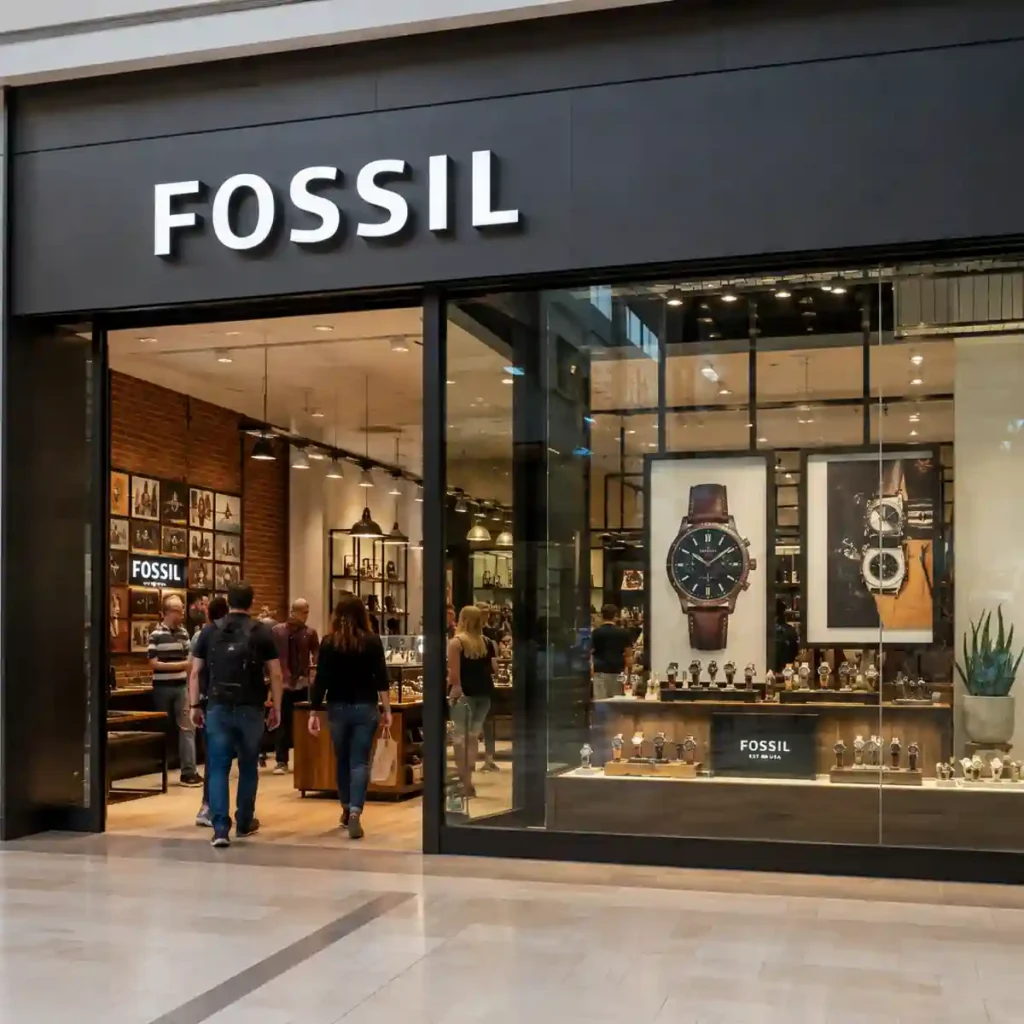

Fossil Group has spent more than five years shrinking the global store network that once made its watches, jewelry and leather goods a fixture in shopping malls. The company operated 395 stores worldwide in April 2021. By July 4, 2026, that footprint had fallen to 176 locations — 219 fewer stores, a decline of about 55%.
That number can easily be misunderstood. Fossil has not announced that 219 stores are closing in 2026. Instead, the figure reflects the cumulative reduction in its company-operated store base since 2021 as Fossil exited weaker locations, reworked parts of its international business and pushed ahead with a broader cost-cutting strategy.
The pace of closures has recently slowed. Fossil closed six stores during its latest quarter, while 11 locations in South Africa moved to a distributor model. Management said just two additional closures are currently planned for the rest of 2026 and expects the company to finish the year with roughly 178 locations worldwide.
How many Fossil stores are still open in 2026?
Fossil’s biggest retreat has taken place in Europe. The company operated 137 stores across the region in April 2021, but only 35 remained by July 2026. The Americas declined from 170 locations to 90, while the Asian store count dropped from 88 to 51.
| Region | April 2021 | July 2026 | Reduction |
|---|---|---|---|
| Americas | 170 | 90 | 80 |
| Europe | 137 | 35 | 102 |
| Asia | 88 | 51 | 37 |
| Total | 395 | 176 | 219 |
The European footprint has fallen by roughly 74% compared with 2021, making it by far Fossil’s sharpest regional contraction. The company also closed 49 stores during 2025, but management’s latest comments suggest the most aggressive phase of the portfolio overhaul may now be largely complete.
Fossil’s strategy mirrors a broader change across the retail industry, where companies are increasingly willing to shut underperforming locations while investing in stores and markets that still generate attractive returns. Similar concerns have surrounded Papa Murphy’s store closures in 2026, where individual closures have also raised questions about the health of the wider business.
Is Fossil going out of business?
Despite the dramatic decline in store numbers, Fossil has not announced plans to shut down its global business. The company continues to operate physical stores and has indicated that retail remains an important part of its strategy alongside online sales, wholesale partners and distributors.
Some of the concern around Fossil has also come from its financial restructuring. A British subsidiary entered a UK restructuring process that later received Chapter 15 recognition in the United States. That proceeding was tied to financial obligations and should not be confused with a liquidation of Fossil Group’s worldwide operations.
Closing stores and restructuring debt can be part of an attempt to stabilize a retailer rather than a signal that every location is disappearing. Other large retailers have faced similar scrutiny, including Albertsons amid its 2026 restructuring and store closures, as companies reassess costs and individual locations without abandoning their wider businesses.
Fossil sales fall 4.9% as margins strengthen
Fossil’s second-quarter 2026 numbers offer a clearer picture of why management appears less eager to keep cutting stores at the same pace.
Net sales declined 4.9% year over year to $209.7 million, compared with $220.4 million a year earlier. The decline in revenue was accompanied by a substantial improvement in profitability at the gross-margin level. Gross margin rose to 62.4% from 57.5%, a gain of 490 basis points.
That improvement helped gross profit increase to $130.8 million from $126.7 million even though Fossil generated less revenue. The company also reported approximately $3 million in operating income. On a constant-currency adjusted basis, management said operating income was about $9 million, roughly double the comparable figure.
Investors and customers can review the company’s latest earnings releases and financial materials through Fossil Group’s quarterly results.
There were also encouraging signs in two important markets. Fossil highlighted strength in the United States, while India delivered double-digit second-quarter growth across Fossil, Armani, Diesel and Michael Kors. Growth in India extended across both wholesale and direct-to-consumer channels.
JCPenney Stores Closing: Ross Park Mall Store Launches Closing Sale
Why is Fossil closing stores?
The pressure on Fossil is about more than declining mall traffic. The traditional fashion-watch market has changed significantly as smartwatches and connected devices from Apple, Samsung and other technology companies compete for the same consumer spending.
At the same time, running a large network of physical stores carries substantial fixed costs, including rent, staffing, inventory and administration. Removing weaker locations gives Fossil an opportunity to reduce those expenses while directing investment toward stores that generate stronger returns.
The company can also reach customers without relying entirely on its own shops. E-commerce, department stores, wholesale partners and international distributors give Fossil several ways to sell its brands even as its company-operated footprint becomes smaller.
Under CEO Franco Fogliato, Fossil has been pursuing a multiyear turnaround that has included more than $100 million in SG&A cost reductions. The company has also placed greater emphasis on full-price selling rather than relying heavily on discounting, while reshaping its business around a more focused omnichannel model.
Its recent decisions suggest management does not view every physical store as a liability. Fossil has extended leases at more than 25 stronger-performing locations in the Americas, reinforcing its position that brick-and-mortar retail still has a role alongside digital and wholesale channels.
Fossil store closures in 2026: What customers need to know
Anyone searching for a list of 219 Fossil stores closing in 2026 should be cautious with that figure. There is no newly announced list of 219 locations scheduled to disappear this year. The number represents the difference between Fossil’s 395 company-operated stores in April 2021 and its 176 stores as of July 2026.
The company’s latest quarter ended with 176 stores, and management says only two more closures are currently planned for the remainder of the year. Fossil expects to have approximately 178 locations globally by the end of 2026, reflecting other changes within the portfolio as well as planned closures.
There are also signs that management sees the business moving toward a more stable phase. Fossil raised its full-year sales outlook and now expects worldwide revenue to decline between 3% and 5%, compared with its previous forecast for a 4% to 6% drop.
The company is targeting a return to year-over-year sales growth in the fourth quarter while continuing to improve profitability and generate positive free cash flow. Whether that momentum can continue will depend on the performance of its core watch brands, consumer demand and Fossil’s ability to turn better margins into sustained revenue growth.
For customers, the picture is therefore more nuanced than the headline store count might suggest. Fossil has unquestionably become a much smaller physical retailer than it was five years ago, but it remains an operating global brand selling through its own stores, websites, wholesale partners and distributors. The next test is whether that leaner footprint can support a lasting turnaround rather than simply a smaller version of the business Fossil once operated.

Make Swikblog your go-to source on Google for reliable updates, smart insights, and daily trends.