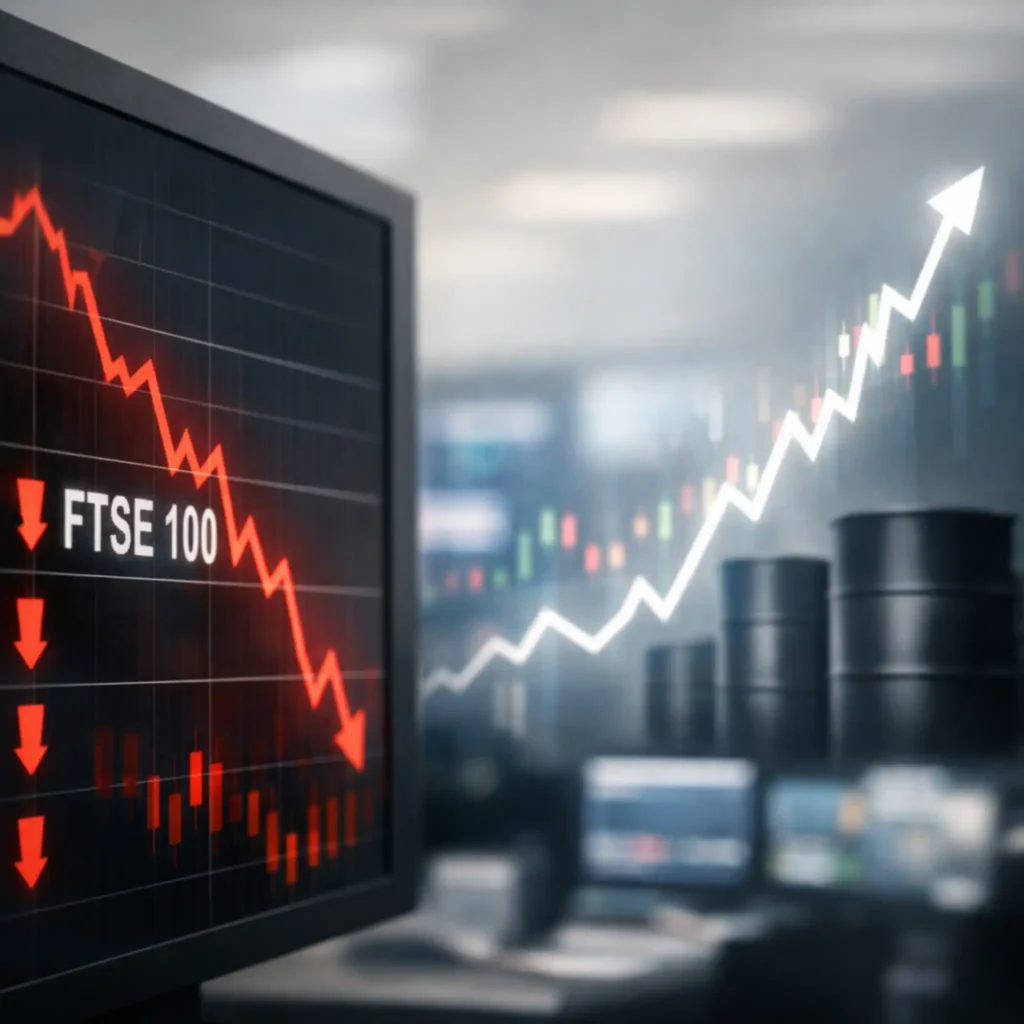

The FTSE 100 came under heavy pressure on Monday, sliding almost 190 points in early trade as a violent move in crude oil rattled investors and reignited fears of a broader inflation and growth shock across global markets. London’s benchmark index dropped to around 10,091, a level not seen since the second week of January, after oil prices leapt sharply on worsening conflict in the Middle East and growing disruption fears around the Strait of Hormuz.
The sell-off was broad and immediate. Investors moved away from travel, industrials, banks, insurers, retailers and property names as the market tried to price in the damage that a prolonged energy shock could do to demand, company costs and consumer confidence. At the same time, the sharp rise in crude created a narrow pocket of strength for energy majors, with Shell and BP among the only risers in the blue-chip index during the early part of the session.
Related reading:
Oil shock becomes the market’s biggest problem
The scale of the oil move quickly became the dominant story. Brent crude, which had already climbed from the mid-$80s to just below $92 by the end of last week, surged above $116 at one stage in Asia trading before easing back closer to the $106 area. That kind of jump in such a short time is exactly the sort of move that can destabilize equity markets, especially in sectors that are highly exposed to fuel, freight and input costs.
For FTSE investors, the concern was not simply the oil price itself, but the signal behind it. Markets were suddenly forced to confront the risk of supply interruptions, shipping disruption, higher insurance costs, tighter energy availability and the possibility that inflation could stay hotter for longer just as growth expectations start to weaken. That combination is rarely friendly for equities, and it helps explain why the early losses were so aggressive across large parts of the London market.
Shell and BP stand out as rare winners
Energy stocks provided one of the few bright spots. Shell rose around 1.7% and BP gained about 1.55% in the opening phase of trading as investors rotated toward companies that could benefit from stronger crude prices. When oil spikes, integrated energy groups often attract defensive flows because higher realized prices can support earnings, cash flow and dividend expectations, even while the wider market struggles.
That divergence was clear across the FTSE 100. While most sectors were sinking, the oil majors were effectively acting as partial shock absorbers for the index. Even so, their gains were nowhere near enough to offset the intense weakness elsewhere, which showed just how widespread the risk-off mood had become.
Miners, industrials and travel stocks lead the declines
The heaviest losses were concentrated in cyclical sectors. Anglo American fell 6.3% and Antofagasta dropped 5.7% as weaker copper prices and a deteriorating growth outlook hit miners hard. Industrial names were also under pressure, with Rolls-Royce, IMI and Spirax among those falling between roughly 4% and 5% as traders assessed the implications of slower trade flows, cost pressure and weaker demand.
Travel-related stocks were hit in the same wave of selling. IAG, easyJet and hotel group IHG all moved sharply lower as investors priced in the damage that high fuel prices and geopolitical uncertainty can inflict on airlines and the broader tourism trade. Luxury retail was not spared either, with Burberry also sliding as the market shifted away from consumer-facing names that could suffer if households and corporate customers pull back.
Banks, insurers and property developers joined the retreat, showing that this was not a narrow commodity story but a full-spectrum repricing of risk. When oil moves violently higher, markets often start worrying about everything at once: margins, central bank policy, borrowing costs, logistics, trade routes and business sentiment.
Why investors are watching the Strait of Hormuz so closely
The market’s anxiety is centered on the possibility of prolonged disruption in one of the world’s most important energy chokepoints. Any effective closure or severe disruption around the Strait of Hormuz can rapidly change the global supply picture, sending traders scrambling to secure barrels and pushing volatility higher across oil, shipping and equities. That is why the move in crude has been so intense and why London, with its heavy weighting toward internationally exposed companies, reacted so sharply.
Analysts have also warned that the current shock carries echoes of earlier commodity crises. Comparisons are already being drawn with past periods when geopolitical conflict, supply bottlenecks and broader market stress fed into each other, creating a domino effect across prices and sentiment. That is a particularly uncomfortable backdrop for the FTSE 100 because many of its largest names are tightly linked to global trade, industrial activity and consumer demand.
Emergency reserve talks add another layer to the story
Adding to the significance of Monday’s move, G7 countries were reported to be preparing talks on a possible release of emergency oil reserves. According to reports, the International Energy Agency coordinated a call between G7 finance ministers, with some officials backing a joint release that could total hundreds of millions of barrels. The very fact that policymakers are discussing reserve action underlines how seriously governments are taking the latest surge in crude.
For investors, that discussion offers two messages at once. On one hand, it suggests authorities are prepared to act if the oil shock worsens. On the other, it confirms that the disruption risk is severe enough to justify emergency coordination. Markets usually pay close attention when reserve releases enter the conversation because it signals that the stress is no longer theoretical.
For now, the FTSE 100 remains highly sensitive to every headline tied to oil, shipping and the conflict itself. If crude stays elevated or climbs again, pressure on miners, airlines, retailers and financials could remain intense, while energy majors may continue to outperform. Monday’s plunge was not just another weak session for London stocks. It was a sharp warning that energy shock risk has returned to the center of the market narrative.
You May Also Like:
Follow official energy market updates from the International Energy Agency

Make Swikblog your go-to source on Google for reliable updates, smart insights, and daily trends.