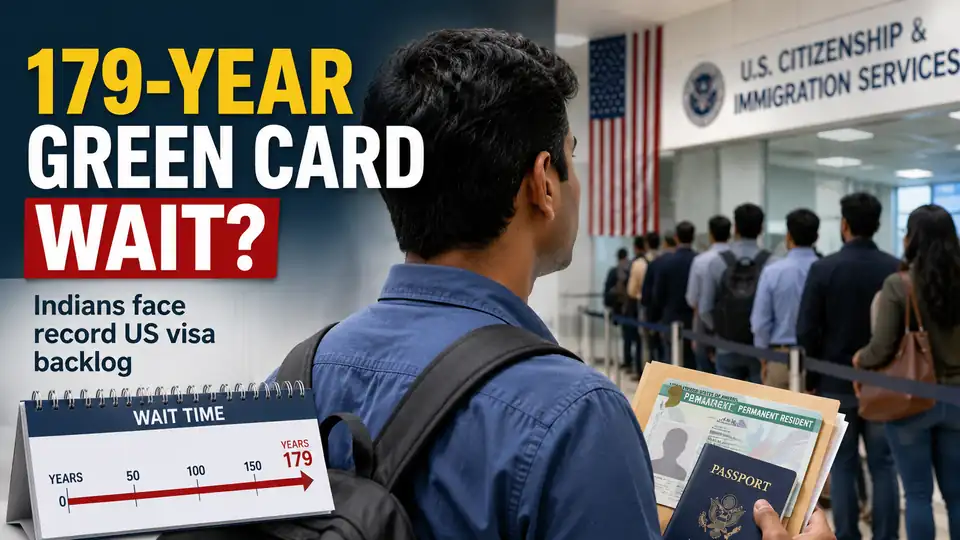

WASHINGTON — A highly skilled worker from India entering one of the most congested US employment-based green card categories in 2026 could face a projected wait of 179 years for permanent residence, according to a new immigration policy analysis.
The estimate applies specifically to Indian nationals with a labor certification application or employment-based immigrant petition filed in January 2026 or later under the second employment-based preference, known as EB-2. It is not an official processing time, a guaranteed deadline or the expected wait for every Indian immigrant.
The projection appears in an August 2026 report from the National Foundation for American Policy, or NFAP. The group estimates a 38-year wait for a newly filed Indian EB-3 case and a four-to-five-year wait in EB-1 if current patterns and immigration limits remain broadly unchanged.
NFAP estimated that 1,264,495 people were waiting across the EB-1, EB-2 and EB-3 categories as of December 2025. Indian nationals and their dependent family members accounted for about 996,599 of them, or 79%.
The Indian backlog included an estimated 731,566 people in EB-2, 213,414 in EB-3 and 51,619 in EB-1. NFAP derived the totals from US Citizenship and Immigration Services petition data and added an estimate for spouses and children, who also consume visa numbers.
Key numbers: NFAP projects waits of 179 years for a new Indian EB-2 applicant, 38 years for EB-3 and four to five years for EB-1. These estimates could change if visa demand falls, applicants leave the queue or Congress changes the law.
Why the Indian green card backlog has become so severe
Two limits built into US immigration law drive the bottleneck. Congress set a base annual ceiling of 140,000 employment-based immigrant visas in 1990. That total includes not only sponsored workers but also their spouses and children.
The law also generally prevents nationals of any one country from receiving more than 7% of the available family-sponsored and employment-based preference visas in a fiscal year. The rule applies equally regardless of a country’s population or the number of qualified applicants, leaving high-demand countries such as India and China with much longer queues.
Unused visa numbers can sometimes flow between categories or from the family-sponsored system into employment-based immigration. Those spillovers temporarily increased the number of employment green cards issued after pandemic-era disruption, but NFAP found that the overall backlog in the first three employment preferences still grew 20.6% between April 2020 and December 2025.
The pressure is greatest in EB-2, which covers many professionals with advanced degrees and people with exceptional ability. EB-3 includes skilled workers, professionals and certain other workers, while EB-1 covers categories such as people with extraordinary ability, outstanding professors and researchers, and some multinational executives.
The State Department’s September 2026 Visa Bulletin provides the government’s monthly snapshot of which priority dates can move forward. A priority date is generally tied to when a labor certification or qualifying immigrant petition was filed. Movement in the bulletin can advance, stop or move backward depending on demand and the number of visas available.
That is why the 179-year figure should be understood as a backlog projection rather than a countdown clock. NFAP calculated how long a new entrant could wait based on the size of the queue and the rate at which green cards are available under existing limits. Future legislation, category spillovers, withdrawals and shifts in demand could materially change the result.
Trump restrictions add uncertainty, but did not create the decades-old cap
The latest analysis arrives as President Donald Trump’s administration pursues tighter legal-immigration policies. Those actions may affect employers, temporary visa holders and the supply of visas that can spill into employment categories. One recent example is a USCIS adjustment-of-status policy change that created fresh uncertainty for immigrants applying for permanent residence from inside the United States. However, the numerical ceiling and per-country constraint at the heart of the Indian backlog were established by Congress decades ago.
That distinction is important. It would be misleading to attribute the full 179-year estimate solely to recent White House policy. NFAP said restrictions affecting family immigration could produce unused family-sponsored numbers that later roll into employment categories, potentially changing future wait-time calculations. Other proposed measures could create different pressures for people trying to remain employed while waiting. Swikblog has separately reported on the Trump administration’s proposed H-1B wage increases, which could raise employer costs and reshape sponsorship decisions if implemented.
Many Indian professionals in the queue live in the United States on H-1B visas. Approved employment-based petitions can allow some workers to extend H-1B status beyond the usual six-year limit while they wait for a visa number, but their immigration position often remains closely connected to continued employment and sponsorship.
A job loss can therefore be especially disruptive. H-1B workers may receive a discretionary grace period of up to 60 days, or until their authorized stay expires if that occurs earlier, to find another qualifying path. That protection is itself under scrutiny, with a DHS proposal potentially threatening the H-1B 60-day grace period. Families can also face uncertainty when children approach age 21 and may no longer qualify as dependents under immigration rules.
The human impact extends well beyond a delayed document. Workers may postpone changing employers, launching businesses or making long-term financial decisions. Spouses and children can remain tied to temporary status for years, while companies risk losing experienced employees to countries offering a clearer route to permanent residence.
NFAP argues that reducing the queue would require Congress to change the annual limits, the treatment of dependents, the per-country formula or exemptions for certain highly skilled applicants. Previous proposals to eliminate per-country employment caps or exempt some advanced-degree holders have failed to become law.
For now, the report’s most striking number is best read as a warning about the structure of the system: under today’s rules and demand, many newly sponsored Indian EB-2 professionals may have no realistic prospect of receiving a green card within their lifetime.
This report provides general news and policy information and is not legal advice. Applicants should consult official US government guidance or a qualified immigration lawyer about individual cases.

Make Swikblog your go-to source on Google for reliable updates, smart insights, and daily trends.