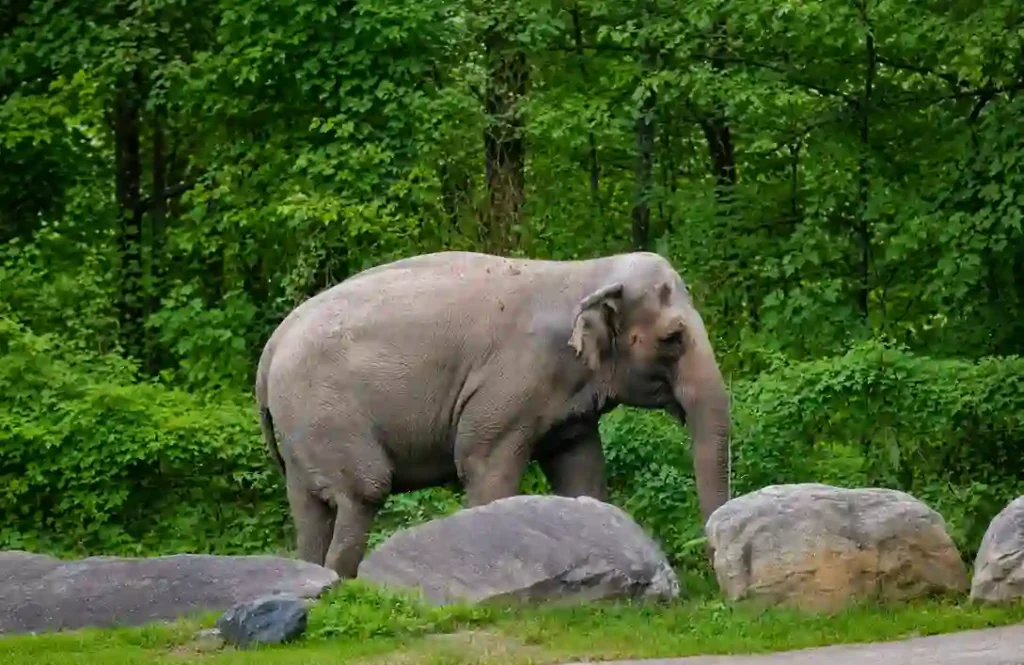

The Bronx Zoo euthanized Happy, its 55-year-old Asian elephant, on May 26, 2026, after her age-related medical conditions progressed and her quality of life declined. The elephant had lived at the New York City zoo for almost five decades and was known internationally for a self-recognition experiment and a closely watched animal-rights lawsuit.
The Wildlife Conservation Society, which operates the zoo, said Happy died peacefully in the presence of keepers, veterinarians and curators. Some had cared for her for more than 30 years.
Key details:
- Date of death: May 26, 2026
- Age: 55
- Bronx Zoo arrival: 1977
- Medical findings: Arthritis and inoperable uterine tumours
- Remaining zoo elephant: Patty, aged 57
What happened during Happy’s final weeks?
Happy’s condition declined despite treatment for health problems associated with advanced age. Veterinary teams monitored her appetite, mobility, behaviour and possible deterioration in kidney or liver function.
She received pain relief, nutritional assistance and hydration therapy as part of hospice-style care. Happy remained in familiar surroundings and could move between the elephant barn and an outdoor yard.
A necropsy conducted after her death found arthritis and several large uterine tumours that could not be removed. The zoo explained that internal tumours of this kind can be difficult to identify in elephants through ordinary examinations and medical imaging.
How Happy reached the Bronx Zoo
Happy was born in the wild in Asia and brought to the United States as a calf. She was one of several young elephants named after characters from Disney’s Snow White and the Seven Dwarfs.
She arrived at the Bronx Zoo in 1977, when she was approximately six years old. Keepers later described her as responsive and food-motivated, with watermelon and strawberries among her preferred treats. She was sometimes observed storing food in her ear for later.
Happy lived with different elephants during her early years. She was eventually housed separately from Patty because of compatibility concerns, although the animals retained visual, auditory and scent contact through barriers.
A scientific breakthrough in 2005
Happy gained worldwide attention after participating in a mirror self-recognition experiment. Researchers placed a visible mark above her eye where it could be detected only through her reflection.
After looking into the mirror, Happy repeatedly touched the mark with her trunk. Her response provided important evidence that elephants can recognise themselves rather than interpreting a reflection as another animal.
The experiment did not claim to measure every aspect of intelligence. It did, however, strengthen scientific understanding of elephant cognition and encouraged further research into the species’ memory, communication and emotional behaviour.
Happy’s scientific legacy remains relevant to wider animal awareness and wildlife conservation efforts that highlight the pressures facing elephants and other threatened species.
Why Happy became the centre of a court case
The Nonhuman Rights Project filed a legal petition in 2018 seeking to have Happy recognised as a legal person for the limited purpose of challenging her confinement through habeas corpus.
The organisation argued that Happy was autonomous and cognitively complex and should be transferred to an elephant sanctuary. The Bronx Zoo maintained that she was receiving professional care and that removing an elderly elephant from a familiar environment could create significant health and welfare risks.
New York’s Court of Appeals rejected the petition by a 5-2 majority in 2022. The court ruled that habeas corpus could not be extended to a nonhuman animal. Two dissenting judges disagreed, ensuring the ruling became an important part of the continuing debate over legal protections for animals.
What happens to Patty now?
Happy’s death left Patty, 57, as the Bronx Zoo’s only elephant. The Wildlife Conservation Society said on July 7 that Patty was healthy, active and regularly participating in enrichment activities with her keepers.
Relocation is being considered, but no final decision has been announced. Members of the zoo’s elephant-care team have visited the accredited Elephant Sanctuary in Tennessee while examining possible options.
The zoo said preparing Patty for transport would probably require at least 12 months of voluntary training. Officials must consider her age, medical needs, the stress of travel and whether she would successfully integrate with unfamiliar elephants.
More developments involving wildlife care, conservation and public safety can be followed through the site’s latest news and public-interest reports.
The Bronx Zoo decided in 2006 that it would gradually conclude its elephant program and stop acquiring additional elephants. Patty’s future will therefore determine how and when the facility’s long history of keeping elephants comes to an end.
Read More:
Why Happy’s story still matters
Happy occupied an unusual place in modern animal history. Her behaviour expanded scientific knowledge of elephant self-awareness, while her court case tested whether traditional legal protections could ever apply beyond humans.
For the people who cared for her, however, her death was more personal. It ended a relationship built through daily routines spanning generations of zoo employees—and closed nearly 50 years of Happy’s life in the Bronx.
Sources: Wildlife Conservation Society, official update on Patty and The Associated Press.

Make Swikblog your go-to source on Google for reliable updates, smart insights, and daily trends.