Alex Freeman’s first-half goal became one of the sharpest VAR moments of the USA’s World Cup meeting with Australia, as an offside call was overturned and the USMNT’s lead moved to 2-0 before the break.
The goal came in the late stages of the first half, after Sergiño Dest drove the attack from the right side and sent an effort toward goal. The shot took a deflection inside a crowded Australian penalty area, changing the path of the ball and forcing the defence to react quickly.
Freeman stayed alive at the far side of the play and met the loose ball with a header, turning it into the net from close range. The assistant’s flag initially went up for offside, briefly stopping the celebration and leaving the goal under review.
After the VAR check, the decision was changed and the goal was awarded. The review judged that Freeman was in a legal position when the decisive touch redirected the ball toward him, turning what first looked like an offside decision into a confirmed USMNT goal.
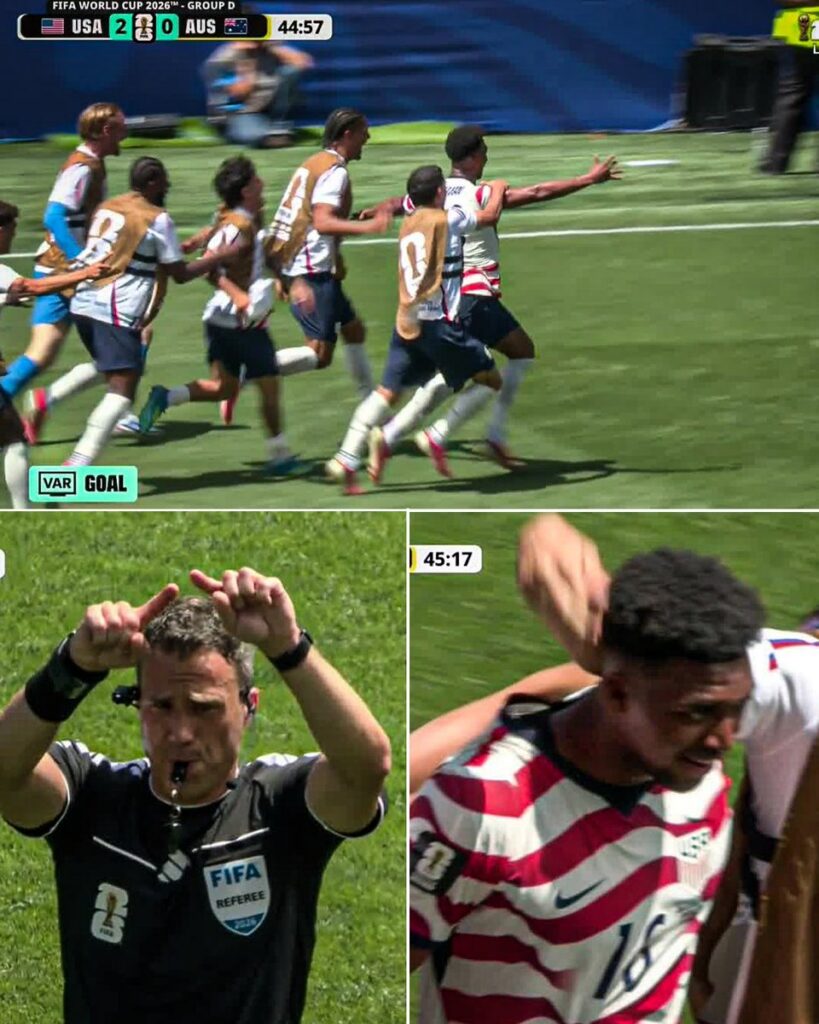
Goal detail: Alex Freeman headed in after a deflected Sergiño Dest shot. The goal was first ruled offside, then given after VAR review, putting the USA 2-0 ahead before half-time.
Freeman’s header changed the shape of the match
The technical detail mattered because the play was not a simple through ball behind the defence. Dest’s shot created the decisive phase, the deflection altered the ball’s direction, and Freeman’s position had to be checked against the timing of that touch.
That is why the VAR review became central to the goal. The original offside call suggested Freeman may have moved too early, but the replay process restored the goal and gave the United States a two-goal cushion at a critical point in the match.
The finish also came after an earlier USA breakthrough caused by pressure from Folarin Balogun. His low cross from the left forced Australia into trouble, with Cameron Burgess turning the ball into his own net while trying to stop the danger. The own goal put the USMNT ahead early and gave the hosts control of the tempo; for more background on the Australian defender, read this profile on Cameron Burgess and the USA own goal.
Australia had already been defending deep for long spells, with the USA working patiently against a compact back line. The second goal made that defensive approach harder to maintain, because the Socceroos suddenly needed to chase the match rather than simply absorb pressure and wait for a counter-attack.
Australia left with a difficult second-half task
The USA’s 2-0 lead reflected more than the scoreline. It showed how quickly pressure, deflections and review decisions can reshape a World Cup game. Australia had limited the number of clean American chances for stretches of the half, but two penalty-area moments left the Socceroos chasing a match that had started to tilt heavily toward the hosts.
Freeman’s goal was especially damaging because of its timing. A one-goal deficit at half-time would have kept Australia close enough to reset tactically, but the VAR-confirmed header gave the USMNT a stronger hold on the match and lifted the Seattle crowd just before the interval.
The match was part of Group D, where the United States, Australia, Türkiye and Paraguay are fighting for position. The official FIFA World Cup schedule lists USA v Australia as one of the key group fixtures, with both teams entering after opening wins.
For the USMNT, the goal gave Freeman a major tournament moment and strengthened the impression that the hosts could turn pressure into decisive chances even without needing long spells of clean finishing. For Australia, it left a far steeper climb after a first half shaped by an own goal, a deflection, a header and a VAR decision that turned offside into 2-0.

Make Swikblog your go-to source on Google for reliable updates, smart insights, and daily trends.