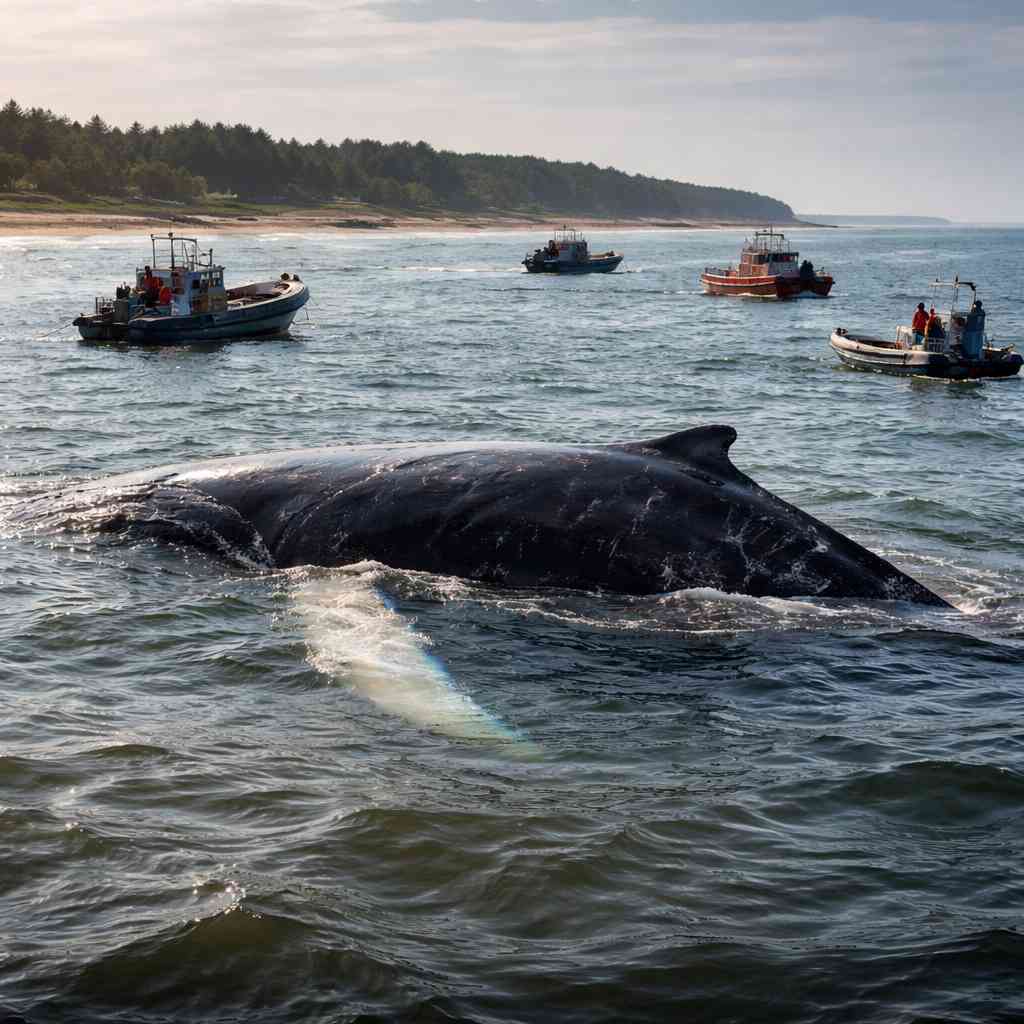

A young humpback whale named “Timmy” is at the centre of an urgent and emotional rescue effort off Germany’s Baltic coast, where it has spent nearly a week trapped in shallow waters, struggling to find its way back to the open ocean.
The whale, estimated to measure between 12 and 15 metres in length, has drifted into a series of shallow bays — an environment that is both unfamiliar and dangerous for a creature built for deep ocean travel. What began as a rare sighting has quickly turned into a race against time, with rescuers increasingly concerned about whether Timmy can survive the ordeal.
According to rescue teams and marine experts, the situation highlights just how difficult it is to guide such a massive animal once it enters restricted waters. Unlike smaller marine species, a humpback whale of this size cannot simply be redirected or physically moved without serious risk.
A young humpback whale, named Timmy by rescuers, was struggling to find its way out of shallow bays off the Baltic coast of Germany after a week-long ordeal that has put its survival in doubt pic.twitter.com/rmrkcAPLwY
— Reuters (@Reuters) March 29, 2026
Week-Long Ordeal in the Wrong Waters
Timmy’s struggle has now stretched into a week, and that duration alone is raising alarm. Humpback whales typically thrive in deep, open waters where they can move freely and dive without restriction. In contrast, the Baltic Sea — especially along parts of the German coastline — is known for its shallow bays, narrow passages and complex routes that can easily disorient large marine animals.
Experts say that once a whale enters this kind of environment, it may have difficulty navigating back out. The pathways toward the Atlantic Ocean are long and not straightforward, making every wrong turn costly in terms of energy and time.
Timmy’s size is also working against it. At up to 15 metres long, the whale has limited room to manoeuvre in shallow zones, increasing the risk of stress, exhaustion and even physical injury if it becomes stranded.
Rescue Efforts Intensify with Boats and Dredging Support
Rescue teams have been working continuously to guide the whale back toward safer waters. Their approach has involved a combination of boats and dredging equipment — a sign of just how serious and complex the operation has become.
Boats are being used to gently steer Timmy in the right direction, while dredging efforts aim to improve water depth in certain areas or create a clearer path for movement. The goal is not to force the whale, but to encourage it to follow a safer route that could eventually lead it back toward the Atlantic.
However, these efforts come with limitations. Rescuers must maintain a careful distance to avoid causing panic or distress, which could push the whale further off course. At the same time, they have to act quickly enough to prevent the situation from deteriorating.
The balance between intervention and restraint has become the defining challenge of this rescue mission.
Why Guiding a Whale Is So Difficult
Freeing a humpback whale is not as simple as directing it toward deeper water. These animals rely on instinct, sound and ocean currents to navigate, and when they find themselves in unfamiliar coastal environments, those natural cues can become unreliable.
In Timmy’s case, the Baltic’s geography adds another layer of difficulty. The route out involves navigating through narrow stretches and avoiding multiple shallow zones before reaching open sea. Even with human assistance, the whale must ultimately make the journey on its own.
Marine experts note that stress and fatigue can further complicate things. After several days in restricted waters, the whale may already be weakened, reducing its ability to respond to guidance or travel long distances.
This is why the rescue effort is not just about getting Timmy out of one bay — it is about setting it on a long and challenging route back to its natural habitat.
The situation has drawn attention far beyond Germany, with many people following updates closely. There is something deeply compelling about the image of such a powerful ocean animal struggling in an environment where it does not belong.
For rescuers, however, the focus remains practical. Every tide, every movement and every shift in direction matters. A small change could either bring Timmy closer to safety or push it further into danger.
For now, the outcome remains uncertain. There is still hope that the whale can be guided back toward deeper waters, but time is becoming a critical factor.
As the operation continues, Timmy’s story stands as a reminder of both the vulnerability of even the largest marine creatures and the limits of human control in such delicate situations.
More details on the rescue effort can be found in this latest Reuters report, as teams continue their work along the Baltic coast.