
By Chetan Sharma
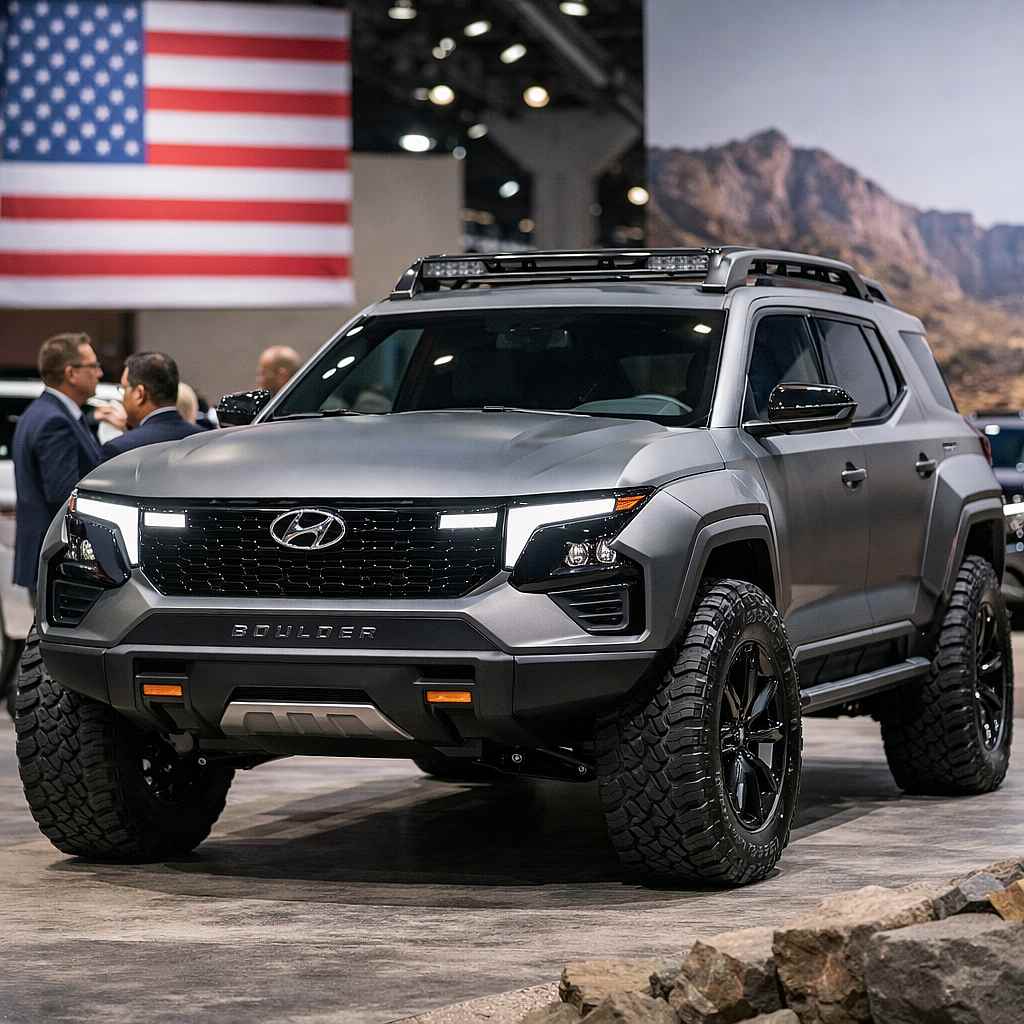
Hyundai Motor Co. (005380.KS) is back in focus after its stock climbed to 471,000 won, gaining 1.18%, following a headline-grabbing reveal at the New York International Auto Show. The company unveiled its rugged ‘Boulder’ concept SUV, signaling a decisive move into the highly profitable US body-on-frame truck segment—a space long dominated by Ford, General Motors, and Stellantis’ Ram.
The timing is notable. Hyundai is aiming for a sixth consecutive year of record US retail sales, and leadership believes expanding into trucks could be the next growth lever. “Customers are telling us they want more,” Hyundai North America CEO Randy Parker said, reinforcing that this is not a one-off concept but part of a broader strategy.
The Boulder concept itself makes that ambition clear. Built with 37-inch off-road tires, a solid rear axle, and a flexible tailgate, the SUV leans heavily into rugged capability. Hyundai’s new “Art of Steel” design language gives it a bold, industrial look that has already drawn comparisons to Ford’s Bronco. Rather than avoiding those comparisons, Hyundai is using them to signal its readiness to compete directly in the segment.
Truck strategy, US expansion, and 2030 roadmap
The Boulder is more than a concept—it’s a preview of Hyundai’s entry into body-on-frame vehicles over the next few years. The company confirmed plans to launch a midsize pickup truck by 2030, specifically designed for the US market. This truck will be built locally using steel from a new Hyundai plant in Louisiana, highlighting a deeper push into American manufacturing.
This move is part of a much larger pipeline. Hyundai plans to introduce 36 new vehicles in North America this decade, spanning internal combustion, hybrid, and electric models. The company is positioning itself to capture demand across all powertrains, rather than betting on a single transition path.
At the center of this strategy is Hyundai’s $12.6 billion Metaplant America facility in Savannah, Georgia. Phase one of the plant is set to produce 300,000 vehicles annually, with phase two targeting 500,000 units by 2030. The project is expected to create around 8,700 jobs, making it one of Hyundai’s largest global investments.
Currently, the Georgia plant is focused entirely on electric vehicles, including the IONIQ 5, which has seen strong year-over-year growth despite the removal of US federal EV tax credits. Hyundai is now moving to add hybrid production at the facility, aligning with its “multi-powertrain” approach that allows customers to transition gradually toward electrification.
The broader goal is clear: Hyundai wants to localize production and reduce exposure to global risks. The company is targeting 80% localized production in the US by 2030, a move aimed at minimizing tariff impacts and stabilizing costs.
Supply chain risks and global pressures emerge
While the growth story is gaining momentum, Hyundai is also facing immediate challenges. The automaker warned that exports to Europe and North Africa are being disrupted due to ongoing conflict in the Middle East, which has affected key shipping routes. These disruptions are increasing logistics costs, delaying deliveries, and putting pressure on suppliers.
Hyundai’s logistics unit, Hyundai Glovis, has been forced to reroute shipments and temporarily store cargo at alternative hubs, including locations like Sri Lanka. Restricted access to certain routes and rising fuel costs are further impacting efficiency.
The company has cautioned that even if the conflict ends soon, supply chain recovery will take time. This adds uncertainty to an already volatile global trade environment, where tariffs and geopolitical risks continue to shift.
Recent sales data reflects some of these pressures. Hyundai reported global sales of 358,759 vehicles in March, down 2.3% year-over-year. Domestic sales fell 2.0%, while overseas sales declined 2.4%. At the same time, South Korea’s exports to the Middle East dropped sharply by 49%, highlighting the scale of disruption.
Despite these headwinds, Hyundai’s stock reaction suggests investors are focusing on the long-term strategy. The combination of US truck expansion, localized manufacturing, and a diversified product lineup positions the company to compete more aggressively in one of the world’s most profitable auto markets.
The key question now is execution. Entering the US truck segment is not just about launching a product—it requires brand credibility, dealer strength, and sustained demand. Hyundai appears ready to take that risk, and early signals from both the market and consumers suggest the move is being taken seriously.
For ongoing updates and detailed market coverage, readers can follow developments on Yahoo Finance.
You may like: ASML stock drops on U.S.-China chip export restrictions under the MATCH Act

Make Swikblog your go-to source on Google for reliable updates, smart insights, and daily trends.