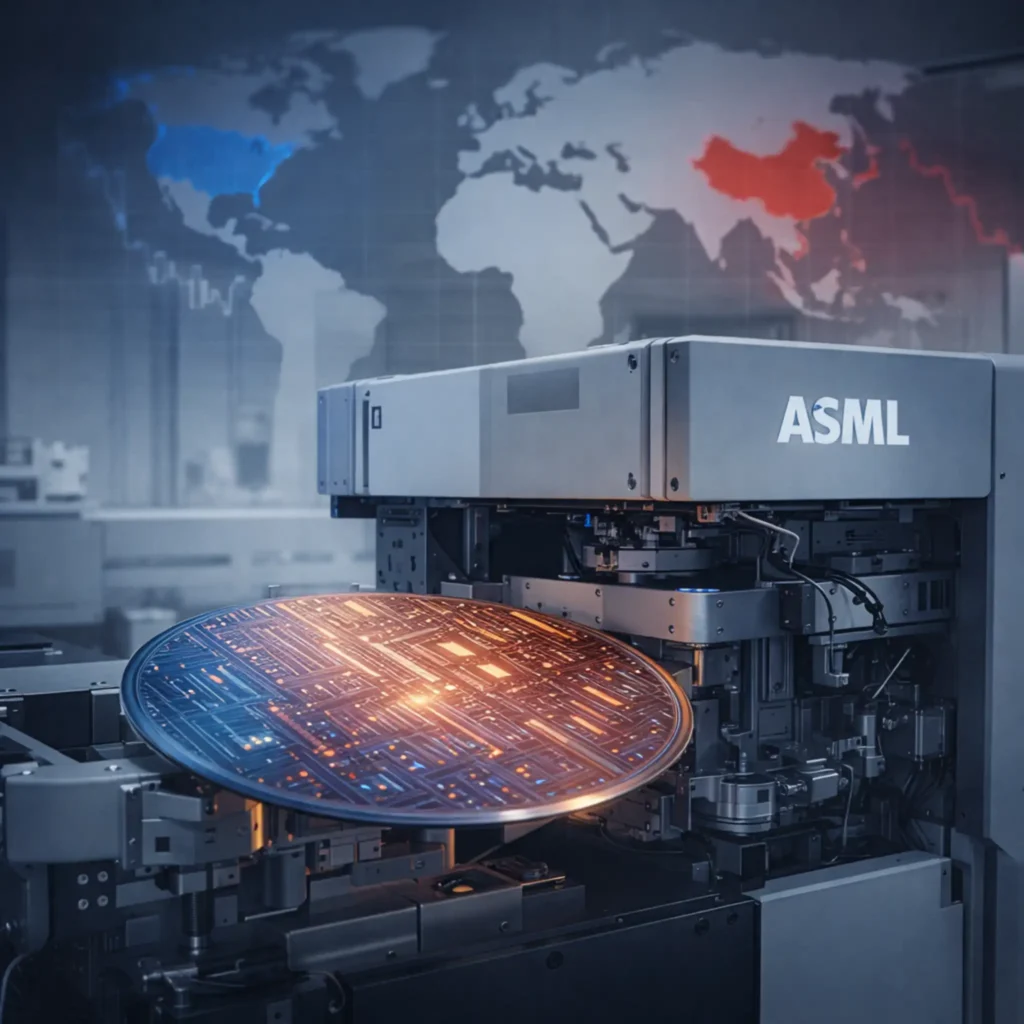

ASML shares dropped sharply after a fresh U.S. policy move threatened to tighten the pressure on China’s chipmaking supply chain, bringing one of the semiconductor industry’s biggest geopolitical fault lines back into focus. The stock closed at $1,317.23, down $42.53 or 3.13%, while after-hours trading showed a modest rebound to around $1,321.50. For investors, the decline was not just a reaction to another Washington headline. It reflected a deeper worry that ASML’s access to one of its most important markets could narrow again at a time when the company still trades with premium expectations built into its valuation.
The trigger was a proposed U.S. bill called the MATCH Act, put forward by a cross-party group of lawmakers who want tighter export restrictions on advanced chipmaking equipment going into China. The proposal is aimed at preserving the U.S. lead in artificial intelligence by limiting China’s access to tools it still cannot fully produce on its own. That puts ASML directly in the spotlight because the Dutch company remains the dominant force in lithography systems used to manufacture advanced semiconductors, especially in immersion DUV technology, an area where China still depends heavily on imported equipment.
The fresh proposal matters because it goes beyond the restrictions already in place. Existing Dutch and U.S.-aligned export controls already block ASML from shipping its most advanced EUV systems to China. However, ASML has continued to sell older DUV lines to Chinese customers and to foreign chipmakers operating fabs inside China. The new law would go further by targeting those channels too, while also aiming to prevent the sale or servicing of equipment used by leading Chinese chipmakers including SMIC, Hua Hong, Huawei, CXMT and YMTC. That servicing angle is especially important because it raises the risk not only to future machine sales but also to the recurring business tied to maintaining installed tools.
According to Reuters, lawmakers framed the bill as a way to stop Chinese groups from obtaining chipmaking tools from companies based in allied countries when similar restrictions already apply to U.S. firms. That point is crucial for ASML because its machines sit at the heart of the global semiconductor production chain, giving the company both enormous pricing power and a constant presence in export-control debates.
China exposure is driving the market reaction
China was ASML’s largest market in 2025, accounting for 33% of sales. The company had already said earlier this year that the share was expected to decline to around 20% in 2026, but the MATCH Act proposal now raises the possibility that this reduction could become more severe if allied governments align behind stricter rules. That is why Friday’s share-price drop felt meaningful. Investors are reassessing whether ASML can replace any lost momentum from China quickly enough through demand in other regions, even with strong long-term industry tailwinds in AI and high-performance computing.
Market data from the session showed how intensely traders reacted. ASML opened at $1,305.41 and moved within a day’s range of $1,298.18 to $1,356.20. The stock’s 52-week range stands at $578.51 to $1,547.22, underlining just how large the swings can be when sentiment around the semiconductor cycle and geopolitical risk shifts together. The company’s reported market cap was about $517.222 billion, with volume of 1,880,998 shares, EPS of 28.58, a P/E ratio of 46.09, and a one-year target estimate of $1,475.61. That target is the reason the current sell-off looks so important: the upside case still exists, but it now has to compete with a bigger policy discount.
Fresh corporate pressure adds to the uneasy backdrop
The export-control shock did not arrive in isolation. Reuters also reported that more than 1,000 ASML employees took part in a lunchtime walk-out at the company’s Veldhoven headquarters in protest over planned job reductions. The protest was tied to a reorganization that includes cuts of 1,700 jobs, or roughly 3.8% of staff. That labor tension adds another uncomfortable layer for investors because it suggests ASML is not only managing external geopolitical risk, but also navigating internal pressure as it reshapes operations.
ASML declined to comment on the draft U.S. legislation, while the Dutch foreign ministry said it was not its place to comment on draft laws proposed by another country. That leaves the market in a familiar position: waiting for policy to become clearer while trying to price the risk before formal decisions are made. For a company with ASML’s market position, the long-term story is still powerful. It remains central to global chip production, faces very limited direct competition in its highest-value technologies, and continues to benefit from structural semiconductor demand.
But Friday’s drop showed that investors are no longer treating China as a secondary issue in the ASML story. The company’s technological advantage is still intact, yet the political environment around that advantage is growing more complicated. If the proposed U.S. bill gains traction, the debate around ASML will shift even more decisively from simple growth potential toward the harder question of how much of that growth can survive a tighter global export regime.

Make Swikblog your go-to source on Google for reliable updates, smart insights, and daily trends.