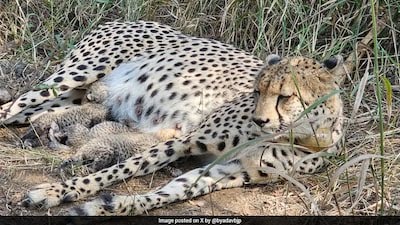

India’s ambitious effort to bring cheetahs back to its forests has reached a significant milestone, as an India-born cheetah has delivered four cubs in the wild at Kuno National Park. The development pushes the country’s total cheetah population to 57, marking one of the most encouraging signs yet for the long-term success of Project Cheetah.
This birth stands apart from earlier ones. Unlike previous litters that occurred within controlled enclosures, these cubs were born in the open forest, making it the first confirmed instance of a wild birth since the reintroduction programme began in 2022.
The mother, a young female cheetah born in India and descended from a South African lineage, has reportedly been living in the wild for over a year. Wildlife officials monitoring the development have indicated that both the mother and her cubs appear healthy and stable, with experts observing from a safe distance to avoid disturbance.
The moment has been described as a turning point for conservationists who have closely followed the project since its launch. The programme, which aims to reintroduce cheetahs after their extinction in India in 1952, has faced both optimism and scrutiny in recent years.
Earlier, in November 2025, another India-born cheetah named Mukhi had delivered five cubs, marking the first time a locally born cheetah reproduced. The latest development builds on that progress but goes further by demonstrating that cheetahs are now successfully adapting to open forest conditions, a key goal of the initiative.
Kuno National Park, located in Madhya Pradesh, has become the focal point of this conservation effort. At present, 54 cheetahs are housed within the park, while a small number have been relocated to nearby sanctuaries to expand their range.
The reintroduction effort has involved international collaboration, with cheetahs brought in from Namibia, South Africa, and more recently Botswana. In February this year, nine cheetahs from Botswana were added to the programme and have since adapted well after completing their quarantine period.
Despite these successes, the journey has not been without challenges. Since the programme began, 21 cheetahs — including both translocated adults and India-born cubs — have died due to a variety of factors. These losses have prompted ongoing discussions among scientists about the long-term sustainability and strategy of the project.
Still, the latest birth in the wild offers a powerful signal that India’s ecosystem is gradually becoming more conducive for cheetahs to thrive again. Conservation experts continue to track their movement, hunting patterns, and health as the species slowly reclaims its place in the country’s natural landscape.
The development also reinforces the broader global importance of large carnivore conservation. Similar reintroduction efforts in Africa and other regions have shown that success often depends on sustained monitoring, habitat stability, and careful population management — principles now guiding India’s approach as well. More insights into global conservation strategies can be explored through WWF’s cheetah conservation work.
As Kuno continues to evolve into a thriving habitat, the birth of these four cubs quietly signals something larger — a rare second chance for a species once lost from the Indian wild.

Make Swikblog your go-to source on Google for reliable updates, smart insights, and daily trends.