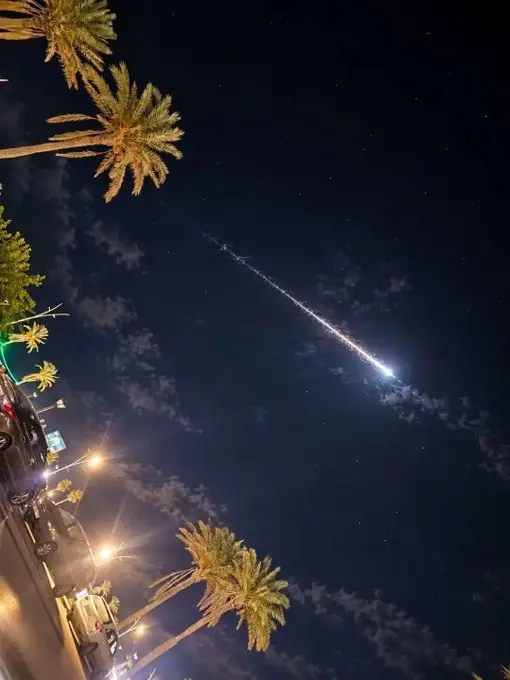
Astronomers around the world are closely monitoring a rare cosmic visitor as Interstellar Comet 3I/ATLAS makes its closest approach to Earth on December 19. The event is drawing significant scientific attention because the object is only the third confirmed interstellar body ever observed passing through our solar system.
Unlike typical comets that originate from the Kuiper Belt or Oort Cloud, 3I/ATLAS is believed to have formed around a completely different star before being ejected into interstellar space. Its current trajectory confirms that it is not gravitationally bound to the Sun, meaning this visit is a one-time encounter.
Why Interstellar Comet 3I/ATLAS Is So Rare
Interstellar objects are exceptionally difficult to detect. They travel at extreme speeds and often remain faint until they are already leaving the inner solar system. Prior to 3I/ATLAS, astronomers had only confirmed two such visitors: ʻOumuamua in 2017 and Comet 2I/Borisov in 2019.
What sets 3I/ATLAS apart is that it is an active comet. Observations show it releasing gas and dust, forming a visible coma and tail. This activity allows scientists to analyze its chemical composition in ways that were not possible with ʻOumuamua.
Why the December 19 Flyby Matters
The December 19 close approach places 3I/ATLAS at an ideal distance for high-quality observations. During this window, astronomers can use ground-based and space telescopes to study the comet’s structure, motion, and chemical makeup in unprecedented detail.
According to astronomers, the geometry of the flyby provides a rare opportunity to perform spectroscopy, which can reveal the presence of water ice, carbon compounds, and other materials that may differ from those found in comets formed within our solar system.
More information about how near-Earth and interstellar objects are tracked is available through NASA’s Center for Near-Earth Object Studies, which monitors fast-moving bodies entering the inner solar system.
What Scientists Hope to Learn
By studying 3I/ATLAS, researchers hope to gain insights into how planetary systems form and evolve beyond our own. The chemical fingerprints locked within the comet’s ice may reflect conditions around another star billions of years ago.
Comparing this data with known solar-system comets could help answer long-standing questions about whether the building blocks of planets — and possibly life — are common throughout the galaxy.
Is There Any Risk to Earth?
Astronomers stress that 3I/ATLAS poses no threat to Earth. Even at its closest point, the comet will pass at a safe distance measured in millions of kilometres. Its significance is entirely scientific, not hazardous.
Once the comet moves away from the Sun, it will fade rapidly, continuing its journey back into interstellar space and never returning.
A Once-in-a-Generation Opportunity
Events like the December 19 flyby are rare, unpredictable, and fleeting. Each interstellar visitor provides a snapshot of another star system, offering data that cannot be replicated in laboratories on Earth.
For astronomers, Interstellar Comet 3I/ATLAS represents a brief but invaluable chance to study material older than the Sun itself — a reminder that our solar system is part of a vast, dynamic galaxy filled with wandering remnants of distant worlds.
Read more on Swikblog:
Latest Space, Science, and Astronomy Updates

Make Swikblog your go-to source on Google for reliable updates, smart insights, and daily trends.