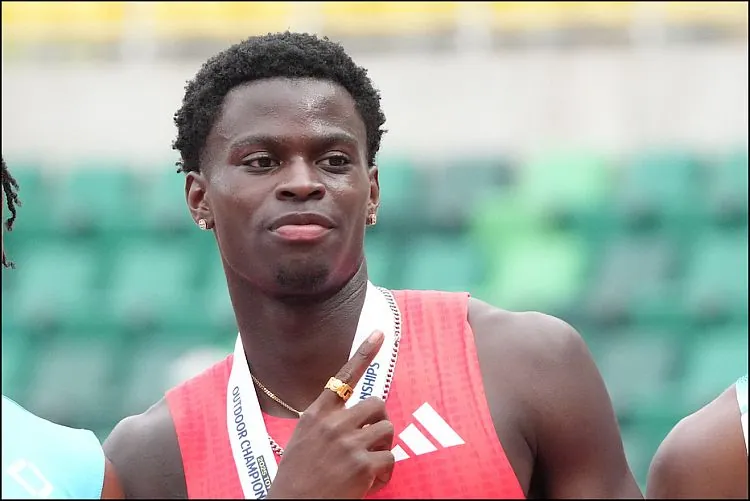

Few expected a world record to fall at the NCAA Outdoor Track and Field Championships. Even fewer expected it to happen in a semifinal. Yet that is exactly what unfolded at Hayward Field in Eugene, Oregon, where Auburn junior Ja’Kobe Tharp produced a performance that instantly entered track and field history.
Tharp clocked an astonishing 12.75 seconds in the men’s 110-meter hurdles semifinal, breaking the previous world record of 12.80 seconds set by American hurdling great Aries Merritt in 2012. The mark had survived nearly 14 years, making Tharp’s achievement one of the most significant moments the sport has seen in recent memory.
The circumstances made the run even more remarkable. The defending NCAA champion was not racing for a medal when the record fell. His objective was simply to qualify for Friday night’s final. Instead, he delivered the fastest performance ever recorded in the event, turning a routine qualifying race into a historic occasion.
What stands out most is the size of the improvement. Tharp entered the championships with a personal best of 13.01 seconds. In a single race, he lowered that mark by 0.26 seconds, an enormous leap at the elite level where improvements are typically measured in hundredths of a second. The legal wind reading of +1.0 m/s ensured the record would stand without controversy.
Speaking afterward, Tharp admitted he was overwhelmed by what had happened. He said he was “speechless” and revealed that breaking the world record had not been his focus. Auburn’s coaching staff had carefully managed his training load leading into the championships, allowing him to peak at the right moment. The strategy paid off in spectacular fashion.
Perhaps the most intriguing comment came when Tharp told ESPN, “I have more in my legs.” That statement immediately shifted attention toward Friday’s final. With the world record already secured, the question now is whether he can back it up with another historic performance when the NCAA title is on the line.
The achievement carries major historical significance beyond the stopwatch. Tharp became the first individual athlete since high jumper Dwight Stones in 1976 to set a world record during the NCAA Championships. For a competition that has showcased generations of Olympic and world champions, that is a rare distinction.
The timing of the feat also added drama to an already eventful week. Just one day before competition began, Hayward Field was evacuated following a bomb threat. Athletes and staff were forced to leave the venue while law enforcement conducted a search. Authorities later issued an all-clear, allowing the championships to proceed. Less than 24 hours later, the same stadium witnessed one of the greatest moments in collegiate track history.
Tharp’s record was not the only headline generated by Auburn. The Tigers’ men’s 4×100-meter relay team of Azeem Fahmi, Kayinsola Ajayi, Austin Kresley and Tyler Davis ran 37.75 seconds to establish a new collegiate record, surpassing LSU’s previous mark of 37.90. The performance reinforced Auburn’s status as one of the premier sprint programs in the country.
Elsewhere at the championships, New Mexico’s Habtom Samuel captured the men’s 10,000-meter title in 27:51.31, adding another major achievement to a season that already included an NCAA indoor championship. The opening day also produced standout performances in the pole vault, long jump, shot put, hammer throw and javelin, highlighting the depth of talent gathered in Eugene.
Moments like these are why NCAA championships continue to capture national attention, similar to the drama and elite-level performances seen during the 2026 NCAA Final Four tournament. The difference is that this time, history was written in less than 13 seconds.
Read More
For official athlete information and career statistics, readers can visit Ja’Kobe Tharp’s Auburn Athletics profile.
Friday night’s final now carries far greater significance than anyone anticipated. Tharp has already secured his place in the record books, but another opportunity awaits. After producing the fastest 110-meter hurdles race ever run, the Auburn star will return to the track with the world watching to see whether history can be repeated.

Make Swikblog your go-to source on Google for reliable updates, smart insights, and daily trends.