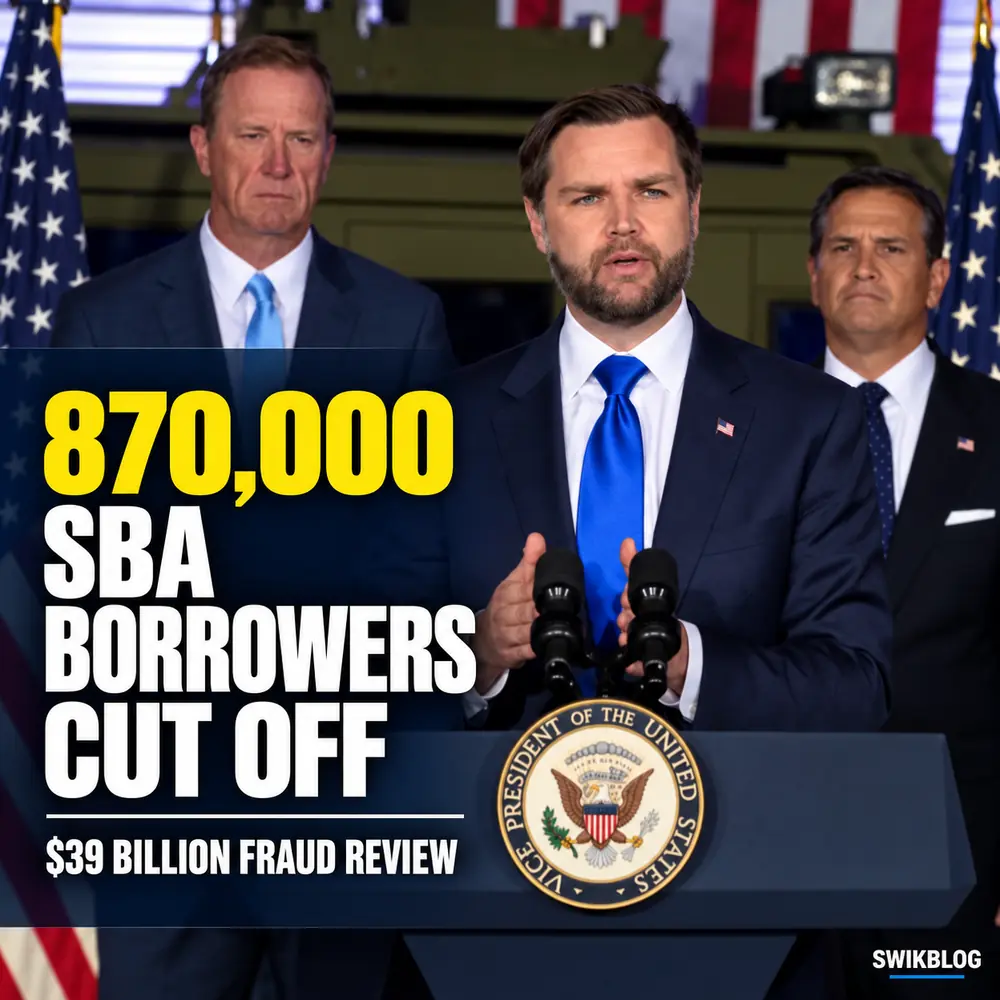

KANSAS CITY, Missouri — About 870,000 borrowers linked to $39 billion in suspected COVID-era loan fraud are being suspended from future Small Business Administration programs. However, the announcement does not mean that every borrower has been convicted—or even criminally charged.
Vice President JD Vance announced the action on Monday alongside Attorney General Todd Blanche, FBI Director Kash Patel and SBA Administrator Kelly Loeffler.
“If you screwed the American taxpayer, the federal government is now going to say you’re cut off, no more,” Vance told reporters. “You shouldn’t be applying anymore, and if you do apply, you’re no longer able to get those benefits.”
The borrowers were identified through a state-by-state review covering 45 states and territories. Loeffler said the new cases involve approximately $39 billion in suspected fraud. When earlier state actions are included, the SBA has now suspended borrowers connected to about $49 billion across all 50 states.
- Affected borrowers cannot receive new SBA-backed small-business or disaster loans.
- They may also lose access to SBA programs such as the 8(a) federal contracting program.
- The $39 billion figure represents loans connected to suspected fraud—not money already recovered.
- An administrative suspension is not a criminal conviction.
Suspended does not automatically mean convicted
This distinction has been lost in many posts describing all 870,000 borrowers as “fraudsters.” The administration said the accounts were tied to suspected fraudulent activity involving the Paycheck Protection Program and COVID Economic Injury Disaster Loans.
Under federal suspension rules, an agency may act when it has an indictment or “adequate evidence” to suspect misconduct and believes immediate action is needed to protect the public interest. A conviction is not required before the initial suspension.
A borrower who receives a suspension notice generally has 30 days to contest it. Unless legal or debarment proceedings begin, a suspension normally cannot exceed 12 months, or 18 months when prosecutors formally request an extension.
That makes descriptions of Monday’s action as an automatic “permanent ban” potentially misleading. The SBA has not publicly explained whether every flagged borrower will face debarment, debt collection, a criminal investigation or eventual removal from the suspension list.
The 870,000 suspensions are separate from 160 criminal cases
The announcement coincided with the Justice Department’s “Heartland fraud surge,” conducted between June 12 and September 1. That operation involved more than 160 defendants and approximately $245 million in alleged intended losses—far fewer people than the 870,000 borrowers affected by the administrative action.
Federal prosecutors charged nearly 80 defendants, while approximately 43 pleaded guilty and around 40 were sentenced in SBA-related cases. Alleged schemes included invented businesses, false payroll figures, identity theft and applications submitted through organized networks.
The government is also pursuing repayment separately. In April, the SBA referred approximately 562,000 delinquent loans worth $22.2 billion to the Treasury Department for collection. Referral allows Treasury to pursue outstanding debt, but it does not mean all $22.2 billion has already been recovered.
There is another complication: the government’s fraud data has previously contained major quality problems. A Government Accountability Office review found that nearly two million of roughly three million COVID-EIDL fraud referrals could not initially be investigated because records were incomplete, incorrect or duplicated.
That history makes the notice and appeal process especially important for borrowers who believe they were incorrectly flagged, including possible identity-theft victims.
The scale of potential fraud remains substantial. The SBA inspector general previously estimated that more than $200 billion—or at least 17% of PPP and COVID-EIDL funding—may have reached potentially fraudulent actors.
Congress extended the limitation period for PPP and COVID-EIDL fraud cases to 10 years. Loans issued in 2020 and 2021 can therefore continue producing investigations and prosecutions through 2030 and 2031.
The expanding federal effort follows other attempts to block financial fraud before money disappears, including Minnesota’s proposed restrictions on crypto ATMs after mounting scam losses.
Cases described as alleged or suspected have not necessarily resulted in a finding of criminal liability.

Make Swikblog your go-to source on Google for reliable updates, smart insights, and daily trends.