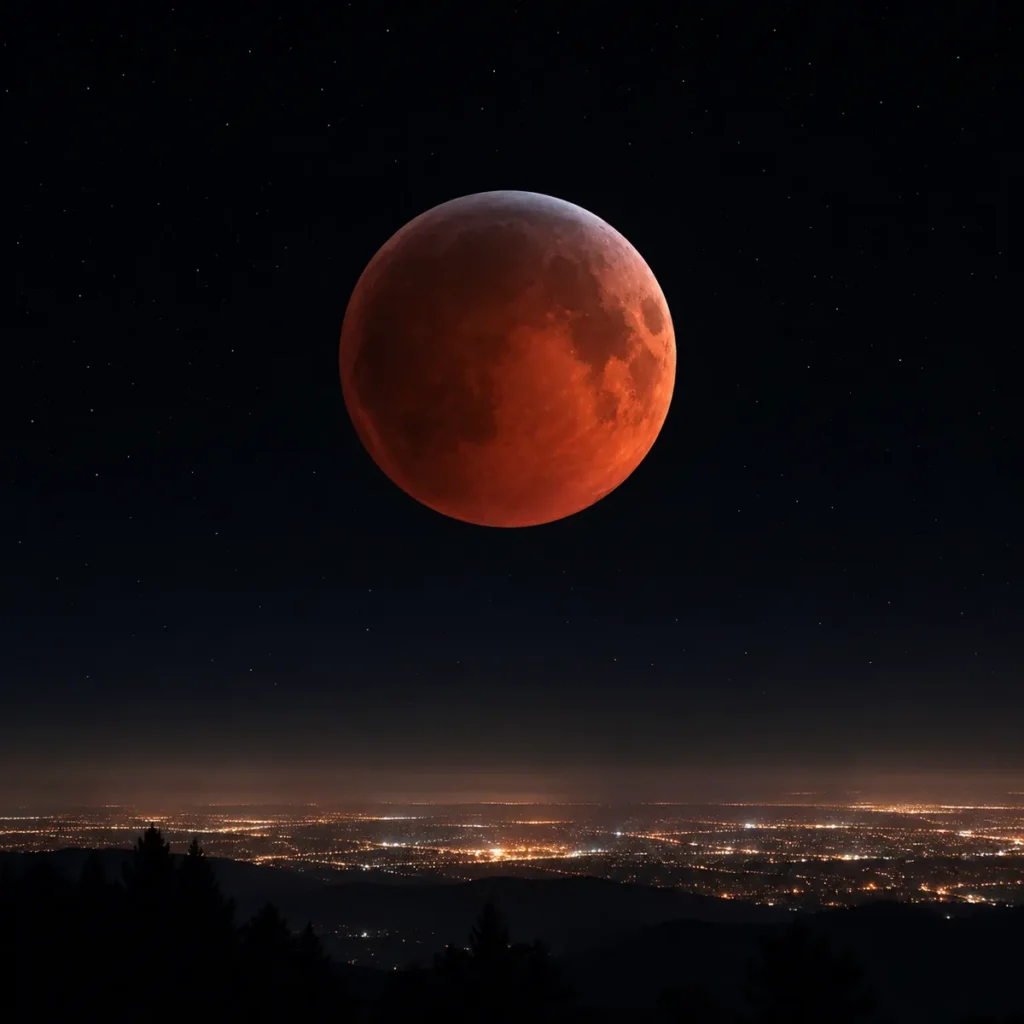

A deep partial lunar eclipse will unfold overnight on August 27–28, 2026, putting about 96.2% of the Moon’s visible disk area inside Earth’s darkest shadow at maximum and potentially producing a striking red or copper “almost Blood Moon.”
The eclipse will be visible across North and South America and parts of Europe and Africa. UK viewers can also see it, but the best stage comes shortly before sunrise on Friday with the Moon very low in the southwestern sky.
Eclipse at a glance
- Date: August 27–28, 2026
- Partial eclipse begins: 02:33 UTC
- Maximum: 04:12 UTC
- Partial eclipse ends: 05:51 UTC
- Area obscured at maximum: About 96.2%
- Type: Partial lunar eclipse
- Eclipse glasses: Not required
What time is the August 2026 lunar eclipse?
The eclipse starts with the subtle penumbral phase at approximately 01:23 UTC on August 28. The main partial phase begins at 02:33 UTC, when the Moon starts entering Earth’s darker umbral shadow.
Maximum eclipse occurs at approximately 04:12 UTC. The partial phase ends around 05:51 UTC, while the final penumbral phase finishes at about 07:01 UTC. The complete event therefore lasts roughly five hours and 38 minutes.
Why are 93% and 96.2% both being reported?
The figures describe different measurements. The eclipse has an umbral magnitude of about 0.930, relating to how deeply the Moon’s diameter enters the umbra. About 96.2% of the lunar disk’s area is obscured at maximum.
Only a narrow portion remains outside the darkest shadow, which is why the eclipse may look remarkably close to a total Blood Moon.
Where will the lunar eclipse be visible?
North and South America are particularly well positioned, with parts of Europe and Africa also able to see the eclipse. Visibility elsewhere depends on whether the Moon is above the horizon during the event.
Time and Date estimates around 3.34 billion people are positioned to see at least some of the partial phase. About 1.28 billion could see the entire partial phase.
What time is the Blood Moon in the UK?
In the UK, the penumbral stage begins around 2:23 a.m. BST, followed by the partial eclipse at 3:33 a.m. Maximum occurs at approximately 5:12 a.m.
By then, the Moon will be extremely low toward the southwest. In London, moonset is around 6:15 a.m., before the global partial phase finishes.
The Royal Observatory Greenwich recommends finding an elevated location with an unobstructed southwestern horizon.
Why will the Moon turn red?
During a lunar eclipse, Earth moves between the Sun and full Moon. Although direct sunlight is blocked, some light travels through Earth’s atmosphere and reaches the lunar surface.
Blue wavelengths scatter more easily, while red and orange wavelengths pass through and are refracted toward the Moon. This can give the eclipsed surface a copper or reddish appearance.
Because a thin section remains outside the umbra, viewers may see an unusual contrast between a dark red Moon and a bright illuminated edge.
Why could the Moon look bigger in the UK?
The Moon will be close to the horizon around maximum eclipse. This can create the Moon illusion, making it appear larger when seen beside buildings, trees or other familiar objects. The Moon is not physically larger; it is a visual perception effect.
Why is it called the Sturgeon Moon?
August’s full Moon is traditionally called the Sturgeon Moon, a name historically associated with seasonal sturgeon fishing in parts of North America. The eclipse may therefore be described as a “Sturgeon Blood Moon,” although its astronomical classification remains a partial lunar eclipse.
Why are two eclipses happening in August?
The event comes just over two weeks after the August 12 total solar eclipse. Readers can compare the events in our guide to the August 2026 solar eclipse viewing times.
They occur close together because eclipses arrive during eclipse seasons, when the Sun, Earth and Moon are positioned appropriately for their shadows to align.
Do you need eclipse glasses?
No. A lunar eclipse is safe to watch directly with the naked eye. Binoculars or a telescope can provide a closer view, but special eclipse glasses are unnecessary.
August 2026 Lunar Eclipse: Date, Time and Where It Was Visible
Tennant Creek Solar Eclipse 2028: Date, Path and What to Know
How to get the best view
UK viewers should find somewhere with a clear southwestern horizon. Dark countryside is not essential, but avoiding bright streetlights can improve contrast.
Cloud will be the biggest uncertainty. Check the latest UK weather forecast shortly before setting out because local cloud conditions can change quickly.
Can you watch the lunar eclipse online?
Yes. Time and Date plans a free livestream beginning at 10 p.m. EDT on August 27 (02:00 UTC), with telescope views expected from Portugal and Spain, weather permitting.
The Virtual Telescope Project plans coverage from 9:30 p.m. EDT (01:30 UTC), featuring telescopes in Italy and Chile. Griffith Observatory in Los Angeles is also planning online coverage and public viewing.
What makes this eclipse special?
The eclipse stops just short of totality. With approximately 96.2% of the lunar disk area obscured, most of the Moon could become dark red while only a thin bright section remains.
For UK observers, that near-total appearance will combine with a Moon sitting close to the horizon. Clear skies and an unobstructed view could therefore produce one of 2026’s most distinctive lunar sights before dawn on August 28.

Make Swikblog your go-to source on Google for reliable updates, smart insights, and daily trends.