
Updated: August 23, 2026
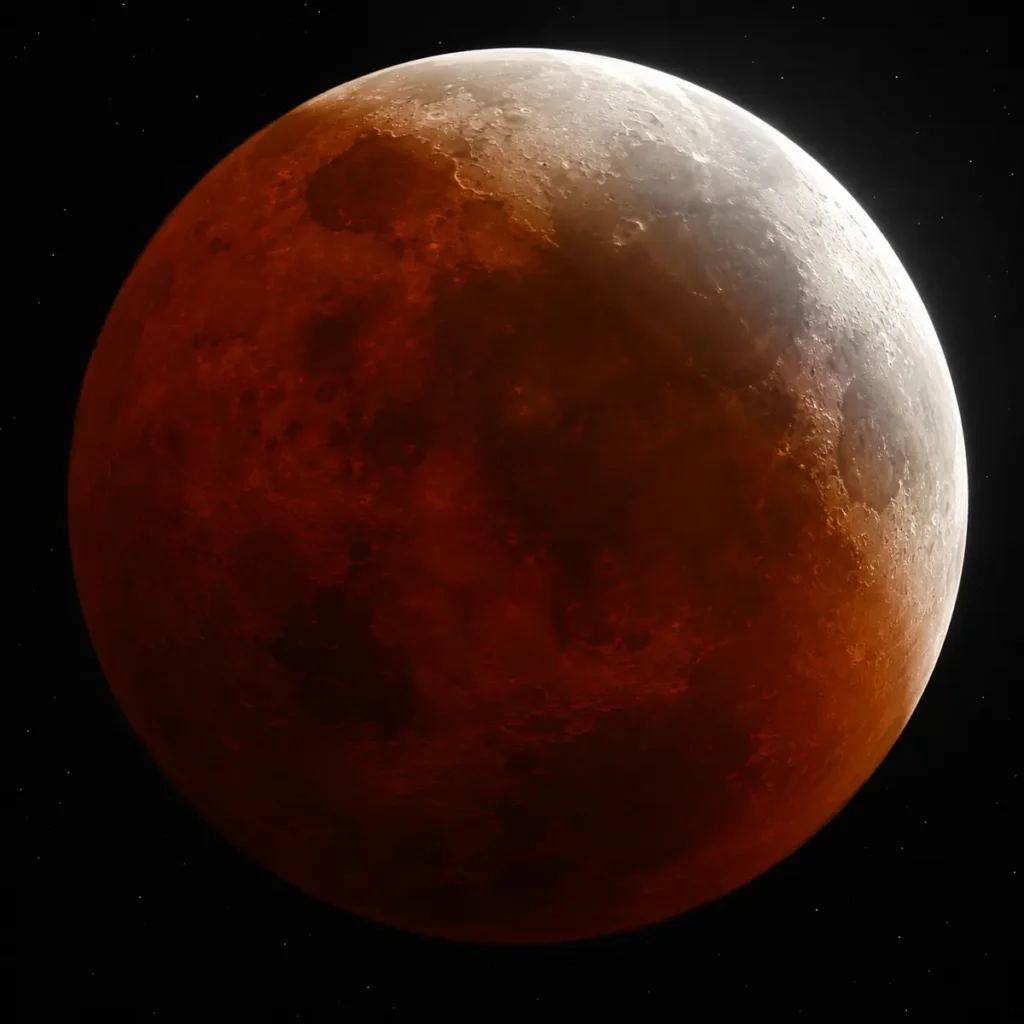
Skywatchers have another major celestial event approaching just over two weeks after the August 12 total solar eclipse. A deep partial lunar eclipse will unfold on August 27-28, 2026, with almost the entire Moon entering Earth’s dark central shadow at the peak of the event.
NASA’s latest eclipse visualization, released August 21, says 96.3% of the Moon’s disk will be inside Earth’s umbra at greatest eclipse. The eclipse will be particularly well placed for much of the Americas, with parts of western Europe and western Africa also able to see the dramatic partial phase.
Unlike the August 12 solar eclipse, no eclipse glasses or other special eye protection are required. Lunar eclipses are safe to watch directly with the naked eye, binoculars or a telescope.
Latest update: eclipse will reach 96.3% coverage
NASA’s Scientific Visualization Studio released detailed new imagery and timing information for the eclipse on August 21. According to the updated visualization, 96.3% of the Moon’s disk will lie inside the umbra at maximum eclipse, making this an exceptionally deep partial lunar eclipse.
NASA’s earlier August skywatching guide described approximately 93% of the Moon’s diameter as entering the umbra. The newer NASA visualization expresses the eclipse in terms of the percentage of the lunar disk covered, which is why readers may encounter both figures.
The eclipse belongs to Saros 138, a repeating family of lunar eclipses separated by approximately 18 years, 11 days and eight hours. The previous eclipse in this series occurred on August 16, 2008, while the next will take place on September 7, 2044.
August 27-28 lunar eclipse: exact worldwide times
The eclipse technically occurs on August 28 in Universal Time, although observers across much of the Americas will watch it during the evening of August 27.
Penumbral eclipse begins: approximately 01:24 UTC on August 28.
Partial eclipse begins: approximately 02:34 UTC.
Maximum eclipse: approximately 04:13 UTC.
Partial eclipse ends: approximately 05:52 UTC.
Penumbral eclipse ends: approximately 07:02 UTC.
The visually dramatic partial phase therefore lasts about 3 hours and 18 minutes, while the entire eclipse, including the subtle penumbral phases, lasts about five hours and 38 minutes.
Where will the August lunar eclipse be visible?
NASA lists the broader visibility region as the Americas, Europe, Africa and western Asia. However, the best view of the deep partial phase depends on whether the Moon is above the horizon at the relevant time.
NASA’s latest visualization says the maximum phase is visible across much of the Americas, excluding Alaska and northwestern Canada, as well as parts of western Europe and western Africa.
Some locations farther east will see only part of the event before the Moon sets. Weather, cloud cover and the Moon’s altitude above the horizon will also determine how clearly the eclipse can be seen.
Will this be a Blood Moon?
Not officially. The August 27-28 event is a partial rather than total lunar eclipse, so a small part of the Moon will remain outside Earth’s umbra even at maximum.
However, because the eclipse is extremely deep, the view could resemble a near-total lunar eclipse. NASA says the eclipsed portion of the Moon may develop a rusty or coppery colour, particularly as maximum eclipse approaches.
Less than an hour after the partial phase begins, the remaining directly illuminated portion of the Moon will become small enough that observers’ eyes can adapt to the darker scene, potentially making the copper colouring easier to notice.
Why could the Moon turn copper or red?
The colour comes from sunlight filtered through Earth’s atmosphere. Shorter blue and violet wavelengths are scattered more efficiently, while longer red and orange wavelengths can travel through the atmosphere and reach the lunar surface.
The result is similar to the colours seen during sunrise and sunset. Atmospheric dust, clouds and other conditions around Earth can influence how dark or colourful the eclipsed Moon appears.
Readers who followed the August 2026 solar eclipse timings for the UK and Ireland will find the viewing requirements very different this time: lunar eclipses require no special eye protection.
Why are two eclipses happening in the same month?
The August 12 solar eclipse and August 27-28 lunar eclipse belong to the same eclipse season.
Solar eclipses occur around new Moon when the Moon passes between Earth and the Sun. Lunar eclipses occur around full Moon when Earth moves between the Sun and Moon.
That geometry explains why solar and lunar eclipses commonly occur roughly two weeks apart during an eclipse season.
How the August 12 solar eclipse was different
The August 12 event was a total solar eclipse, with totality crossing northern Russia, Greenland, Iceland, northern Spain and a small part of Portugal. A partial solar eclipse was visible across a much wider area.
Solar eclipses have comparatively narrow viewing zones because observers must be positioned within the Moon’s shadow as it crosses Earth. A lunar eclipse can be observed across a much larger portion of Earth wherever the Moon is above the horizon.
There is also an important safety difference. Certified eclipse glasses or another safe solar-viewing method are required whenever any part of the Sun is directly visible during a solar eclipse. No eye protection is needed for the August 27-28 lunar eclipse.
How to watch the August 27-28 eclipse
No telescope is necessary. Find a location with a clear view of the Moon and, if possible, move away from bright streetlights and other sources of artificial light.
Binoculars or a small telescope can make Earth’s curved shadow particularly striking as it moves across lunar craters and other surface features.
Because the eclipse happens at different local times around the world, viewers should check their local moonrise, moonset and eclipse timings before heading outside.
Those following lunar events through 2026 can also compare the eclipse with the June 2026 Strawberry Moon and micromoon, when the Moon’s position in its orbit affected its apparent size.
Tennant Creek Solar Eclipse 2028: What You Need to Know
What eclipses come next?
NASA lists an annular solar eclipse for February 6, 2027, followed by a penumbral lunar eclipse on February 20-21, 2027.
A much-anticipated total solar eclipse follows on August 2, 2027. Totality will cross southern Spain, parts of North Africa, Saudi Arabia and Yemen, while a partial eclipse will be visible across a much wider region.
For now, attention turns to August 27-28. With 96.3% of the lunar disk entering Earth’s umbra at maximum eclipse, the event will come exceptionally close to totality and could deliver one of the most striking lunar views of 2026.

Make Swikblog your go-to source on Google for reliable updates, smart insights, and daily trends.