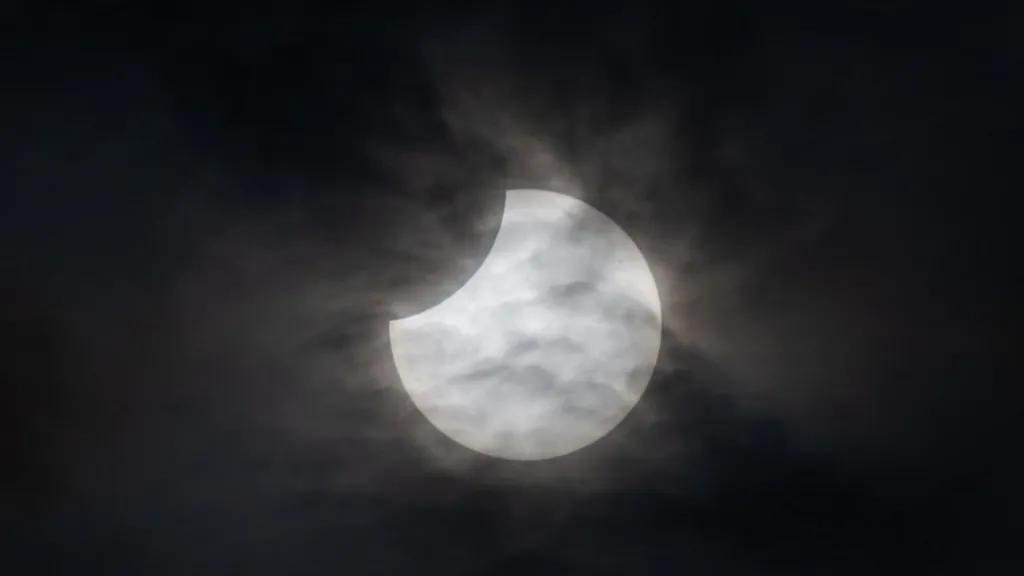

A major partial solar eclipse will cross the UK and Ireland on Wednesday, August 12, 2026, while a narrow path of totality passes across Greenland, Iceland, northern Spain, northern Russia and a small part of Portugal.
For Britain and Ireland, this will be the deepest solar eclipse seen in many locations since 1999. More than 90% of the Sun will be covered across much of the UK, with parts of south-west Ireland approaching 98% obscuration.
Latest Solar Eclipse Update – August 12, 2026
- UK viewing window: The eclipse begins between approximately 6:08pm and 6:18pm BST, depending on location.
- Maximum eclipse: Peak coverage occurs across the UK and Ireland between roughly 7:05pm and 7:16pm.
- London: Around 91.4% of the Sun will be obscured, with maximum eclipse near 7:13pm.
- South-west England: Cornwall, Devon and Plymouth will experience approximately 94% to 96% coverage.
- Ireland: Dublin will reach about 94%, Cork around 96.4% and Skellig Michael approximately 98%.
- Latest UK forecast: Central, southern and eastern England and Wales have the best prospects for clear views. More cloud is expected across northern England, Scotland and Northern Ireland.
- Best viewing direction: Choose an open location with an unobstructed western horizon because the Sun will be relatively low in the evening sky.
- End time: The partial eclipse will finish across Britain and Ireland by approximately 8:10pm.
- Path of totality: Totality crosses northern Russia, Greenland, Iceland, northern Spain and a small part of north-western Portugal, lasting up to approximately two minutes and 18 seconds.
- Live coverage: Online eclipse broadcasts begin at approximately 6:15pm BST for viewers affected by cloud.
- Later tonight: The Perseid meteor shower peaks overnight into August 13, with particularly dark viewing conditions due to the new Moon.
Safety warning: Britain and Ireland remain outside the path of totality. Certified eclipse glasses or a safe indirect viewing method must be used throughout the event. Thin cloud, ordinary sunglasses and looking through a phone screen do not provide adequate eye protection.
Latest Solar Eclipse Update – August 12, 2026
- London: about 91.4% coverage, peaking around 7:13pm.
- Plymouth: around 94.7% coverage near 7:16pm.
- Cornwall and Devon: roughly 94% to 96% coverage.
- Dublin: about 94% coverage around 7:10pm.
- Cork: around 96.4% coverage.
- Skellig Michael: close to 98% obscuration.
- Totality: visible only inside the narrow eclipse path crossing Greenland, Iceland, northern Spain, northern Russia and a small part of Portugal.
Safety: The UK and Ireland remain outside the path of totality, so proper eclipse glasses or another approved viewing method must be used when looking directly at the Sun.
The eclipse begins shortly after 6pm in most locations and reaches maximum coverage roughly an hour later. The Moon will then gradually move away from the Sun, with the event ending around 8pm.
What time does the August 12 solar eclipse start?
Exact times vary by location. In London, the eclipse begins at about 6:17pm BST, reaches maximum at around 7:13pm and ends close to 8:06pm.
Western areas will generally see deeper coverage. Plymouth is expected to reach about 94.7%, while Cornwall and Devon could see between 94% and 96% of the Sun obscured.
| Location | Maximum | Sun obscured |
|---|---|---|
| Belfast | 7:08pm | 93.05% |
| Dublin | 7:10pm | 93.99% |
| Galway | 7:10pm | 95.95% |
| Limerick | 7:12pm | 96.03% |
| Cork | 7:13pm | 96.43% |
| Skellig Michael | 7:13pm | 98.01% |
The Royal Observatory Greenwich eclipse guide provides additional viewing and safety information.
Best places to see the eclipse
Devon, Cornwall and western Pembrokeshire are expected to offer some of Britain’s deepest eclipse views. Plymouth should see around 94.66% coverage, while London will reach about 91.4%, Birmingham around 91.8%, Edinburgh about 90.7% and Newcastle just over 90%.
South-west Ireland will be even closer to totality. Skellig Michael is expected to reach about 98.01%, followed by Cork at 96.43%, Limerick at 96.03% and Galway at 95.95%.
A clear western horizon will be important because the Sun will be relatively low in the sky. Cloud cover could still determine whether the eclipse is visible from any particular location.
Will it become dark?
Daylight should become noticeably dimmer as maximum eclipse approaches, but Britain and Ireland will not experience the dramatic darkness of totality.
Even at 98% coverage, a small part of the Sun remains visible and is still powerful enough to damage eyesight. The entire eclipse must therefore be treated as a partial eclipse across the UK and Ireland.
The path of totality crosses Greenland, Iceland and parts of Spain, where the Moon will completely cover the Sun for a short period.
For another future eclipse destination, see the Tennant Creek solar eclipse 2028 viewing guide.
How to watch the eclipse safely
Never look directly at the partially eclipsed Sun without suitable solar protection. Ordinary sunglasses are not safe.
Purpose-made eclipse glasses should comply with the ISO 12312-2 safety standard. Any glasses that are scratched, torn, punctured or damaged should not be used.
Eclipse glasses must also never be used while looking through unfiltered binoculars, telescopes or camera lenses. Magnifying equipment requires a properly fitted solar filter at the front of the instrument.
If eclipse glasses are unavailable, a pinhole projector provides a safe indirect way to watch the changing shape of the Sun.
Can you photograph the eclipse with a phone?
Smartphones and cameras should not be pointed directly at the Sun for prolonged periods without an appropriate solar filter, particularly when telephoto lenses are involved.
For phone users, photographing the changing light, landscape and people watching the eclipse may be safer and easier than attempting a close-up image of the Sun.
Read More
Perseid meteor shower follows later that night
The Perseid meteor shower also peaks around the night of August 12 into August 13, giving skywatchers another event to look for after the eclipse.
The Perseids are produced by debris from comet Swift-Tuttle entering Earth’s atmosphere. Dark locations away from city lights will provide the best chance of seeing meteors.
Anyone planning to stay outside after the eclipse can also use this meteor shower and night-sky viewing guide.
The grand stellar spectacle of the year has arrived. A total solar eclipse will be easily visible over parts of Europe on Wednesday. https://t.co/xl1rzrcsM0
— CNN (@CNN) August 12, 2026
What viewers should remember
- Check the eclipse time for your exact location.
- Choose a location with a clear western horizon.
- Check the latest cloud conditions before travelling.
- Use certified eclipse glasses for direct viewing.
- Never use ordinary sunglasses.
- Do not look through unfiltered binoculars or telescopes.
- Use a pinhole projector if proper eclipse glasses are unavailable.
- Use a suitable solar filter when photographing the Sun.
For most people in the UK and Ireland, the main viewing window will run from shortly after 6pm until around 8pm on August 12, with maximum eclipse shortly after 7pm. It will be the strongest solar eclipse seen across many parts of Britain and Ireland since 1999.

Make Swikblog your go-to source on Google for reliable updates, smart insights, and daily trends.