
M5 traffic chaos near Bristol caused major disruption after a police incident forced the motorway to close in both directions, leaving drivers stuck in miles-long queues and triggering widespread delays across key routes. Even after the motorway reopened, congestion continued to impact commuters across the region, highlighting how quickly traffic conditions can spiral when a major route like the M5 is shut.
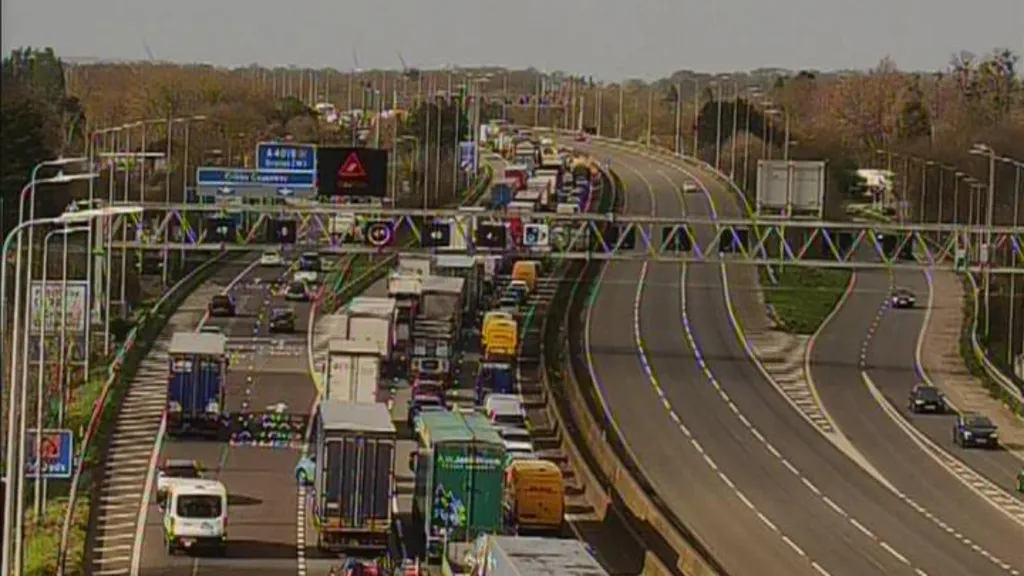
The incident occurred on Tuesday, March 17, when the M5 was closed between junction 18 for Avonmouth and junction 19 for Portbury. Emergency services responded to the scene, bringing traffic to a halt in both directions while the situation was managed. During the closure, traffic monitoring services reported around three miles of queuing southbound and approximately two miles northbound, with conditions quickly worsening as vehicles were held on the motorway.
M5 traffic queues stretched for miles during closure
According to traffic monitoring service Inrix, congestion rapidly built up on both sides of the closure. Southbound delays extended from J19 A369 Martcombe Road (Portishead) down to J20 B3133 Ettlingen Way (Clevedon), while northbound queues also formed as traffic was stopped and diverted.
Inrix reported: “Queueing traffic due to police incident on M5 Southbound from J19 A369 Martcombe Road (Portishead) to J20 B3133 Ettlingen Way (Clevedon).” This highlights the scale of disruption, as traffic backed up across multiple junctions within a short period.
Even after Avon and Somerset Police confirmed that the motorway had reopened, the situation did not immediately improve. Long delays continued, with congestion reaching as far as junction 20 for Clevedon northbound and junction 17 for Cribbs Causeway southbound. This kind of extended congestion is typical when traffic has been stationary for a prolonged period.
Diversions hit A4 Portway and A370 routes
The closure did not just affect motorway traffic. As drivers attempted to avoid the blocked section, surrounding roads quickly became congested. The A4 Portway into Bristol towards Hotwells experienced heavy traffic as vehicles diverted from the southbound carriageway.
At the same time, the A370 towards Congresbury saw increased pressure from northbound diversion traffic. These routes are not designed to handle motorway-level volumes, which meant delays spread beyond the M5 itself and into the wider Bristol road network.
This ripple effect is one of the biggest challenges during motorway incidents. Once traffic is forced onto alternative routes, congestion can build rapidly, often taking longer to clear than the original incident itself.
Earlier disruption added to traffic pressure
The March 17 incident followed another disruption just a day earlier. On Monday, March 16, southbound M5 traffic was temporarily halted near Portishead and Clevedon. Although all lanes reopened by around 8:20 a.m., delays continued for some time afterward, with congestion clearing closer to 8:50 a.m.
That earlier disruption also caused knock-on delays across surrounding roads, with travel times increasing by around 15 minutes during peak congestion. The back-to-back incidents likely contributed to ongoing traffic pressure in the region, making Tuesday’s disruption even more impactful for regular commuters.
Why this M5 stretch is critical for Bristol traffic
The section between Avonmouth (J18) and Portbury (J19) is one of the most important links in the Bristol transport network. It connects key commercial routes, commuter traffic, and access to surrounding areas. Any disruption here has an immediate and widespread impact.
Because the M5 serves both local and long-distance traffic, closures affect not just Bristol but also regional travel across the South West. When both directions are shut, the impact doubles, forcing vehicles into already busy local roads and increasing congestion across multiple routes simultaneously.
This explains why delays extended well beyond the immediate closure zone and continued even after the motorway reopened. Traffic does not simply disappear once lanes reopen—it takes time for backed-up vehicles to clear and for flow to return to normal.
Delays continued even after reopening
Although authorities confirmed that the M5 had reopened, drivers continued to face long delays. Congestion remained on the motorway itself as well as on diversion routes, including the A4 and A370.
This is a common pattern during major incidents. Once several miles of traffic have built up, it can take a significant amount of time for conditions to stabilize. Vehicles rejoining the motorway, merging traffic, and continued pressure on alternative routes all contribute to slower recovery.
Drivers seeking updates during such incidents often rely on official sources like National Highways and live tracking platforms such as Traffic England, which provide real-time information on closures, delays, and road conditions.
What drivers should expect next
While the immediate incident has been cleared, the effects of the disruption may continue for some time. Residual congestion, delayed journeys, and pressure on surrounding routes can all extend travel times even after normal motorway operations resume.
Motorists traveling near Bristol should remain cautious and allow extra time for their journeys, especially during peak hours. Routes such as the M5, A4 Portway, and A370 may continue to experience slower-than-usual traffic as conditions gradually return to normal.
This latest M5 traffic incident highlights how quickly a single event can escalate into a major regional disruption. A short stretch of motorway closure was enough to create miles of queues, impact multiple junctions, and affect travel across Bristol and beyond. For drivers, it serves as a reminder that even brief incidents on critical routes can have lasting effects on the entire road network.

Make Swikblog your go-to source on Google for reliable updates, smart insights, and daily trends.