
Manchester Airport flights cancelled on Thursday quickly became one of the clearest signs of how fast a geopolitical crisis can spread into everyday travel disruption. What began as a military escalation involving the US, Israel and Iran has turned into a rolling aviation shock across the Middle East and Europe, with airspace restrictions, grounded aircraft, delayed repatriation plans and growing uncertainty for passengers who were expecting normal departures from one of the UK’s busiest international gateways.
For travellers in the North West, the disruption was immediate and highly visible. Manchester Airport saw eight major international departures cancelled on March 5, following ten cancellations the previous day, as airlines struggled to operate through a region that normally functions as one of the world’s most important connecting corridors. Routes that depend heavily on Gulf hubs were among the hardest hit, leaving passengers to recheck itineraries, wait for rebooking updates and rethink onward travel plans.
The cancelled Manchester Airport flights
The cancelled services on Thursday were concentrated around destinations that are central to long-haul connections between Europe, Asia and the Middle East. The affected departures from Terminal 2 were:
- 7.45am Doha QR022 operated by Qatar Airways
- 8.25am Abu Dhabi EY078 operated by Etihad Airways
- 10.15am Bahrain GF004 operated by Gulf Air
- 11.15am Delhi 6E034 operated by IndiGo
- 12.00pm Kuwait KU114 operated by Kuwait Airways
- 1.40pm Abu Dhabi EY074 operated by Etihad Airways
- 2.05pm Doha QR028 operated by Qatar Airways
- 7.55pm Abu Dhabi EY076 operated by Etihad Airways
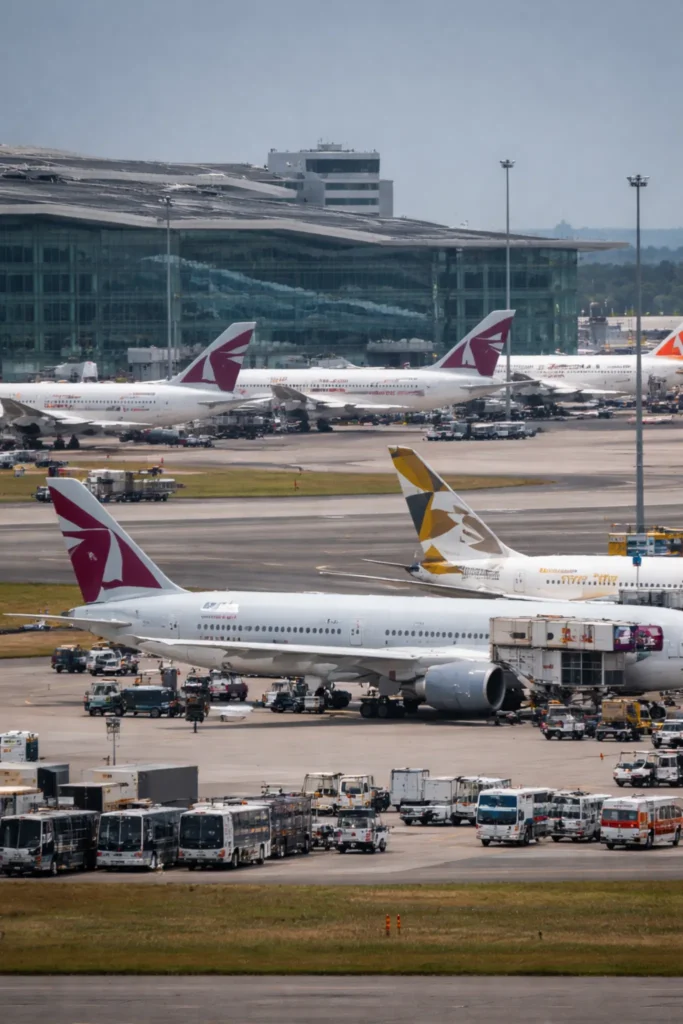
That list captures more than a difficult day at one airport. It shows how heavily modern airline schedules depend on the Gulf as a transfer zone. When airspace closes over countries such as Jordan, Qatar and Bahrain, the effect is not limited to flights heading into the immediate conflict zone. Aircraft rotations break down, crew positioning becomes harder, airport stands fill up and schedules across multiple continents start to unravel.
Why Manchester has been hit so hard
Manchester Airport is not just a regional gateway. It is a major international departure point for passengers heading to South Asia, the Gulf and onward global destinations. Services to places such as Doha, Abu Dhabi, Bahrain, Kuwait and Delhi rely on smooth access to Middle Eastern airspace and stable hub operations. Once those hubs face restrictions or operational pressure, cancellations can spread quickly through the network.
The broader picture has added to the pressure. Across the region, thousands of passengers have been stranded as airlines suspend or reroute services. British nationals have also been caught up in the disruption, with the UK government working on evacuation arrangements from Muscat after the conflict intensified. That has added a human dimension to the story, turning an airline scheduling problem into a wider crisis for families, holidaymakers, business travellers and transit passengers trying to get back to the UK.
Travellers affected by cancellations should check airline notifications carefully and review the latest UK Civil Aviation Authority passenger rights guidance for refunds, rerouting and duty-of-care support during disruption.
Heathrow disruption shows the crisis is wider than Manchester
Manchester is far from the only UK airport feeling the strain. Heathrow has also faced mounting disruption as aircraft have been left out of position and airlines have struggled to maintain normal rotations. When planes are unable to return to their scheduled routes because of closed or unsafe airspace, the problem moves beyond one cancelled departure. It can lead to parked aircraft, delayed inbound services, crew knock-on issues and a much wider capacity squeeze across the network.
That matters for Manchester passengers too. Even if a specific route is not permanently suspended, the wider system is under pressure. Fewer available aircraft, longer detours around restricted airspace and tighter turnaround times can all reduce resilience. In practical terms, that means more delays, last-minute schedule changes and less confidence that a rebooked flight will operate exactly as planned.
What this means for passengers now
For most travellers, the immediate questions are simple. Can the ticket be refunded. Will the airline offer a new routing. Is accommodation covered if the cancellation forces an overnight stay. UK passenger-rights rules usually protect travellers on UK departures and on flights operated by UK or EU airlines, especially when it comes to rerouting or refunds. But because this disruption is tied to war and airspace safety restrictions, compensation claims may be treated differently under extraordinary-circumstances rules.
That does not remove airline responsibilities altogether. Passengers should still expect communication, alternative travel options where possible and support during significant disruption. The most important step remains the most basic one: do not rely on old booking confirmations. Flight status can change quickly in a crisis like this, especially when the disruption is tied to security conditions rather than routine operational issues.
The bigger takeaway is that this is no longer a local airport inconvenience. It is part of a much wider global travel shock that is still evolving. Manchester Airport flights cancelled on Thursday became a visible symbol of that reality, with long-haul routes to key Gulf and Asian destinations suddenly pulled from the board. For travellers, the safest assumption now is continued volatility until the airspace picture stabilizes and airline networks regain some breathing room.

Make Swikblog your go-to source on Google for reliable updates, smart insights, and daily trends.